Warfarin
Warfarin is an oral anticoagulant which inhibits the reduction of vitamin K to its active hydroquinone form, which in turn acts as a cofactor in the carboxylation of clotting factor II, VII, IX and X (mnemonic = 1972) and protein C.
Indications
Monitoring
Patients on warfarin are monitored using the INR (international normalised ration), the ratio of the prothrombin time for the patient over the normal prothrombin time. Warfarin has a long half-life and achieving a stable INR may take several days. There a variety of loading regimes and computer software is now often used to alter the dose.
Note some drugs may reduce the effect of warfarin. The table below summarises some common examples:
Side-effects:
Contranindications
Warfarin primarily affects the extrinsic clotting pathway through its action on factor VII. In larger doses levels of factor II, IX and X will also reduce
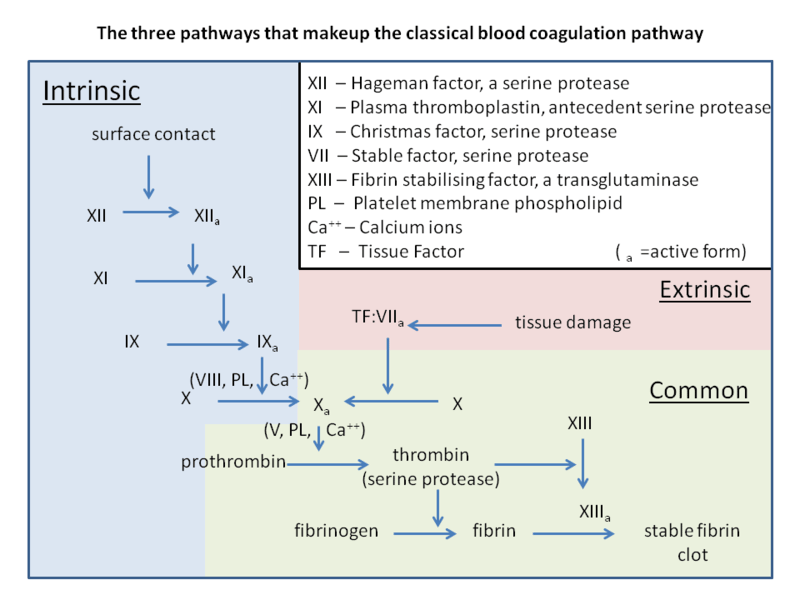 | |
The clotting pathways. Click on image to enlarge
Indications
- Venous thromboembolism: target INR = 2.5, if recurrent 3.5
- Atrial fibrillation, target INR = 2.5
- Mechanical heart valves, target INR depends on the valve type and location. Mitral valves generally require a higher INR than aortic valves.
Monitoring
Patients on warfarin are monitored using the INR (international normalised ration), the ratio of the prothrombin time for the patient over the normal prothrombin time. Warfarin has a long half-life and achieving a stable INR may take several days. There a variety of loading regimes and computer software is now often used to alter the dose.
Warfarin takes at least 48 to 72 hours for the anticoagulant effect to develop fully. Some studies suggest 5 days is typical.
Warfarin also inhibits the vitamin K dependent anticoagulant protein C, which means patients may be in a hyper-coaguable state for the first few days of warfarin therapy. Heparin is usually given concurrently when initiating warfarin and continued until the INR has been ≥ 2 for at least two consecutive days or for five days (whichever is the longer).
Warfarin also inhibits the vitamin K dependent anticoagulant protein C, which means patients may be in a hyper-coaguable state for the first few days of warfarin therapy. Heparin is usually given concurrently when initiating warfarin and continued until the INR has been ≥ 2 for at least two consecutive days or for five days (whichever is the longer).
Factors that may potentiate warfarin:
- Liver disease
- P450 enzyme inhibitors, e.g.: amiodarone, ciprofloxacin, clarithromycin
- Cranberry juice
- Drugs which displace warfarin from plasma albumin, e.g. NSAIDs
- Inhibit platelet function: NSAIDs
Note some drugs may reduce the effect of warfarin. The table below summarises some common examples:
| Drugs that Enhance the Effect of Warfarin | Drugs that Reduce the Effect of Warfarin |
|---|---|
| Amiodarone | Barbiturates |
| Metronidazole | Carbamazepine |
| Fluconazole | Phenytoin |
| Ciprofloxacin | Rifampin |
| Erythromycin | St. John's Wort |
| Cimetidine | Vitamin K |
| Aspirin | Cholestyramine |
| Clopidogrel | Sucralfate |
| NSAIDs | Ginseng |
| SSRIs | Phenobarbital |
| Sulfamethoxazole/Trimethoprim | Vitamin K |
| Isoniazid | Azathioprine |
| Ketoconazole | Griseofulvin |
| Levofloxacin | Primidone |
| Omeprazole | Mercaptopurine |
Side-effects:
- haemorrhage
- teratogenic, although can be used in breast-feeding mothers
- skin necrosis: when warfarin is first started biosynthesis of protein C is reduced. This results in a temporary procoagulant state after initially starting warfarin, normally avoided by concurrent heparin administration. Thrombosis may occur in venules leading to skin necrosis
- purple toes
Contranindications
- Avoid use within 48 hours postpartum
- Haemorrhagic stroke
- Significant bleeding
- Pregnancy
- Severe hepatic impairment
Warfarin overdose
Overdose can be treated with vitamin K, FFP and prothrombin complex concentrates such as Beriplex and Octaplex.
Overdose can be treated with vitamin K, FFP and prothrombin complex concentrates such as Beriplex and Octaplex.