Adenosine
On this page
Adenosine is a purine nucleoside used as an anti-arrhythmic agent to treat supra ventricular tachycardias. It is also used in myocardial perfusion scanning.
*In patients taking dipyridamole or recipients of cardiac transplant a lower initial dose of 3mg should be used.
*The 2021 resus council guidelines advocate a third adenosine dose of 18mg and this is quoted by RCEM learning in their 2023 tachycardia article but note this is not supported by the AHA or the BNF who quote a third dose of 12mg.
Contra-indications to using adenosine
Mechanism of action
- Causes transient heart block in the AV node
- Agonist of the adenosine A1 receptor which inhibits adenylyl cyclase reducing cAMP which in turn inhibits Ca2+ ion influx into cells and promotes K+ efflux out of nerve cells.
- The above result in neuronal hyperpolarization, increasing the threshold for action potentials and decreasing conduction.
- Adenosine has a very short half-life of approximately 8-10 seconds
Important drug interactions
The effects of adenosine are enhanced by dipyridamole (anti-platelet agent) and blocked by theophyllines. It should be avoided in asthmatics due to possible bronchospasm.
The effects of adenosine are enhanced by dipyridamole (anti-platelet agent) and blocked by theophyllines. It should be avoided in asthmatics due to possible bronchospasm.
Administration
For adults with SVT:- Ensure cardiac monitoring in place
- Initially 6 mg*, administer into central or large peripheral vein and give over 2 seconds
- followed by 12 mg after 1–2 minutes if required, then 18 mg* after 1–2 minutes if required, increments should not be given if high level AV block develops at any particular dose.
*In patients taking dipyridamole or recipients of cardiac transplant a lower initial dose of 3mg should be used.
*The 2021 resus council guidelines advocate a third adenosine dose of 18mg and this is quoted by RCEM learning in their 2023 tachycardia article but note this is not supported by the AHA or the BNF who quote a third dose of 12mg.
Common side effects
- Abdominal discomfort
- Arrhythmias (atrioventricular block)
- Chest pain (discontinue)
- Dizziness
- Dry mouth
- Bronchospasm and dyspnoea
- Flushing
- Headache
- Hypotension (discontinue if severe)
- Pain
- Paraesthesia
- Throat discomfort
- Can enhance conduction down accessory pathways, resulting in increased ventricular rate (e.g. WPW syndrome)
Contra-indications to using adenosine
- Asthma
- Chronic obstructive pulmonary disease
- Decompensated heart failure
- Long QT syndrome
- 2nd of 3rd degree AV block and sick sinus syndrome (unless pacemaker fitted)
- Severe hypotension
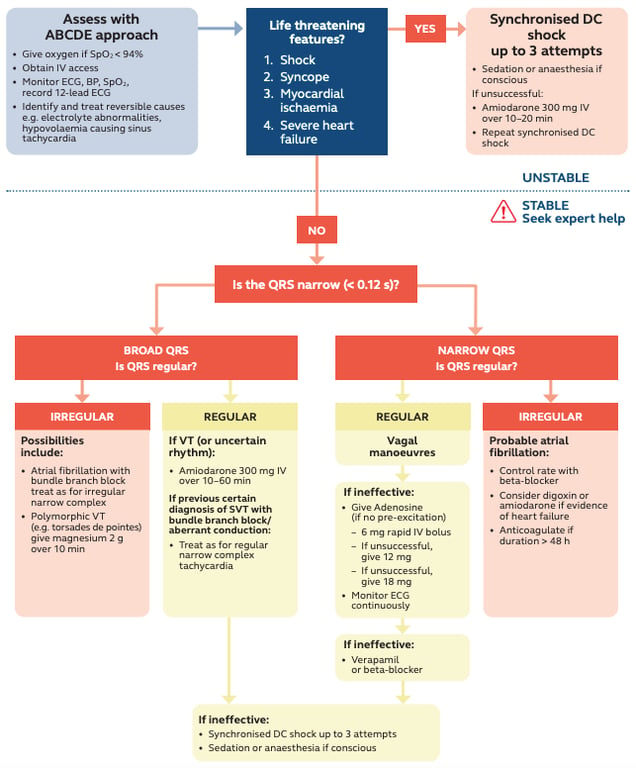 | |
The 2021 resuscitation council algorithm for treatment of tachycardia with a pulse click on image to enlarge