Pneumonia: a very basic introduction
On this page
Pneumonia is one of the most common presentations encountered in clinical practice. Strictly speaking it describes any inflammatory condition affecting the alveoli of the lungs, but in the vast majority of patients this is secondary to a bacterial infection.
As mentioned before, bacterial pneumonia is by far the most common type of pneumonia seen in clinical practice. Other infective causes include:
The table below shows some of the organisms which can cause pneumonia
Idiopathic interstitial pneumonia is a group of non-infective causes of pneumonia. Examples include cryptogenic organizing pneumonia which describes a form of bronchiolitis which may develop as a complication of rheumatoid arthritis or amiodarone therapy.
Community vs. hospital-acquired pneumonia
The majority of patients develop pneumonia within the community, i.e. outside of hospital and these patients are said to have community-acquired pneumonia (CAP). Patients who develop pneumonia within hospitals are said to have hospital-acquired pneumonia. The distinction is important as the causative organisms vary and hence first-line antibiotic guidelines are also different.
Symptoms
Signs
Investigations
Chest x-ray
Bloods
Arterial blood gases
Management
Patients with pneumonia require the following:
The management of patients with community-acquired pneumonia is usually determined according to a risk stratification process using a scoring system called CURB-65.
The CURB-65 score is as follows:
Patients with a CURB-65 score of 0 should be managed in the community.
Patients with a CURB-65 score of 1 should have their Sa02 assessed which should be >92% to be safely managed in the community and a CXR performed. If the CXR shows bilateral/multilobar shadowing hospital admission is advised.
Patients with a CURB-65 score of 2 or more should be managed in hospital as this represents a severe community acquired pneumonia.
The CURB-65 score also correlates with an increased risk of mortality at 30 days with patients with a CURB-65 score of 4 approaching a 30% mortality rate at 30 days.
Causes
As mentioned before, bacterial pneumonia is by far the most common type of pneumonia seen in clinical practice. Other infective causes include:
- viral
- fungal (e.g. Pneumocystis jiroveci)
The table below shows some of the organisms which can cause pneumonia
| Organism | Notes |
|---|---|
| Streptococcus pneumoniae (pneumococcus) | Accounts for 80% of cases Particularly associated with high fever, rapid onset and herpes labialis A vaccine to pneumococcus is available |
| Haemophilus influenzae | Particularly common in patients with COPD |
| Staphylococcus aureus | Often occurs in patient following influenza infection |
| Mycoplasma pneumoniae | One of the atypical pneumonias, which often present a dry cough and atypical chest signs/x-ray findings Autoimmune haemolytic anaemia and erythema multiforme may be seen |
| Legionella pneumophilia | Another one of the atypical pneumonias Hyponatraemia and lymphopenia common |
| Klebsiella pneumoniae | Classically seen in alcoholics |
| Pneumocystis jiroveci | Typically seen in patients with HIV Presents with a dry cough, exercise-induced desaturations and the absence of chest signs |
Idiopathic interstitial pneumonia is a group of non-infective causes of pneumonia. Examples include cryptogenic organizing pneumonia which describes a form of bronchiolitis which may develop as a complication of rheumatoid arthritis or amiodarone therapy.
Community vs. hospital-acquired pneumonia
The majority of patients develop pneumonia within the community, i.e. outside of hospital and these patients are said to have community-acquired pneumonia (CAP). Patients who develop pneumonia within hospitals are said to have hospital-acquired pneumonia. The distinction is important as the causative organisms vary and hence first-line antibiotic guidelines are also different.
Symptoms and signs
Symptoms
- cough
- sputum
- dyspnoea
- chest pain: may be pleuritic
- fever
Signs
- signs of systemic inflammatory response: fever, tachycardia
- reduced oxygen saturations
- ausculatation: reduced breath sounds, bronchial breathing
Investigations
Chest x-ray
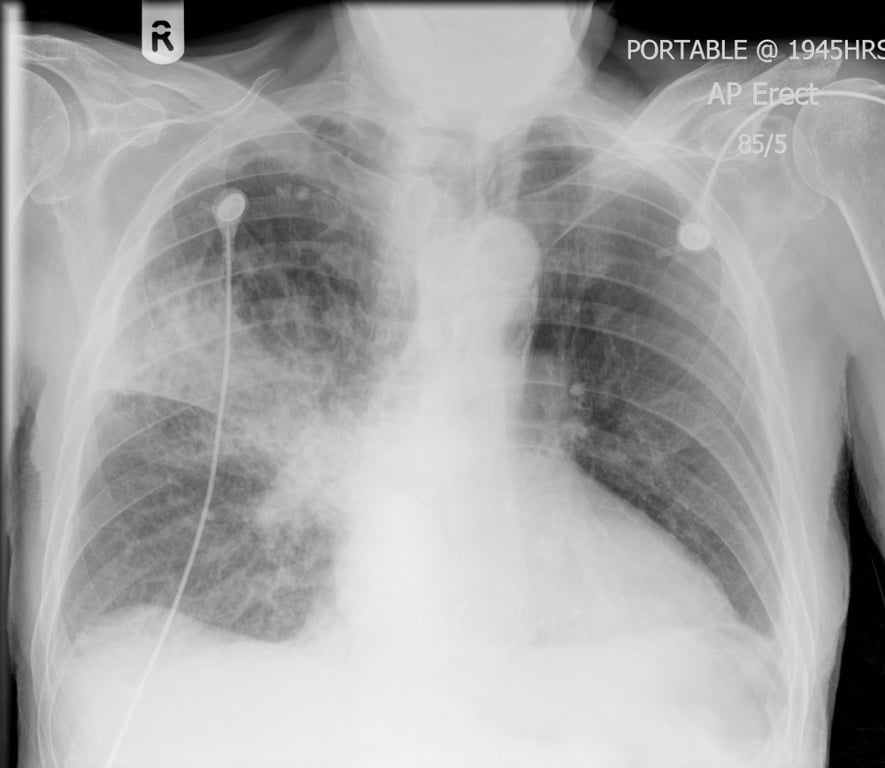
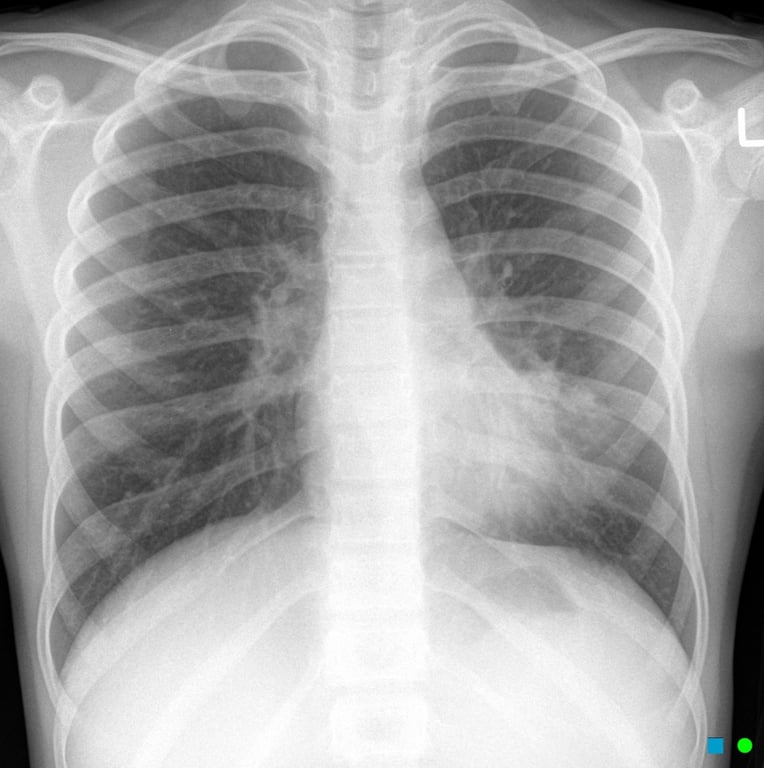
- the classical x-ray finding in pneumonia is consolidation
 | |
| © Image used on license from Radiopaedia | |
This film demonstrates classical signs of right upper lobe consolidation - abnormal opacity within the right upper lobe abutting the horizontal fissure. Note how the 'position' of the consolidation on the film (i.e. in the 'middle' of the lung) doesn't necessarily correlate with the lobe affected.
 | |
| © Image used on license from Radiopaedia | |
Here the consolidation is harder to spot. Look at the left heart border - it is normally well dermaracted with the lung. Here it is fuzzy - this is a classic sign of left lingula consolidation.
Bloods
- full blood count: would usually show a neutrophilia in bacterial infections
- urea and electrolytes: check for dehydration (remember the 'U' for urea in CURB-65, see below) and also other changes seen with some atypical pneumonias
- CRP: raised in response to infection
Arterial blood gases
- indicated if the oxygen saturations or low or the patient has pre-existing respiratory disease, for example COPD
Management
Patients with pneumonia require the following:
- antibiotics: to treat the underlying infection
- supportive care: for example oxygen therapy if the patients is hypoxaemic, intravenous fluids if the patient is hypotensive or shows signs of dehydration
The management of patients with community-acquired pneumonia is usually determined according to a risk stratification process using a scoring system called CURB-65.
The CURB-65 score is as follows:
| Criterion | Marker |
|---|---|
| C | Confusion (abbreviated mental test score <= 8/10) |
| U | Urea >7 mmol/L |
| R | Respiration rate >= 30/min |
| B | Blood pressure: systolic <= 90 mmHg and/or diastolic <= 60 mmHg |
| 65 | Aged >= 65 years |
Patients with a CURB-65 score of 0 should be managed in the community.
Patients with a CURB-65 score of 1 should have their Sa02 assessed which should be >92% to be safely managed in the community and a CXR performed. If the CXR shows bilateral/multilobar shadowing hospital admission is advised.
Patients with a CURB-65 score of 2 or more should be managed in hospital as this represents a severe community acquired pneumonia.
The CURB-65 score also correlates with an increased risk of mortality at 30 days with patients with a CURB-65 score of 4 approaching a 30% mortality rate at 30 days.