Acute abdominal pain: a very basic introduction
On this page
Acute abdominal pain is one of the most common presentations encountered in clinical practice.
One of the most common ways to think about the potential causes is the location of the pain. Sometimes patients present with generalised pain but probably the most common present is pain in a particular region of the abdomen. Some conditions characteristically cause central pain before localising to a particular area. A good example is appendicitis, which typically presents with central abdominal pain before localising to the right iliac fossa.
This approach, whilst useful, is however limited as patients commonly present with atypical findings and as mentioned previously the site of the pain can change over time.
Another way of classifying the causes of an acute abdomen, or any condition, is by using a surgical sieve:
Infective
Inflammatory
Vascular
Traumatic
Metabolic
The tables below gives the key characteristics of common causes of abdominal pain.
Hepatobiliary problems
Upper gastrointestinal tract problems
Gynaecological causes
Vascular causes
Causes
One of the most common ways to think about the potential causes is the location of the pain. Sometimes patients present with generalised pain but probably the most common present is pain in a particular region of the abdomen. Some conditions characteristically cause central pain before localising to a particular area. A good example is appendicitis, which typically presents with central abdominal pain before localising to the right iliac fossa.
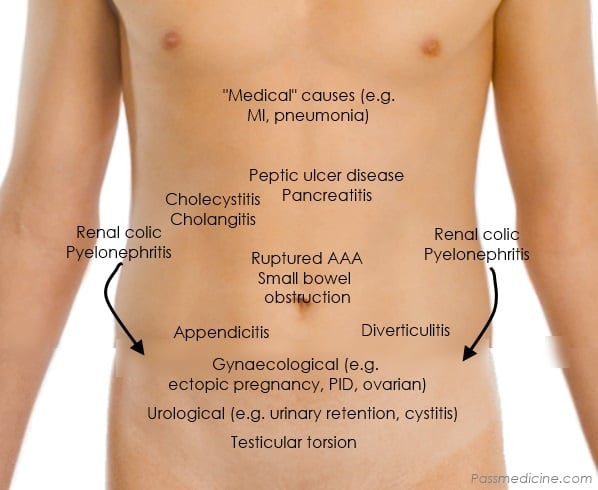 | |
Diagram showing stereotypical areas where particular conditions present. The diagram is not exhaustive and only lists the more common conditions seen in clinical practice. Note how pain from renal causes such as renal/ureteric colic and pyelonephritis may radiate and move from the loins towards the suprapubic area.
This approach, whilst useful, is however limited as patients commonly present with atypical findings and as mentioned previously the site of the pain can change over time.
Another way of classifying the causes of an acute abdomen, or any condition, is by using a surgical sieve:
Infective
- gastroenteritis
- appendicitis
- diverticulitis
- pyelonephritis
- cholecystitis
- cholangitis
- pelvic inflammatory disease
- hepatitis
- pneumonia
Inflammatory
- pancreatitis
- peptic ulcer disease
Vascular
- ruptured abdominal aortic aneurysm
- mesenteric ischaemia
- myocardial infarction
Traumatic
- ruptured spleen
- perforated viscus (e.g. oesophagus, stomach, bowel)
Metabolic
- renal/ureteric stone
- diabetic ketoacidosis
The tables below gives the key characteristics of common causes of abdominal pain.
Hepatobiliary problems
| Condition | Typical location of pain | Notes |
|---|---|---|
| Biliary colic | Right upper quadrant | Caused by a gallstone getting lodged in the bile duct Classically provoked by eating a fatty meal In contrast to acute cholecystitis no fever and inflammatory markers are normal |
| Acute cholecystitis | Right upper quadrant | Inflammation/infection of the gallbladder secondary to impacted gallstones Murphy's sign positive (arrest of inspiration on palpation of the RUQ) Fever and raised inflammatory markers |
| Ascending cholangitis | Right upper quadrant | Ascending cholangitis is a bacterial infection of the biliary tree. The most common predisposing factor is gallstones. Charcot's triad of right upper quadrant pain, fever and jaundice occurs in about 20-50% of patients |
| Acute pancreatitis | Epigastrium, sometimes radiating through to the back | Usually due to alcohol or gallstones Pain is often very severe. Examination may reveal tenderness, ileus and low-grade fever |
Upper gastrointestinal tract problems
| Condition | Typical location of pain | Notes |
|---|---|---|
| Peptic ulcer disease | Epigastrium | There may be a history of NSAID use or alcohol excess. Duodenal ulcers: more common than gastric ulcers, epigastric pain relieved by eating Gastric ulcers: epigastric pain worsened by eating Features of upper gastrointestinal haemorrhage may be seen (haematemesis, melena etc) |
Lower gastrointestinal tract problems
| Condition | Typical location of pain | Notes |
|---|---|---|
| Appendicitis | Right iliac fossa | Pain initial in the central abdomen before localising to the right iliac fossa (RIF). Anorexia is common. Tachycardia, low-grade pyrexia, tenderness in RIF Rovsing's sign: more pain in RIF than LIF when palpating LIF |
| Acute diverticulitis | Left lower quadrant | Colicky pain typically in the LLQ Diarrhoea, sometimes bloody. Fever, raised inflammatory markers and white cells |
| Intestinal obstruction | Central | History of malignancy (intraluminal obstruction)/previous operations (adhesions) Vomiting. Not opened bowels recently 'Tinkling' bowel sounds |
Urological causes
| Condition | Typical location of pain | Notes |
|---|---|---|
| Renal colic | Loin pain radiating to the groin | Pain is often severe but intermittent. Patient's are characteristically restless. Visible or non-visible haematuria may be present |
| Acute pyelonephritis | Loin pain | Fever and rigors are common as is vomiting |
| Urinary retention | Suprapubic | Caused by obstruction to the bladder outflow. Much more common in men, who often have a history of benign prostatic hyperplasia |
Gynaecological causes
Remember, all women of a reproductive age who present with abdominal pain should be considered pregnant until proven otherwise
| Condition | Typical location of pain | Notes |
|---|---|---|
| Ectopic pregnancy | Right or left iliac fossa | Typically presents with pain and a history of amenorrhoea for the past 6-9 weeks. Vaginal bleeding may be present |
Vascular causes
| Condition | Typical location of pain | Notes |
|---|---|---|
| Ruptured abdominal aortic aneurysm | Central abdominal pain radiating to the back | Presentation may be catastrophic (e.g. Sudden collapse) or sub-acute (persistent severe central abdominal pain with developing shock) Patients may be shocked (hypotension, tachycardic) Patients may have a history of cardiovascular disease |
| Mesenteric ischaemia | Central abdominal pain | Patients often have a history of atrial fibrillation or other cardiovascular disease Diarrhoea, rectal bleeding may be seen A metabolic acidosis is often seen (due to 'dying' tissue) |