Diabetes mellitus: a very basic introduction
On this page
Diabetes mellitus is one of the most common conditions encountered in clinical practice and represents a significant burden on the health systems of the developed world. It is now estimated that 8% of the total NHS budget is now spent on managing patients with diabetes mellitus.
Diabetes mellitus may be defined as a chronic condition characterised by abnormally raised levels of blood glucose.
Why is the management of diabetes mellitus so important?
Before the advent of insulin therapy untreated type 1 diabetes would usually result in death. Poorly treated type 1 diabetes mellitus can still result in significant morbidity and mortality (as a result of diabetic ketoacidosis). However, the main focus of diabetes management now is reducing the incidence of macrovascular (ischaemic heart disease, stroke) and microvascular (eye, nerve and kidney damage) complications.
There are a number of different types of diabetes mellitus:
The presentation of diabetes mellitus depends very much on the type:
Remember that the polyuria and polydipsia are due to water being 'dragged' out of the body due to the osmotic effects of excess blood glucose being excreted in the urine (glycosuria).
There are 4 main ways to check blood glucose:
The diagnostic criteria are determined by WHO.
If the patient is symptomatic:
If the patient is asymptomatic the above criteria apply but must be demonstrated on two separate occasions.
In 2011 WHO released supplementary guidance on the use of HbA1c for the diagnosis of diabetes:
Management
The principle of managing diabetes mellitus are as follows:
Type 1 diabetes
Type 2 diabetes
The table below shows some of the main drugs used in the management of diabetes mellitus:
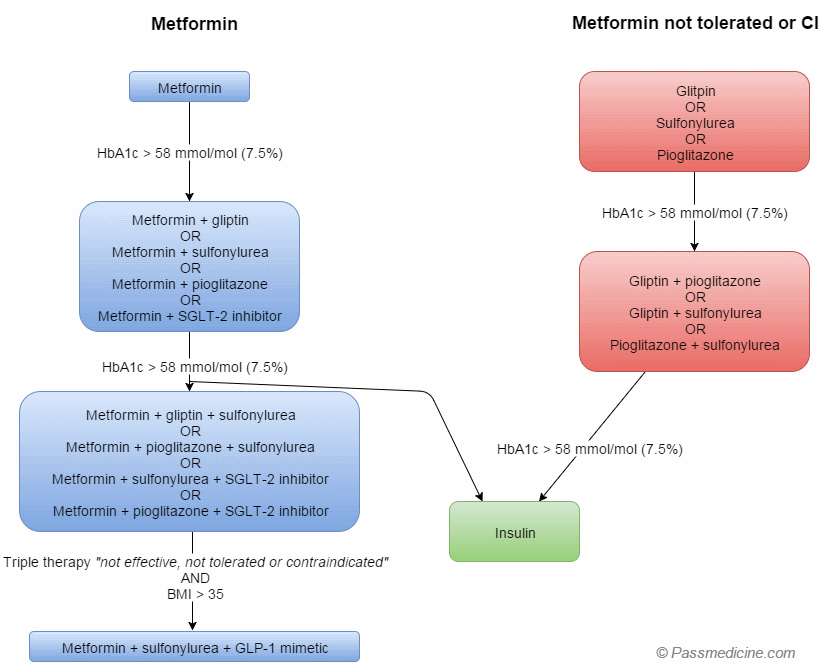
NICE provide guidelines on how drug therapy should be used in T2DM:
*common in exams, much less common in clinical practice
What is diabetes mellitus?
Diabetes mellitus may be defined as a chronic condition characterised by abnormally raised levels of blood glucose.
Why is the management of diabetes mellitus so important?
Before the advent of insulin therapy untreated type 1 diabetes would usually result in death. Poorly treated type 1 diabetes mellitus can still result in significant morbidity and mortality (as a result of diabetic ketoacidosis). However, the main focus of diabetes management now is reducing the incidence of macrovascular (ischaemic heart disease, stroke) and microvascular (eye, nerve and kidney damage) complications.
Types of diabetes mellitus
There are a number of different types of diabetes mellitus:
| Type | Notes |
|---|---|
| Type 1 diabetes mellitus (T1DM) | Autoimmune disorder where the insulin-producing beta cells of the islets of Langerhans in the pancreas are destroyed by the immune system This results in an absolute deficiency of insulin resulting in raised glucose levels Patients tend to develop T1DM in childhood/early adult life and typically present unwell, possibly in diabetic ketoacidosis |
| Type 2 diabetes mellitus (T2DM) | This is the most common cause of diabetes in the developed world. It is caused by a relative deficiency of insulin due to an excess of adipose tissue. In simple terms there isn't enough insulin to 'go around' all the excess fatty tissue, leading to blood glucose creeping up. |
| Prediabetes | This term is used for patients who don't yet meet the criteria for a formal diagnosis of T2DM to be made but are likely to develop the condition over the next few years. They, therefore, require closer monitoring and lifestyle interventions such as weight loss |
| Gestational diabetes | Some pregnant develop raised glucose levels during pregnancy. This is important to detect as untreated it may lead to adverse outcomes for the mother and baby |
| Maturity onset diabetes of the young (MODY) | A group of inherited genetic disorders affecting the production of insulin. Results in younger patients developing symptoms similar to those with T2DM, i.e. asymptomatic hyperglycaemia with progression to more severe complications such as diabetic ketoacidosis |
| Latent autoimmune diabetes of adults (LADA) | The majority of patients with autoimmune-related diabetes present younger in life. There are however a small group of patients who develop such problems later in life. These patients are often misdiagnosed as having T2DM |
| Other types | Any pathological process which damages the insulin-producing cells of the pancreas may cause diabetes to develop. Examples include chronic pancreatitis and haemochromatosis. Drugs may also cause raised glucose levels. A common example is glucocorticoids which commonly result in raised blood glucose levels |
Symptoms and signs
The presentation of diabetes mellitus depends very much on the type:
| Type 1 DM | Type 2 DM |
|---|---|
| Weight loss Polydipsia Polyuria May present with diabetic ketoacidosis
| Often picked up incidentally on routine blood tests Polydipsia Polyuria |
Remember that the polyuria and polydipsia are due to water being 'dragged' out of the body due to the osmotic effects of excess blood glucose being excreted in the urine (glycosuria).
Investigations
There are 4 main ways to check blood glucose:
- a finger-prick bedside glucose monitor
- a one-off blood glucose. This may either be fasting or non-fasting
- a HbA1c. This measures the amount of glycosylated haemoglobin and represents the average blood glucose over the past 2-3 months
- a glucose tolerance test. In this test, a fasting blood glucose is taken after which a 75g glucose load is taken. After 2 hours a second blood glucose reading is then taken
The diagnostic criteria are determined by WHO.
If the patient is symptomatic:
- fasting glucose greater than or equal to 7.0 mmol/l
- random glucose greater than or equal to 11.1 mmol/l (or after 75g oral glucose tolerance test)
If the patient is asymptomatic the above criteria apply but must be demonstrated on two separate occasions.
In 2011 WHO released supplementary guidance on the use of HbA1c for the diagnosis of diabetes:
- a HbA1c of greater than or equal to 6.5% (48 mmol/mol) is diagnostic of diabetes mellitus
- a HbAlc value of less than 6.5% does not exclude diabetes (i.e. it is not as sensitive as fasting samples for detecting diabetes)
- in patients without symptoms, the test must be repeated to confirm the diagnosis
- it should be remembered that misleading HbA1c results can be caused by increased red cell turnover
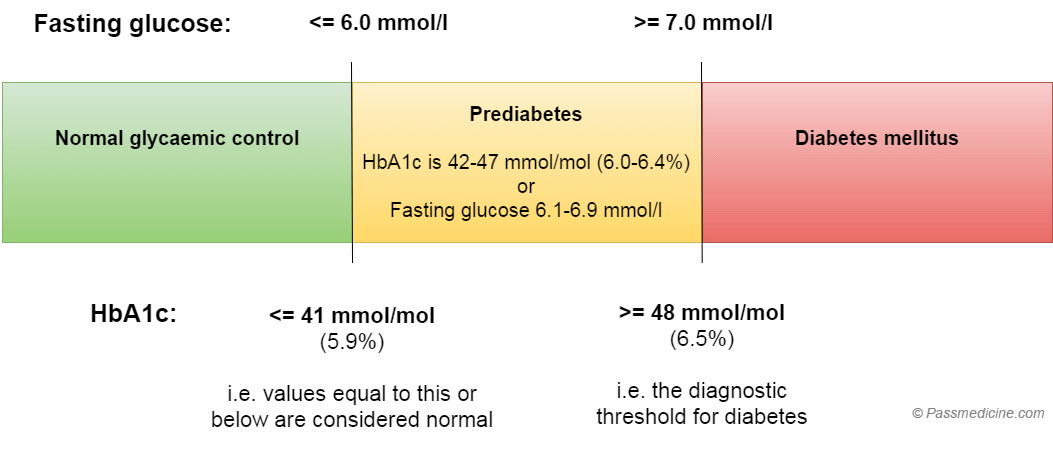 | |
Diagram showing the spectrum of diabetes diagnosis
Management
The principle of managing diabetes mellitus are as follows:
- drug therapy to normalise blood glucose levels
- monitoring for and treating any complications related to diabetes
- modifying any other risk factors for other conditions such as cardiovascular disease
Type 1 diabetes
- patients always require insulin to control the blood sugar levels. This is because there is an absolute deficiency of insulin with no pancreatic tissue left to stimulate with drugs
- different types of insulin are available according to their duration of action
Type 2 diabetes
- the majority of patients with type 2 diabetes are controlled using oral medication
- the first-line drug for the vast majority of patients is metformin
- second-line drugs include sulfonylureas, gliptins and pioglitazone. Please see the table below for further information
- if oral medication is not controlling the blood glucose to a sufficient degree then insulin is used
The table below shows some of the main drugs used in the management of diabetes mellitus:
| Drug class | Mechanism of action | Route | Main side-effects | Notes |
|---|---|---|---|---|
| Insulin | Direct replacement for endogenous insulin | Subcutaneous | Hypoglycaemia Weight gain Lipodystrophy | Used in all patients with T1DM and some patients with poorly controlled T2DM Can be classified according to source (analogue, human sequence and porcine) and duration of action (short, immediate, long-acting) |
| Metformin | Increases insulin sensitivity Decreases hepatic gluconeogenesis | Oral | Gastrointestinal upset Lactic acidosis* | First-line medication in the management of T2DM Cannot be used in patients with an eGFR of < 30 ml/min |
| Sulfonylureas | Stimulate pancreatic beta cells to secrete insulin | Oral | Hypoglycaemia Weight gain Hyponatraemia | Examples include gliclazide and glimepiride |
| Thiazolidinediones | Activate PPAR-gamma receptor in adipocytes to promote adipogenesis and fatty acid uptake | Oral | Weight gain Fluid retention | Only currently available thiazolidinedione is pioglitazone |
| DPP-4 inhibitors (-gliptins) | Increases incretin levels which inhibit glucagon secretion | Oral | Generally well tolerated but increased risk of pancreatitis | |
| SGLT-2 inhibitors (-gliflozins) | Inhibits reabsorption of glucose in the kidney | Oral | Urinary tract infection | Typically result in weight loss |
| GLP-1 agonists (-tides) | Incretin mimetic which inhibits glucagon secretion | Subcutaneous | Nausea and vomiting Pancreatitis | Typically result in weight loss |
NICE provide guidelines on how drug therapy should be used in T2DM:
 | |
*common in exams, much less common in clinical practice