Respiratory physiology: Lung volumes
On this page
The diagram below demonstrates the lung volumes which may be measured:
Tidal volume (TV)
Inspiratory reserve volume (IRV) = 2-3 L
Expiratory reserve volume (ERV) = 700-1100ml
Residual volume (RV) = 1.2L
Functional residual capacity (FRC) = 1.8-2.4L
Vital capacity (VC) = 3-5L
Total lung capacity (TLC) is the sum of the vital capacity + residual volume
Physiological dead space (VD)
Summary of lung volumes and capacities
Total lung capacity (TLC) does not change significantly with age but the composition of lung volumes change with advancing age as follows:
Loss of alveolar wall structural support, muscle atrophy and other changes associated with advancing age result in a reduction in lung elasticity, increased chest wall compliance and increased air trapping. This is sometimes termed 'senile emphysema'
In emphysema increases in FRC and RV are also seen however TLC will increase slightly in patients with emphysema.
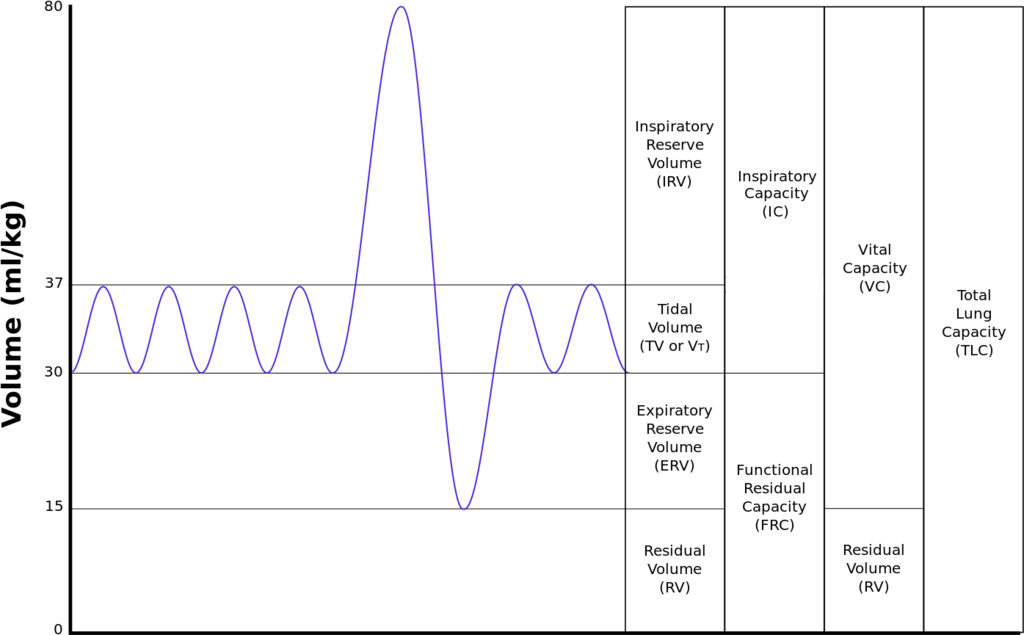 | |
Click on image to enlarge
Tidal volume (TV)
- volume inspired or expired with each breath at rest
- Average around 500ml
Inspiratory reserve volume (IRV) = 2-3 L
- maximum volume of air that can be inspired at the end of a normal tidal inspiration
- inspiratory capacity = TV + IRV
Expiratory reserve volume (ERV) = 700-1100ml
- maximum volume of air that can be expired at the end of a normal tidal expiration
Residual volume (RV) = 1.2L
- volume of air remaining after maximal expiration
- increases with age
- RV = FRC - ERV
Functional residual capacity (FRC) = 1.8-2.4L
- volume of air remaining in the lungs after a normal tidal expiration
- FRC = ERV + RV
Vital capacity (VC) = 3-5L
- Maximum volume of air that can be expired after a maximal inspiration
- Average around 5L in males and 3-3.5L in females
- Decreases with age
- VC = IC + ERV
Total lung capacity (TLC) is the sum of the vital capacity + residual volume
Physiological dead space (VD)
- Dead space is the air in the lungs that does not take part in gas exchange
- VD = tidal volume * (PaCO2 - PeCO2) / PaCO2
- where PeCO2 = expired air CO2
Summary of lung volumes and capacities
| Lung volume/capacity | Average volume male | Average volume female | Calculation |
|---|---|---|---|
| Vital capacity (VC) | 5000ml | 3000ml | IRV + TV + ERV |
| Inspiratory capacity (IC) | 3800ml | 2400ml | IRV + TV |
| Functional residual capacity (FRC) | 2400ml | 1800ml | ERV + RV |
| Total lung capacity (TLC) | 6000ml | 4200ml | IRV + TV + ERV + RV |
| Inspiratory reserve volume (IRV) | 3300ml | 1900ml | |
| Tidal volume (TV) | 500ml | 500ml | |
| Expiratory reserve volume (ERV) | 1100ml | 700ml | |
| Residual volume (RV) | 1200ml | 1100ml |
Spirometry cannot be used to measure residual volume (RV) and therefore cannot be used to obtain values for FRC or TLC as these measurements include the RV.
Measurement of the residual volume has to be done via indirect methods such as radiographic planimetry, body plethysmography, closed circuit dilution (including the helium dilution technique) and nitrogen washout.
Measurement of the residual volume has to be done via indirect methods such as radiographic planimetry, body plethysmography, closed circuit dilution (including the helium dilution technique) and nitrogen washout.
Ageing and emphysema
Ageing has effects on lung volumes primarily as a result of changes in pulmonary elastic and resistive properties.Total lung capacity (TLC) does not change significantly with age but the composition of lung volumes change with advancing age as follows:
- Functional residual capacity (FRC) ↑ increased
- Residual volume (RV) ↑ increased
- Inspiratory capacity (IC) ↓ decreased
- Vital capacity (VC) ↓ decreased
Loss of alveolar wall structural support, muscle atrophy and other changes associated with advancing age result in a reduction in lung elasticity, increased chest wall compliance and increased air trapping. This is sometimes termed 'senile emphysema'
In emphysema increases in FRC and RV are also seen however TLC will increase slightly in patients with emphysema.
Obstructive disease
In obstructive lung disease the following is seen:- Functional residual capacity (FRC) ↑ increased
- Residual volume (RV) ↑ increased
- Total lung capacity (TLC) ↑ increased
- Inspiratory capacity (IC) ↓ decreased