Respiratory physiology: PEFR & FEV1/FVC Ratio
Peak expiratory flow rate
Peak expiratory flow rate (PEFR) is a useful test that measures a patient's maximum speed of expiration. It is usually quick and easy to perform. Expected PEFR varies depending on age, sex and height.PEFR is dependent on initial lung volumes and patient effort. PEFR decreases when airways resistance is increased.
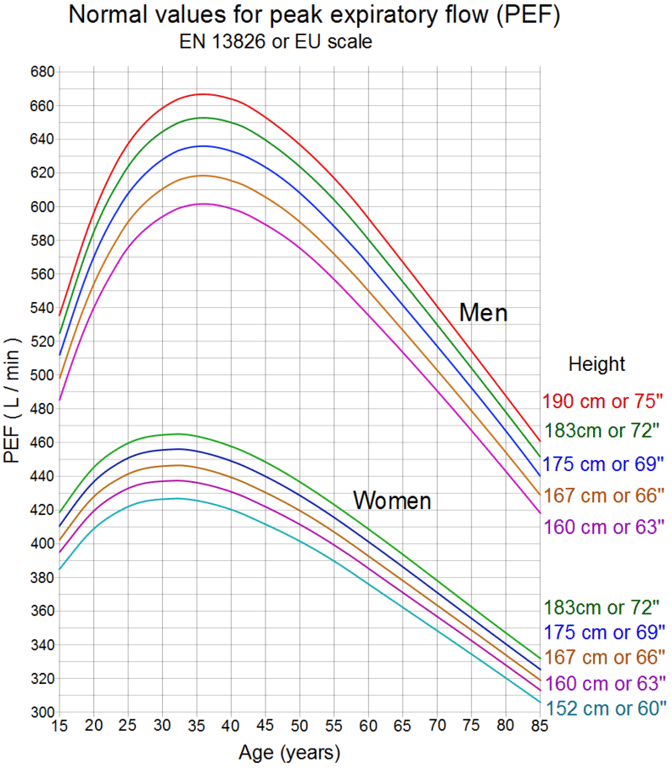 | |
PEFR charts showing normal expected values dependent on age, sex and height
Spirometry
Spirometry provides more information than PEFR and measures the volume of air expired over time. The FEV1 and FVC are perhaps the most important values obtained and are used in the diagnosis of obstructive and restrictive lung diseases.
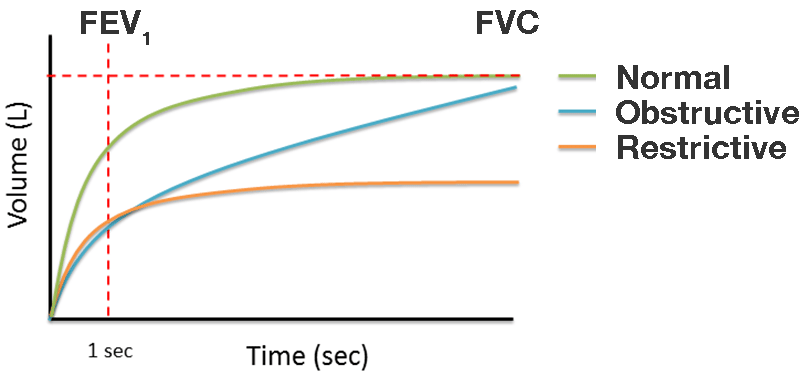 | |
Illustration showing variation in patterns of FEV1 and FVC in obstructive and restrictive lung disease
Forced vital capacity (FVC)
The FVC is the maximum volume of air that can be expelled from the lungs after maximum inspiration. In restrictive lung disease the FVC is reduced as the lung volume is reduced. The FVC may be normal or reduced in obstructive lung disease.
Forced expiratory volume (FEV)
The FEV1 measures the maximum amount of air a patient can exhale in the first second of expiration following maximum inspirationInterpretation of results
NICE consider a FEV1/FVC ratio of less than 70% (0.7) consistent with obstructive lung disease (asthma and COPD)
Normal FEV1 and FVC are >80% predicted. Normal FEV1/FVC is 0.75-0.85
Normal FEV1 and FVC are >80% predicted. Normal FEV1/FVC is 0.75-0.85
| Obstructive | Restrictive | |
|---|---|---|
| FEV1 | Low | Low |
| FVC | Normal or low | Low |
| FEV1/FVC | Low | Normal or high |
| PEFR | Low | Low |
| Example causes | Asthma COPD | Pulmonary fibrosis (any cause) Sarcoidosis Obesity Neuromuscular disease Atelectasis Pneumonia Pulmonary effusion Pulmonary oedema |