Respiratory physiology: Oxygen transport
Oxygen is a fundamental requirement for aerobic respiration. In the blood it is carried in two ways:
Oxygen diffuses from the alveoli into the pulmonary capillaries where it binds with haemoglobin. Each haemoglobin molecule can bind up to 4 oxygen molecules. This equates to a maximum theoretical oxygen-carrying capacity of 1.39 ml O2 per gram Hb (known as Hufner's constant. In real life oxygen-binding capacity is typically 1.31 to 1.34 mL O2 per gram Hb).
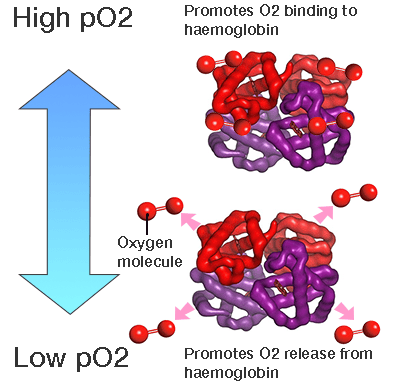
Haemoglobin oxygen binding depends on the partial pressure of oxygen in the tissues. Low tissue pO2 promotes haemoglobin-oxygen dissociation where as high partial pressure of oxygen in the tissues promote haemoglobin-oxygen binding (as shown in the diagram below)
Haemoglobin binding is said to occur in a co-operative manor. This means that when one oxygen molecule binds to haemoglobin it causes a structural change that increases the molecules affinity for oxygen and makes binding the subsequent haemoglobin molecule easier.
Oxygen dissociation curve
The oxygen dissociation curve describes the relationship between the percentage of saturated haemoglobin and partial pressure of oxygen in the blood. It is not affected by haemoglobin concentration
Basics
*2,3-diphosphoglycerate
Comparison of different haemoglobin variants
- Bound to haemoglobin (98.5%)
- Dissolved in plasma (1.5%)
Oxygen diffuses from the alveoli into the pulmonary capillaries where it binds with haemoglobin. Each haemoglobin molecule can bind up to 4 oxygen molecules. This equates to a maximum theoretical oxygen-carrying capacity of 1.39 ml O2 per gram Hb (known as Hufner's constant. In real life oxygen-binding capacity is typically 1.31 to 1.34 mL O2 per gram Hb).
Haemoglobin oxygen binding depends on the partial pressure of oxygen in the tissues. Low tissue pO2 promotes haemoglobin-oxygen dissociation where as high partial pressure of oxygen in the tissues promote haemoglobin-oxygen binding (as shown in the diagram below)
 | |
Haemoglobin binding is said to occur in a co-operative manor. This means that when one oxygen molecule binds to haemoglobin it causes a structural change that increases the molecules affinity for oxygen and makes binding the subsequent haemoglobin molecule easier.
Key points
- One haemoglobin molecule binds up to four oxygen molecules in a co-operative manner
- Haemoglobin is the primary transporter of oxygen in humans
Oxygen dissociation curve
The oxygen dissociation curve describes the relationship between the percentage of saturated haemoglobin and partial pressure of oxygen in the blood. It is not affected by haemoglobin concentration
Basics
- shifts to left = for given oxygen tension there is increased saturation of Hb with oxygen i.e. decreased oxygen delivery to tissues
- shifts to right = for given oxygen tension there is reduced saturation of Hb with oxygen i.e. enhanced oxygen delivery to tissues
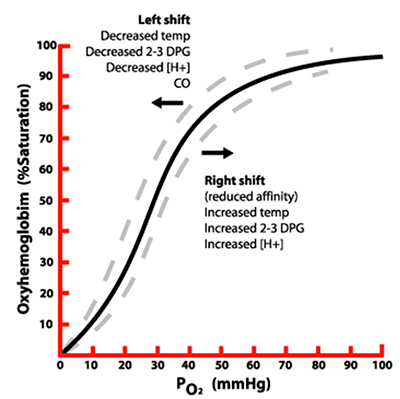 | |
| Shifts to Left = Lower oxygen delivery | Shifts to Right = Raised oxygen delivery |
|---|---|
| HbF, methaemoglobin, carboxyhaemoglobin Low [H+] (alkali) Low pCO2 Low 2,3-DPG Low temperature | Raised [H+] (acidic) Raised pCO2 Raised 2,3-DPG* Raised temperature |
The L rule
Shifts to L → Lower oxygen delivery, caused by
Another mnemonic is 'CADET, face Right!' for CO2, Acid, 2,3-DPG, Exercise and Temperature
Shifts to L → Lower oxygen delivery, caused by
- Low [H+] (alkali)
- Low pCO2
- Low 2,3-DPG
- Low temperature
Another mnemonic is 'CADET, face Right!' for CO2, Acid, 2,3-DPG, Exercise and Temperature
*2,3-diphosphoglycerate
Comparison of different haemoglobin variants
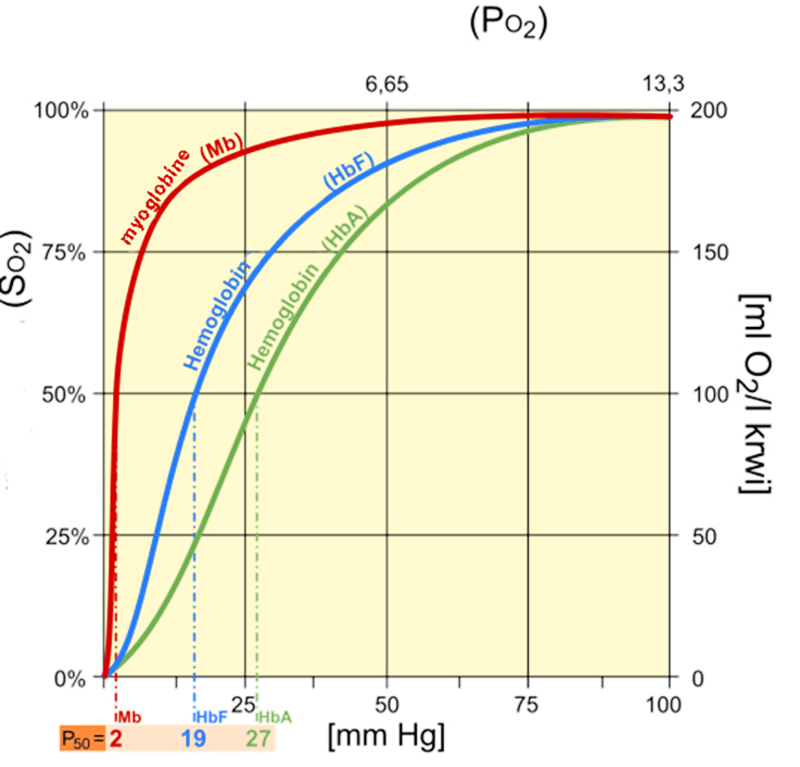 | |
Diagram illustrating the curve for Myoglobin, Fetal and Adult Hb