Cell structure: organelles
Cells are the smallest structural and functional units of the body. Cells are enclosed by a phospholipid plasma membrane. Cells contain a protein rich fluid called cytosol that accounts for around half of the volume within a cell. The remaining half of the cellular volume is composed of organelles and cytoskeleten support structures.
Organelles are subcellular structures that have one or more specific roles. They are typically enclosed by phospholipid membrane.
Mitochondria
Mitochondria are responsible for energy production via aerobic respiration. They utilise oxygen to convert sugars and small fatty acids into adenosine triphosphate (ATP). ATP is the energy source for cellular reactions.
ATP is produced in the mitochondria by a process called oxidative phosphorylation. The precursors for oxidative phosphorylation are generated in the mitochondria via the Krebs cycle (citric acid cycle).
Note some ATP is produced in the cytosol by glycolysis but this is an anaerobic reaction. For each glucose molecule metabolised only 2 ATP are generated by anaerobic respiration whereas aerobic respiration has a maximum yield of 38 ATP (normal yield is around 30 ATP).
Mitochondria also play a role in Ca2+ homeostasis and body heat production.
Rough endoplasmic reticulum (RER) has ribosomes attached to its surface which have translocated from the nucleus. Ribosomes are the site of protein synthesis, they bind to mRNA and match it to tRNA which then codes the appropriate amino acid of a protein. The RER acts as the site of protein assembly and also functions to ensure proper protein folding and modifications occur. Modifications have several purposes such as tagging for secretion, folding proteins, tagging for destruction or packing for transport. Examples of modifications include glycosylation and disulfide bond formation.
Smooth endoplasmic reticulum (SER) serves as a site of lipid production and as a store of intracellular calcium.
Organelles are subcellular structures that have one or more specific roles. They are typically enclosed by phospholipid membrane.
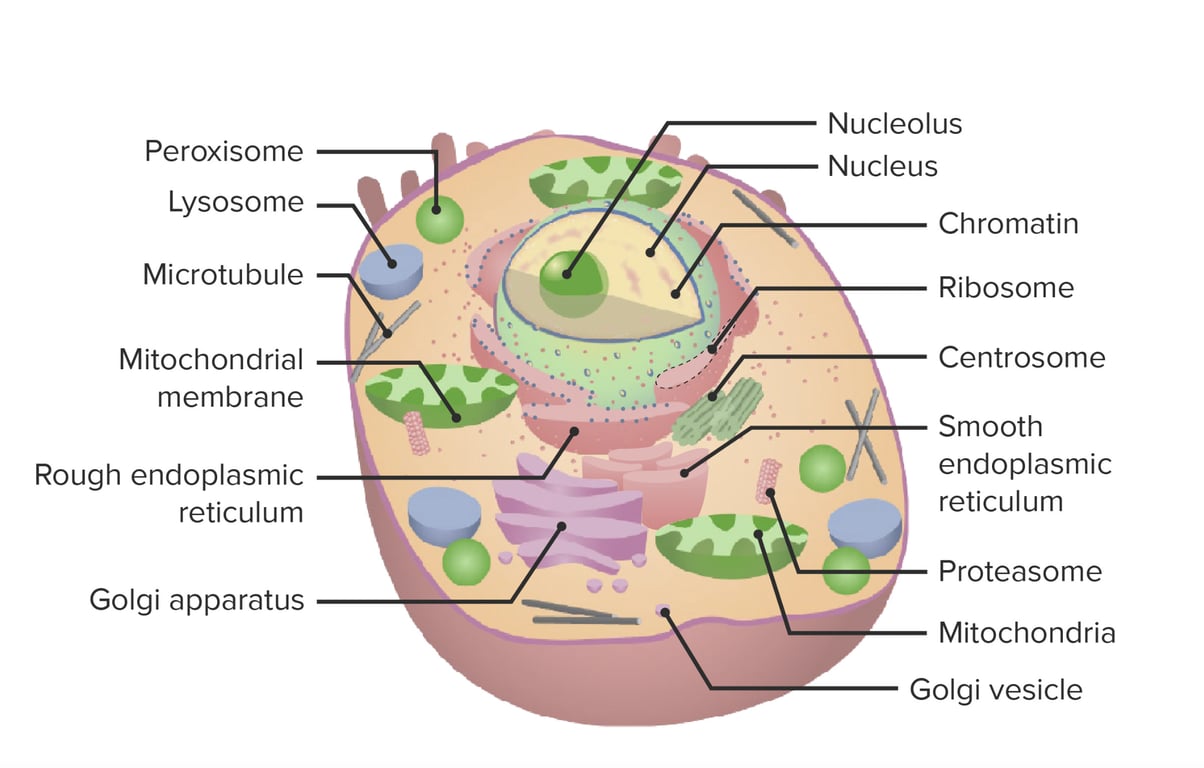 | |
Image showing cell organelles. Click on image to enlarge
Mitochondria
Mitochondria are responsible for energy production via aerobic respiration. They utilise oxygen to convert sugars and small fatty acids into adenosine triphosphate (ATP). ATP is the energy source for cellular reactions.
ATP is produced in the mitochondria by a process called oxidative phosphorylation. The precursors for oxidative phosphorylation are generated in the mitochondria via the Krebs cycle (citric acid cycle).
Note some ATP is produced in the cytosol by glycolysis but this is an anaerobic reaction. For each glucose molecule metabolised only 2 ATP are generated by anaerobic respiration whereas aerobic respiration has a maximum yield of 38 ATP (normal yield is around 30 ATP).
Mitochondria also play a role in Ca2+ homeostasis and body heat production.
Nucleus
The nucleus contains chromosomes and the nucleolus. The nucleolus is membrane-less and produces ribosomes.Endoplasmic reticulum
The endoplasmic reticulum plays a key role in protein and lipid manufacture and transport. It may be smooth or rough.Rough endoplasmic reticulum (RER) has ribosomes attached to its surface which have translocated from the nucleus. Ribosomes are the site of protein synthesis, they bind to mRNA and match it to tRNA which then codes the appropriate amino acid of a protein. The RER acts as the site of protein assembly and also functions to ensure proper protein folding and modifications occur. Modifications have several purposes such as tagging for secretion, folding proteins, tagging for destruction or packing for transport. Examples of modifications include glycosylation and disulfide bond formation.
Defective proteins are tagged with ubiquitin molecules allowing them to be identified and degraded by proteasomes.
Smooth endoplasmic reticulum (SER) serves as a site of lipid production and as a store of intracellular calcium.
Golgi apparatus
The Golgi apparatus are closely associated with endoplasmic reticulum and also play a role in post translational processing, packaging and modification of new proteins. The Golgi apparatus will package proteins for particular destinations e.g. it may pack proteins into secretory vesicles for transport outside of the cell or package digestive enzymes into lysosomes.Lysosomes
Lysosomes are small vesicles containing digestive enzymes (acid hydrolase enzymes). Lysosomes digest and recycle material from defective proteins. The pH within the lysosome vesicle is acidic (5.0) which is optimal for its enzymatic contents to work.Table 1: Organelle summary
| Organelle/macromolecule | Main function |
|---|---|
| Endoplasmic reticulum | Rough endoplasmic reticulum
Smooth endoplasmic reticulum
|
| Golgi apparatus | Modifies, sorts, and packages these molecules that are destined for cell secretion Site of O-linked glycosylation |
| Mitochondria | Aerobic respiration. Contains mitochondrial genome as circular DNA |
| Nucleus | DNA maintenance and RNA transcription |
| Lysosome | Breakdown of large molecules such as proteins and polysaccharides |
| Nucleolus | Ribosome production |
| Ribosome | Translation of RNA into proteins |
| Peroxisome | Catabolism of very long chain fatty acids and amino acids Results in the formation of hydrogen peroxide |
| Proteasome | Along with the lysosome pathway involved in degradation of protein molecules that have been tagged with ubiquitin |