Cell structure: membrane
On this page
Human cells and almost all of the organelles within cells are enclosed by a membrane which consists of a phospholipid bilayer with embedded membrane proteins. Embedded proteins have several functions including signalling, transport channels and structural support.
The phospholipid component consists of hydrophilic ('water-loving') heads, made up of choline and phosphate, and hydrophobic ('water-hating') fatty acid tails. In an aqueous environment they organise into a bilayer with heads facing out and tails facing inwards. The phospholipid units are free to move within their layer, a phenomenon known as lateral diffusion so the membrane is fluid
Lipid soluble (hydrophobic) substances, such as cholesterol, incorporate into the membrane. Substances with hydrophilic and hydrophobic properties, such as proteins, can be tethered part in and part out of the membrane.
Large molecules like glucose or charged molecules like ions cannot pass through the bilayer easily and they typically require transporters or ion channels to move across the bilayer. In some cases proteins may be packaged in vesicles and transported via endocytosis.
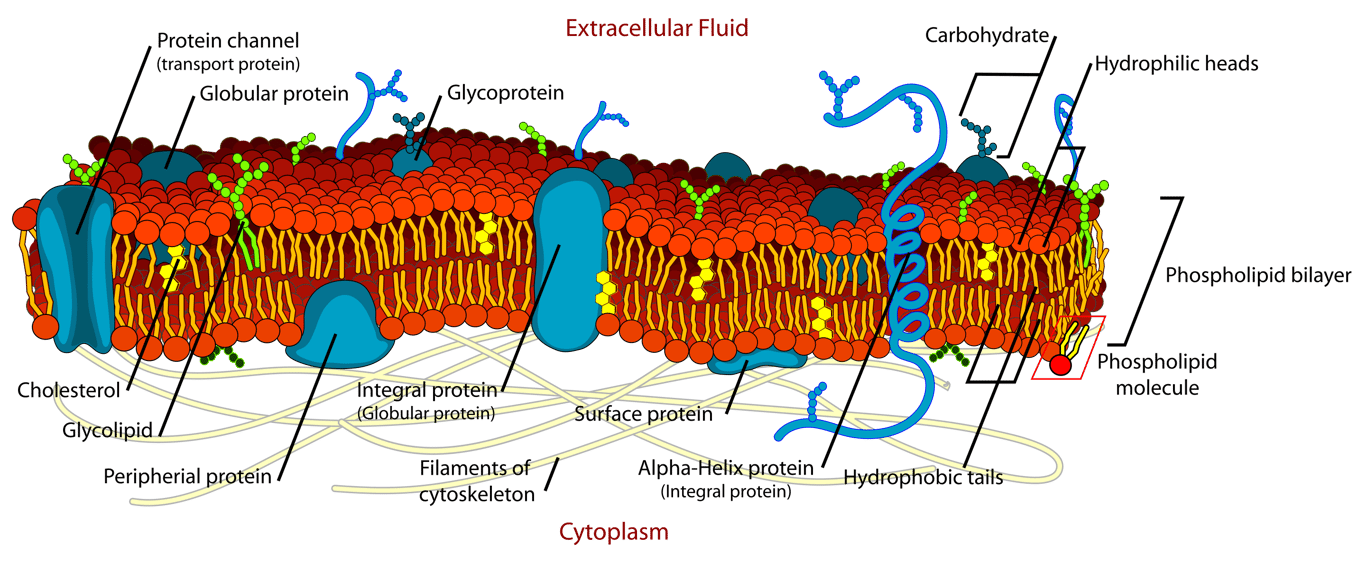 | |
Cell membrane highlighting phospholipid bilayer structure. Click on image to enlarge
The phospholipid component consists of hydrophilic ('water-loving') heads, made up of choline and phosphate, and hydrophobic ('water-hating') fatty acid tails. In an aqueous environment they organise into a bilayer with heads facing out and tails facing inwards. The phospholipid units are free to move within their layer, a phenomenon known as lateral diffusion so the membrane is fluid
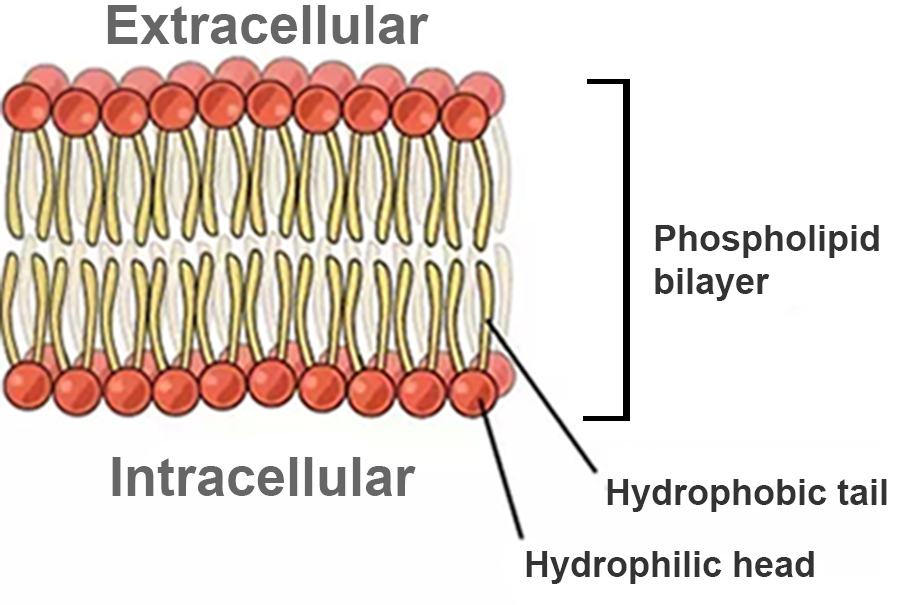 | |
Close up illustration of phospholipid bilayer structure. Click on image to enlarge
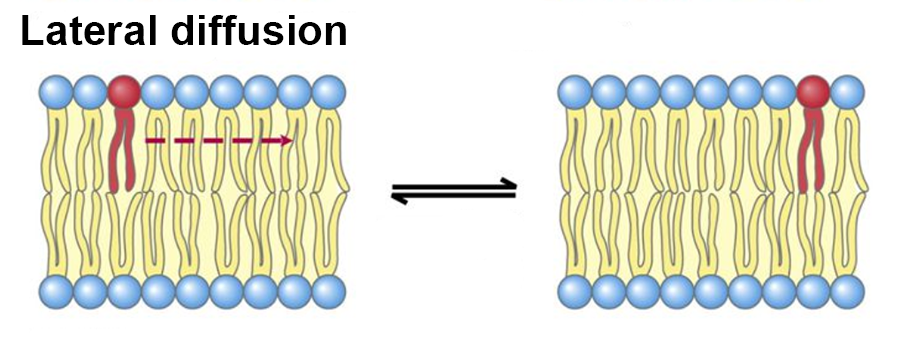 | |
Lateral diffusion within the phospholipid bilayer. Click on image to enlarge
Lipid soluble (hydrophobic) substances, such as cholesterol, incorporate into the membrane. Substances with hydrophilic and hydrophobic properties, such as proteins, can be tethered part in and part out of the membrane.
Membrane proteins
Membrane proteins have many functions:- Enzymes such as phospholipase which is bound to the inner surface of the bilayer in the cytosol plays a role in signalling
- Transmembrane proteins which span the bilayer and function as receptors, ion channels and transporters
- Transmembrane proteins which which span the bilayer and function as structural support and signalling links with other cells such as integrins and cadherins. These may bind to the cellular cytoskeleton and extracellular matrix.
- Spectrin is a protein which binds to the inner layer and forms a cytoskeleton framework.
- G proteins (see below)
G proteins have multiple functions acting as signalling molecules, responding to chemical mediators such as hormones or neurotransmitters and are involved in the regulation of many cell functions.
G protein-coupled receptors (GPCRs) are cell surface receptors that detect molecules outside the cell and activate cellular responses. They are coupled with G proteins
G proteins can be thought of as molecular switches. G protein activity is regulated by GTP, which they bind and hydrolyse to GDP. When they are bound to GTP they are 'on' when they are bound to GDP they are 'off'. G proteins may actiavte or inhibit other proteins.
Transport through the membrane
Lipid soluble molecules such as O2, CO2 and small molecules like H2O and urea can readily pass through the bilayer.Large molecules like glucose or charged molecules like ions cannot pass through the bilayer easily and they typically require transporters or ion channels to move across the bilayer. In some cases proteins may be packaged in vesicles and transported via endocytosis.