Varicella zoster
Chickenpox is caused by primary infection with varicella zoster virus (VZV and is also known as human herpes virus 3 or HHV3). Shingles is reactivation of dormant virus in dorsal root ganglion
Clinical features
Management
Clinically shingles typically presents with signs of nerve irritation (patients may describe this as burning, itching or paraesthesia) for several days before eruption of the shingles rash within the dermatomal distribution of the affected nerve. The patient may feel unwell with malaise, myalgia, headache and fever prior to the rash presenting.
The rash typically appears as erythema with small vesicles. New vesicle clusters may keep forming for up to 7 days. Vesicles will usually dry out and crust over within 10 days of their appearance. Resolution usually takes 2-3 weeks.
Management
The majority of patients with shingles are not seriously ill but the clinician should admit or seek urgent specialist advise for patients with shingles who have the following:
For most patients management will consist of:
Prescribe an oral antiviral treatment within 72 hours of rash onset for people with any of the following criteria:
If it is not possible to initiate treatment within 72 hours, consider starting antiviral treatment up to one week after rash onset, especially if the person is at higher risk of severe shingles or complications.
For immunocompetent children with shingles, antiviral treatment is not usually recommended.
Chickenpox infection
- Highly infectious
- Spread via droplets primarily via the respiratory route
- Can be caught from someone with shingles
- Infectivity = 4 days before rash, until 5 days after the rash first appeared*
- incubation period = 10-21 days
Varicella Key Points
- The incubation period is 7 - 23 days (mean time is 14 days).
- Primary infection typically occurs in 4-10 year olds
- Diagnosis is usually clinical
- After primary infection virus lies dormant in posterior root ganglion and reactivates in 20% of patients causing shingles
Clinical features
- Typically mild & self limiting
- Symptoms tend to be more severe in older children/adults
- Fever initially
- Itchy, rash starting on head/trunk before spreading. Initially macular then papular then vesicular
- Systemic upset is usually mild
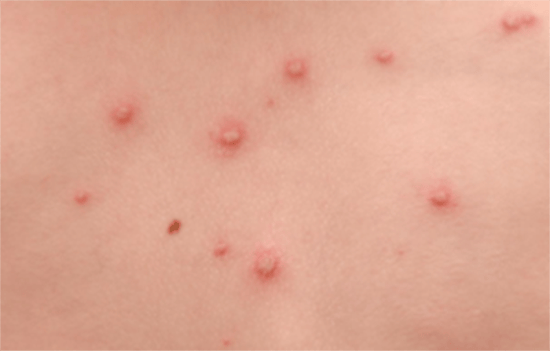 | |
Chickenpox rash. Vesicles visible
Management
- Typically supportive
- keep cool, trim nails
- Calamine lotion
- School exclusion: People with chickenpox should avoid contact with other people for at least 5 days from the onset of the rash and until all blisters have crusted over
- Immunocompromised patients and newborns with peripartum exposure should receive varicella zoster immunoglobulin (VZIG). If chickenpox develops then IV aciclovir should be considered
Who should get aciclovir?
Consider prescribing oral aciclovir 800 mg 5 times a day for 7 days for an immunocompetent, non-pregnant adult or adolescent (aged 14 years or older) with chickenpox who presents within 24 hours of rash onset, particularly for people with severe chickenpox or those at increased risk of complications, such as smokers.
Aciclovir may be prescribed to pregnant patients but is off-license.
Who should not get aciclovir?
Aciclovir is not recommended for otherwise healthy children with uncomplicated chickenpox.
Complications
Common:- Secondary bacterial infection of the lesions.
- pneumonia
- encephalitis (cerebellar involvement may be seen)
- disseminated haemorrhagic chickenpox
- arthritis, nephritis and pancreatitis may very rarely be seen
 | |
| © Image used on license from Radiopaedia | |
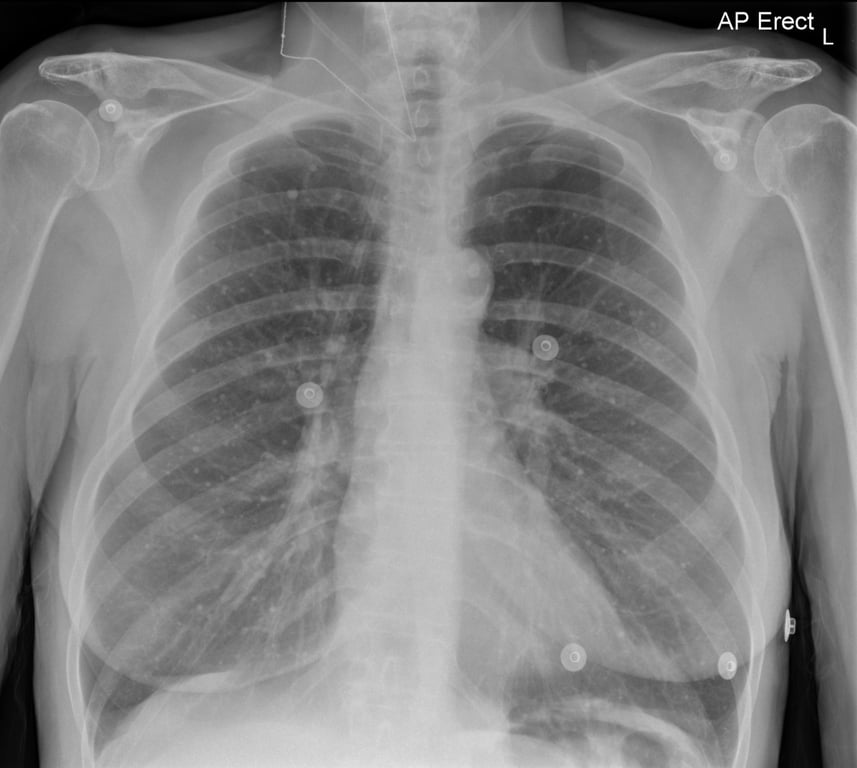
Chest x-ray showing miliary opacities secondary to healed varicella pneumonia. Multiple tiny calcific miliary opacities noted throughout both lungs. These are of uniform size and density suggesting calcification. There is no focal lung parenchymal mass or cavitating lesion seen.The appearances are characteristic for healed varicella pneumonia.
Shingles
Following primary infection with varicella zoster (Chickenpox) the virus remains dormant in the geniculate, trigeminal or dorsal root ganglia of the nervous system. Reactivation of the virus, often in response to a decline in immune function, results in the virus travelling down the affected nerve and producing shingles.Clinically shingles typically presents with signs of nerve irritation (patients may describe this as burning, itching or paraesthesia) for several days before eruption of the shingles rash within the dermatomal distribution of the affected nerve. The patient may feel unwell with malaise, myalgia, headache and fever prior to the rash presenting.
The rash typically appears as erythema with small vesicles. New vesicle clusters may keep forming for up to 7 days. Vesicles will usually dry out and crust over within 10 days of their appearance. Resolution usually takes 2-3 weeks.
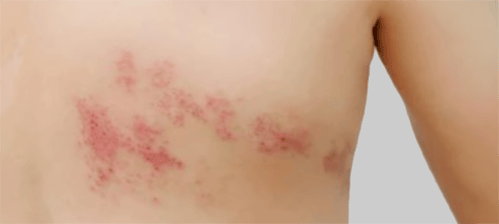 | |
Shingles in a thoracic dermatome distribution. Note the shingles rash does not cross the midline Click on image to enlarge
In immunocompetent patients, the most frequent site of reactivation is the thoracic nerves followed by the ophthalmic division of the trigeminal nerve (ophthalmic shingles).
Shingles affecting the facial nerve (CN VII) is referred to as Ramsay Hunt syndrome.
Shingles affecting the facial nerve (CN VII) is referred to as Ramsay Hunt syndrome.
Management
The majority of patients with shingles are not seriously ill but the clinician should admit or seek urgent specialist advise for patients with shingles who have the following:
- Suspected serious complications such as meningitis, encephalitis, or myelitis
- Ophthalmic shingles
- Patient is severely immunocompromised
- Immunocompromised patient who is systemically unwell or severe/widespread rash
- New vesicles are forming after 7 days of antiviral treatment, or healing is delayed.
- Pregnant or breastfeeding woman
For most patients management will consist of:
- Keep vesicles covered & dry to prevent secondary bacterial infection
- Advise people may catch chickenpox from exposure to vesicle fluid if not already immune
- Pain relief: initially paracetamol alone or in combination with codeine or NSAID. Neuropathic painkillers such as amitriptyline should be considered if above ineffective or pain severe.
- Consider antiviral treatment (see box below) with aciclovir, valaciclovir or famciclovir
- Steroids may be used in the first 2 weeks following rash onset in immunocompetent adults with localized shingles if pain is severe, but only in combination with antiviral treatment.
When to prescribe antivirals in shingles
Prescribe an oral antiviral treatment within 72 hours of rash onset for people with any of the following criteria:
- Immunocompromise (if severe immuncompromise may require admission).
- Non-truncal involvement (such as shingles affecting the neck, limbs, or perineum).
- Moderate or severe pain.
- Moderate or severe rash.
- Over 50 years of age to reduce the incidence of post-herpetic neuralgia
If it is not possible to initiate treatment within 72 hours, consider starting antiviral treatment up to one week after rash onset, especially if the person is at higher risk of severe shingles or complications.
For immunocompetent children with shingles, antiviral treatment is not usually recommended.