Synaptic transmission
Action potentials are transmitted between nerve cells (neurones) by the release of neurotransmitters which cross the synapse between neurones.
Nerve axons terminate as a bulbous swelling called a bouton or end bulb. The bouton of the terminating nerve axon is separated from an adjacent cell by the synaptic cleft. Postganglionic neurones typically have multiple branches, or varicosities, with multiple boutons.
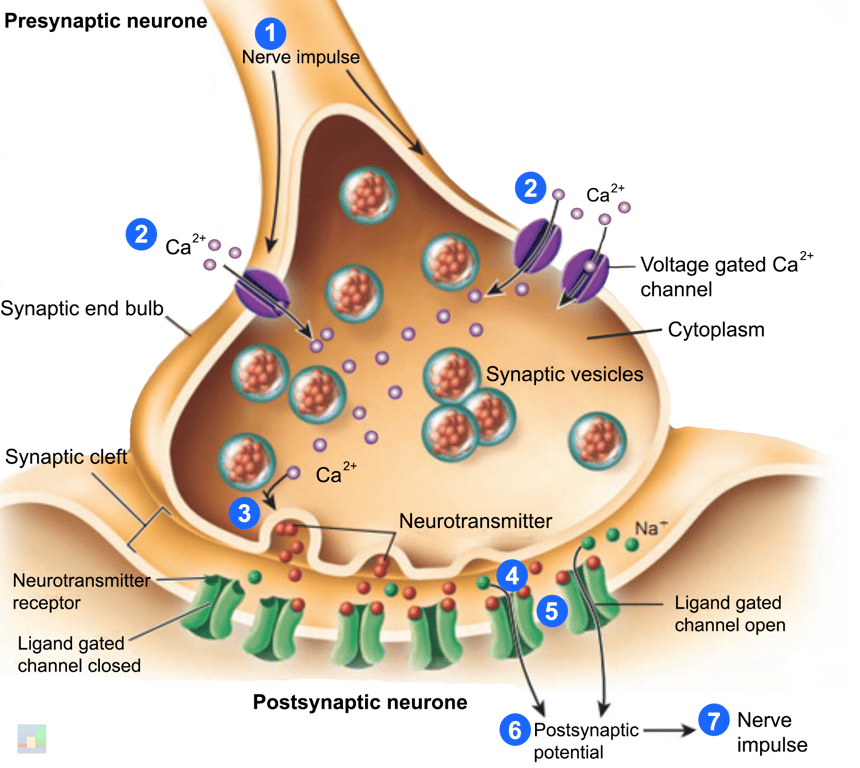
Enzymes at the end bulb synthesise the neurotransmitters acetylcholine and noradrenaline which are stored in vesicles. When an action potential reaches the nerve ending it causes opening of voltage gated calcium channels which allow an influx of Ca2+.
Calcium promotes neurotransmitter vesicle fusion with the membrane and neurotransmitter release into the synaptic cleft. The neurotransmitter crosses the synaptic cleft and binds to receptors on the postsynaptic membrane which activates the response in the postsynaptic neurone.
Neurotransmitters are removed at the end of activation. In cholinergic synapses acetylcholine is broken down by cholinesterases. In adrenergic synapses noradrenaline is cleared via a number of mechanisms:
Nerve axons terminate as a bulbous swelling called a bouton or end bulb. The bouton of the terminating nerve axon is separated from an adjacent cell by the synaptic cleft. Postganglionic neurones typically have multiple branches, or varicosities, with multiple boutons.
The synaptic cleft is a narrow gap typically measuring 10-20 nm
Vesicles measure approximately 50 nm
Vesicles measure approximately 50 nm
Enzymes at the end bulb synthesise the neurotransmitters acetylcholine and noradrenaline which are stored in vesicles. When an action potential reaches the nerve ending it causes opening of voltage gated calcium channels which allow an influx of Ca2+.
Calcium promotes neurotransmitter vesicle fusion with the membrane and neurotransmitter release into the synaptic cleft. The neurotransmitter crosses the synaptic cleft and binds to receptors on the postsynaptic membrane which activates the response in the postsynaptic neurone.
 | |
click on image to enlarge
Neurotransmitter release may be suppressed by stimulation of presynaptic inhibitory receptors e.g. α2 receptors in adrenergic synapses.
Neurotransmitters are removed at the end of activation. In cholinergic synapses acetylcholine is broken down by cholinesterases. In adrenergic synapses noradrenaline is cleared via a number of mechanisms:
- Active uptake of noradrenaline into neurones via uptake-1
- Facilitated diffusion into smooth muscle via uptake 2
- Metabolism in the neurone by mitochondrial monoamine oxidase (MAO)
- Catabolism in the circulation by catechol-O-methyl transferase (COMT)
Key Points
- Cholinesterase breaks down acetylcholine.
- MAO and COMT break down noradrenaline.
- Calcium causes neurotransmitter vesicles to fuse with the presynaptic cell, releasing the neurotransmitter into the synapse.