Wall tension
On this page
Tube structures such as the alveoli of the respiratory system and vessels of the cardiovascular systems maintain a balance of transmural pressure (pressure difference across their walls that typically expand the tube) and surface or wall tension (a contractile force that restricts expansion) to maintain patency whilst avoiding overstretching.
When transmural pressure increases the tube stretches increasing wall tension.
The relationship between wall tension, (transmural) pressure and radius is described using the law of Laplace that states that the wall tension of a hollow sphere or cylinder is proportional to both the pressure of its contents and its radius.
This is relevant in cardiomyopathy as the radius of the ventricle increases, wall tension or wall thickness must increase to maintain ventricular pressure.
It is also relevant in the lung as alveoli would see a large increase in pressure as the radius of the alveoli decreases (such as happens during expiration). Small alveoli would eventually collapse if it were not for the presence of surfactant which reduces surface tension. Surfactant becomes more concentrated as the alveoli shrink & therefore decreases surface tension more strongly the smaller the alveoli become.
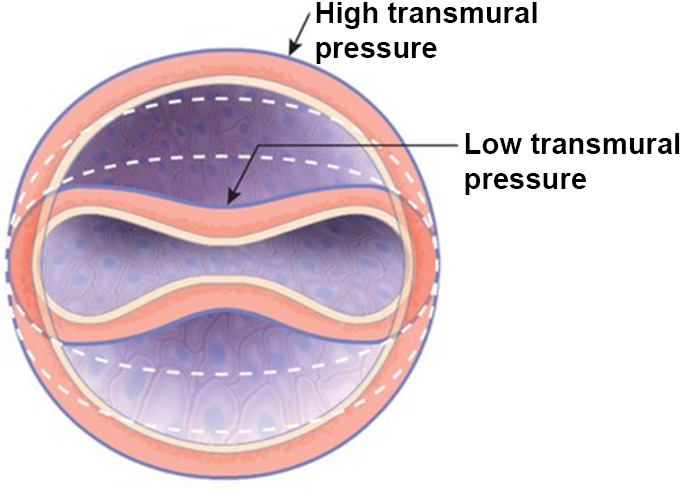 | |
High transmural pressure stretching vessel and low transmural pressure resulting in a flaccid vessel wall. click on image to enlarge
When transmural pressure increases the tube stretches increasing wall tension.
The relationship between wall tension, (transmural) pressure and radius is described using the law of Laplace that states that the wall tension of a hollow sphere or cylinder is proportional to both the pressure of its contents and its radius.
Pressure = (Tension x Wall thickness) ÷ Radius
It may be written as either of the below:
P = Tw / r or
where T = wall tension, w = wall thickness and r = radius
It may be written as either of the below:
P = Tw / r or
T = Pr / w
where T = wall tension, w = wall thickness and r = radius
This is relevant in cardiomyopathy as the radius of the ventricle increases, wall tension or wall thickness must increase to maintain ventricular pressure.
It is also relevant in the lung as alveoli would see a large increase in pressure as the radius of the alveoli decreases (such as happens during expiration). Small alveoli would eventually collapse if it were not for the presence of surfactant which reduces surface tension. Surfactant becomes more concentrated as the alveoli shrink & therefore decreases surface tension more strongly the smaller the alveoli become.
Key points
- Transmural pressure is directly proportional to wall tension
- Transmural pressure is directly proportional to wall thickness
- Transmural pressure is inversely proportional to radius
- Wall tension is directly proportional to radius
- Wall tension is inversely proportional to wall thickness