Skeletal muscle: motor units
Muscle fibres do not usually contract individually. Several muscle fibres contract simultaneously as they are innervated by the same α motor neurone.
The motor unit is the smallest part of a muscle that can contract independently of other regions of the muscle. The number of muscle fibres innervated by a one motor neurone is highly variable and may number anywhere from 5-2000. The number of muscle fibres within a motor unit is a function of the muscle's ability for accurate and refined motion. Precision is inversely proportional to the size of the motor unit e.g. large muscles that generate powerful but course movement such as the quadriceps will have >1000 fibres per motor neurone whereas precision small muscles such as the extra-ocular muscles will typically have <10 fibres per motor neurone.
Muscle fibres of each motor unit are distributed amongst fibres of other motor units which distributes the oxygen demand of the muscle.
When a motor neurone is activated, all of the muscle fibres innervated by the motor neurone are stimulated and contract. The activation of a single motor neurone will typically result in a weak but distributed muscle contraction.
Activation of additional motor units will result in more muscle fibres being activated, and therefore a stronger muscle contraction. Motor unit recruitment is a measure of how many motor neurones are activated and therefore how many muscle fibres of a muscle are stimulated to contract.
There is an order of recruitment based on the size of the neurone cell bodies. Motor units are generally recruited in order of smallest to largest i.e. smallest motor neurones recruited first to largest motor neurones recruited last.
As contraction force increases, slow twitch fibres are recruited first followed by fast twitch. This is known as Henneman's size principle (or simply the size principle).
The single motor neurone and all the muscle fibres it supplies are termed the motor unit
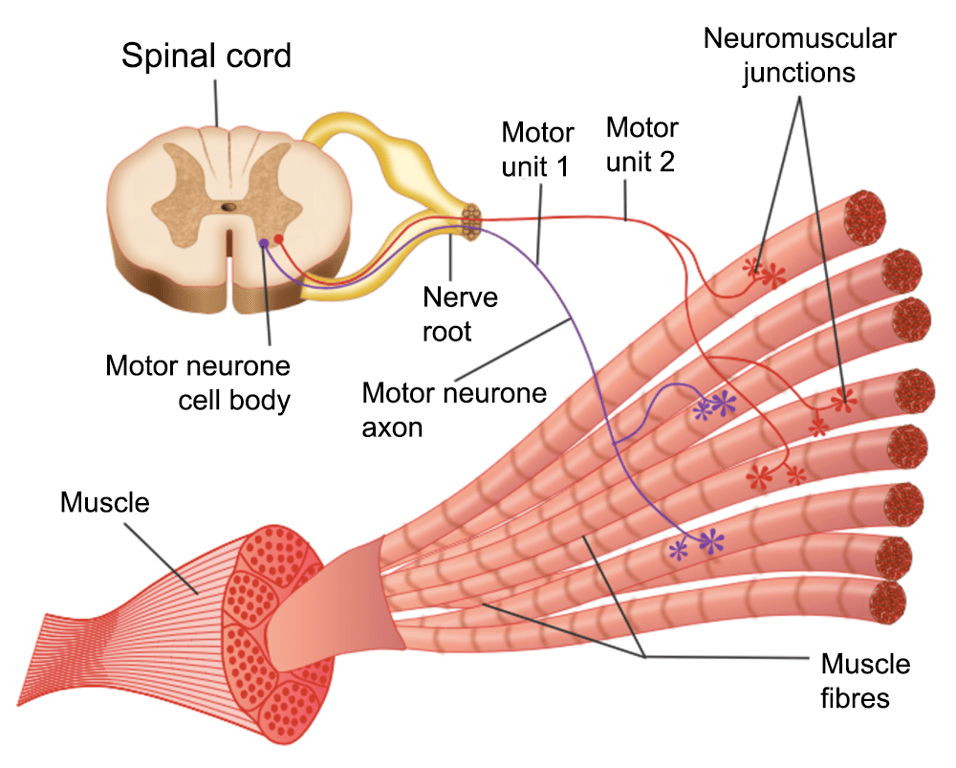 | |
Image showing two motor units (one in blue and one in red). Demonstrating how different motor units have different neurones but their axons travel in the same nerve and innervate the same muscle albeit differing fibres within that muscle. click on image to enlarge
The motor unit is the smallest part of a muscle that can contract independently of other regions of the muscle. The number of muscle fibres innervated by a one motor neurone is highly variable and may number anywhere from 5-2000. The number of muscle fibres within a motor unit is a function of the muscle's ability for accurate and refined motion. Precision is inversely proportional to the size of the motor unit e.g. large muscles that generate powerful but course movement such as the quadriceps will have >1000 fibres per motor neurone whereas precision small muscles such as the extra-ocular muscles will typically have <10 fibres per motor neurone.
Muscle fibres of each motor unit are distributed amongst fibres of other motor units which distributes the oxygen demand of the muscle.
Motor Unit Recruitment
The required force generated by muscle contraction can be variable. When there is an increase in contractile force requirements additional motor units may be recruited to provide additional contractile force.When a motor neurone is activated, all of the muscle fibres innervated by the motor neurone are stimulated and contract. The activation of a single motor neurone will typically result in a weak but distributed muscle contraction.
Activation of additional motor units will result in more muscle fibres being activated, and therefore a stronger muscle contraction. Motor unit recruitment is a measure of how many motor neurones are activated and therefore how many muscle fibres of a muscle are stimulated to contract.
The higher the recruitment the stronger the muscle contraction will be
There is an order of recruitment based on the size of the neurone cell bodies. Motor units are generally recruited in order of smallest to largest i.e. smallest motor neurones recruited first to largest motor neurones recruited last.
There are 3 basic types of motor unit:
Type I cells are sometimes referred to as 'slow twitch' whilst type 2 are sometimes referred to as 'fast twitch'.
- Type IA, slow resistant motor unit, smallest neurone cell bodies.
- Type IIA, fast resistant motor unit.
- Tyoe IIB, fast fatiguable motor unit, largest neurone cell cells.
Type I cells are sometimes referred to as 'slow twitch' whilst type 2 are sometimes referred to as 'fast twitch'.
As contraction force increases, slow twitch fibres are recruited first followed by fast twitch. This is known as Henneman's size principle (or simply the size principle).