Insulin physiology
On this page
Insulin
Insulin is a polypeptide hormone produced by the beta cells of the endocrine pancreas. Insulin regulates the absorption of glucose from the blood into liver, fat and skeletal muscle cells. Insulin is a key hormone in regulating the metabolism of carbohydrates, fats and protein via its effect on glucose uptake. Insulin is an anabolic hormone.
Insulin is produced by β (beta) cells in the pancreatic islets (islets of Langerhans)
Insulin synthesis & structure
Insulin is synthesised as an inactive precursor molecule called preproinsulin. Preproinsulin is cleaved to remove signalling peptides then folded to form proinsulin with the two ends, called the 'A-chain' and the 'B-chain', becoming fused together with three disulfide bonds. The proinsulin is packaged into secretory vesicles where it undergoes a final series of enzymatic cleavage to remove the central C-protein and two pairs of amino acids that connect each end of the c-peptide to the main insulin molecule. The result is active insulin with the insulin A and B chains now connected with two disulfide bonds.
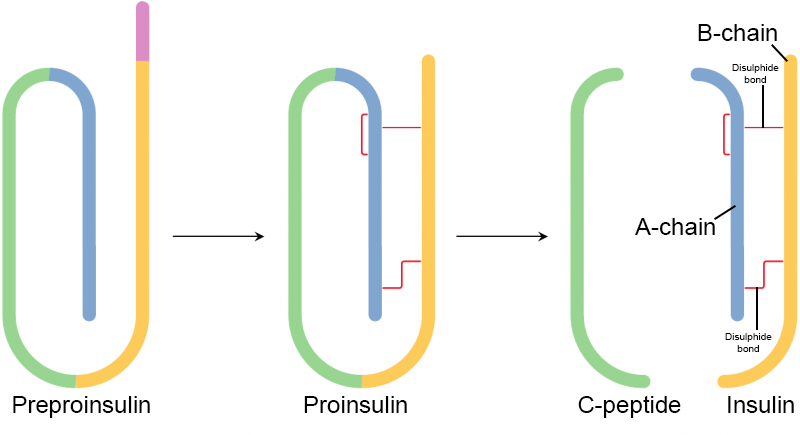 | |
Preproinsulin, proinsulin, insulin and c-peptide. Click on image to enlarge
C-peptide (also known as connecting peptide) is secreted in equimolar amounts to insulin.
It may be used clinically to measure a persons own insulin secretion even if they are receiving exogenous insulin injections as medicinal forms of insulin do not contain C-peptide. In fact C-peptide may be a better measure of insulin production than insulin itself as the liver metabolises a large and variable amount of insulin secreted into the portal vein but does not metabolise C-peptide.
It may be used clinically to measure a persons own insulin secretion even if they are receiving exogenous insulin injections as medicinal forms of insulin do not contain C-peptide. In fact C-peptide may be a better measure of insulin production than insulin itself as the liver metabolises a large and variable amount of insulin secreted into the portal vein but does not metabolise C-peptide.
Insulin release
Insulin release is stimulated initially during eating by the parasympathetic nervous system (via acetylcholine) and hormones such as secretin. The main stimulus for insulin release however is a rise in plasma glucose levels. Insulin secretion is also be stimulated by free fatty acids, ketone bodies and amino acids (especially arginine).
Other substances known to stimulate insulin release include sulfonylurea's, cholecystokinin (CCK), and the gastrointestinally derived incretins e.g. glucagon-like peptide-1 (GLP-1) and glucose-dependent insulinotropic peptide (GIP).
The main stimulus for insulin release is a rise in plasma glucose levels.
Insulin release reduces as plasma glucose concentration falls. Catecholamines acting at beta cell alpha-2-adrenoceptors inhibit insulin release hence high gluocse levels at times of stress. Somatostatin has also been shown to inhibit insulin release.
Note the effect on insulin release due to catecholamine release by the sympathetic nervous system has conflicting influences. Insulin release is inhibited by α2-adrenergic receptors but stimulated by β2-adrenergic receptors. The net effect of norepinephrine (noradrenaline) from sympathetic nerves and epinephrine (adrenalin) from adrenal glands on insulin release is inhibition due to dominance of the α-adrenergic receptors
Insulin effects
Insulin promotes the uptake of glucose and subsequent manufacture of glycogen and triglycerides. It has the following effects:
- Inhibits gluconeogenesis (biosynthesis of glucose from certain non-carbohydrate carbon substrates)
- Inhibits glycogenolysis (breakdown of glycogen to glucose 1-phosphate)
- Stimulates glycolysis (conversion of glucose into pyruvate)
- Stimulates glycogenesis (formation of glycogen utilising glucose)
- Inhibits lipolysis in adipose tissue (lowering plasma fatty acid levels)
- Stimulates lipogenesis (conversion of fatty acids and glycerol into triglycerides(fat). Note fatty acid synthesis starts with acetyl CoA)
- Stimulates the uptake of triglycerides from the blood into adipose tissue and muscle.
- Promotes protein synthesis
- Promotes uptake of K+ ions into cells
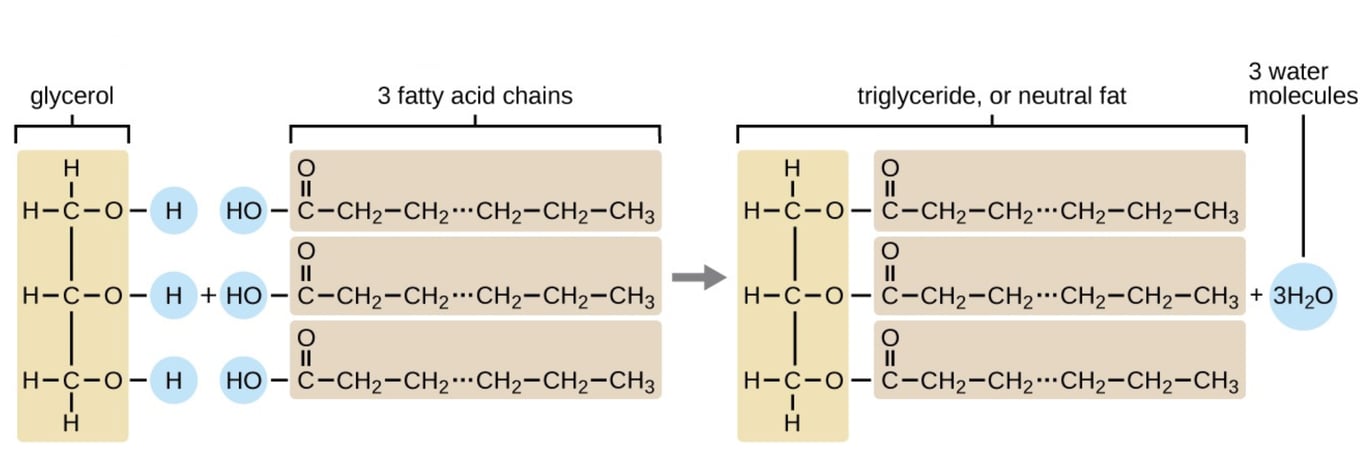 | |
Lipogenesis. Note the fatty acids are first synthesised from acetyl CoA (not shown). Click on image ti enlarge
Insulin & glucose uptake
Insulin exerts its action via binding to insulin receptors. The main target tissues for insulin are skeletal muscle and adipose tissue.
Red blood cells, as well as cells of the brain, kidneys & small intestine do not have insulin receptors on their cell membranes and do not require insulin for glucose uptake.
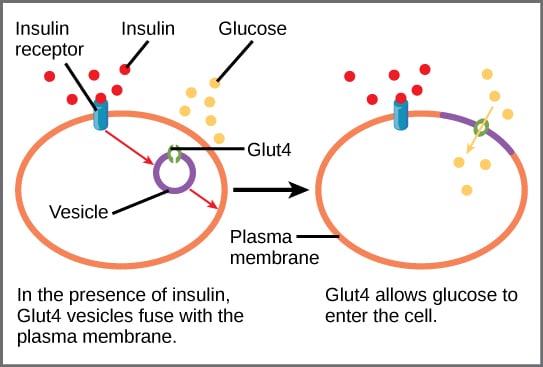
Insulin binds to insulin receptors. The insulin receptor is a transmembrane protein composed of alpha and beta subunits. The beta subunit contains a tyrosine kinase element (i.e. insulin receptors are tyrosine kinase receptors). When activated by insulin the tyrosine kinase element becomes active and undergoes phosphorylation. This activates a cascade of intermediary signalling proteins that ultimately result in translocation of GLUT-4 glucose transporter molecules, and to a lesser extent GLUT-1 transporter molecules, to the cell surface. These transport molecules allow glucose cross the cell membrane by diffusion.
Insulin, GLUT-4 & glucose transport overview
- Glucose needs to be transported across the phospholipid bilayer into the cell so that it can be utilised (either for energy via ATP or stored as glycogen)
- The phospholipid bilayer is virtually impermeable to glucose normally
- Insulin binds to receptors on the cell and induces GLUT4 proteins via tyrosine kinase and intermediary molecules
- These glucose transporter proteins embed into the phospholipid bilayer and act like tunnels through which glucose can pass along its concentration gradient
- This is an example of facilitated diffusion
 | |