Diabetes mellitus
On this page
Definition
Diabetes mellitus (DM) is a group of metabolic disorders in which persistent hyperglycaemia (random plasma glucose more than 11.1 mmol/L) is caused by deficient insulin secretion, resistance to the action of insulin, or bothClassification
- Type 1 diabetes: absolute insulin deficiency typically the result of autoimmune destruction of the pancreatic islet β-cells causes persistent hyperglycaemia.
- Type 2 diabetes: insulin resistance and relative insulin deficiency result in persistent hyperglycaemia.
- Gestational diabetes: hyperglycaemia develops during pregnancy but usually resolves postpartum.
- Other specific types of diabetes include monogenic diabetes, diabetes secondary to pancreatic disease e.g. pancreatitis, malignancy, trauma, cystic fibrosis, or haemochromatosis, diabetes secondary to endocrine disorders e.g. acromegaly, Cushing's syndrome, hyperthyroidism, or phaeochromocytoma & diabetes secondary to drug treatment (usually corticosteroids).
Type 1 diabetes mellitus:
- Accounts for around 5% of DM cases
- Absolute insulin deficiency. GLUT-4 glucose transporters do not incorporate into cell membranes
- Autoimmune destruction of pancreas
- Requires lifelong exogenous insulin
- Accounts for around 95% of DM cases
- Insulin deficiency (but not absolute) and/or insulin resistance
- Advancing age, obesity and genetic predisposition (family history) are major risk factors
Diagnosis
Diagnosis of type 1 diabetes:
Based on clinical grounds in adults presenting with hyperglycaemia (random plasma glucose more than 11 mmol/L).
Adults with type 1 diabetes typically present with one or more of the following:
- Ketosis.
- Rapid weight loss.
- Age of onset younger than 50 years.
- Body mass index (BMI) below 25 kg/m2.
- Personal and/or family history of autoimmune disease.
Suspect type 1 diabetes in a child or young person presenting with hyperglycaemia and the characteristic features of:
- Polyuria.
- Polydipsia.
- Weight loss.
- Excessive tiredness.
Diagnosis of type 2 diabetes:
Suspect a diagnosis of type 2 diabetes in patients with persistent hyperglycaemia that may or may not be accompanied by the following features:
- Polydipsia
- Polyuria
- Blurred vision
- Unexplained weight loss
- Recurrent infections
- Lethargy
- Acanthosis nigricans
- Presence of risk factors
| Persistent hyperglycaemia defining features |
|---|
|
| Patients with persistent hyperglycaemia and clinical features of diabetes can be diagnosed with diabetes Patients with persistent hyperglycaemia but no clinical features should only be diagnosed after repeat testing |
| Risk factors for developing type 2 diabetes mellitus |
|---|
|
Diabetes should not be diagnosed on the basis of a single abnormal HbA1c or plasma glucose result. Repeat testing to confirm the diagnosis is advised.
Note severe hyperglycaemia in people with acute infection, trauma, circulatory or other stress may be transitory and is not diagnostic of diabetes.
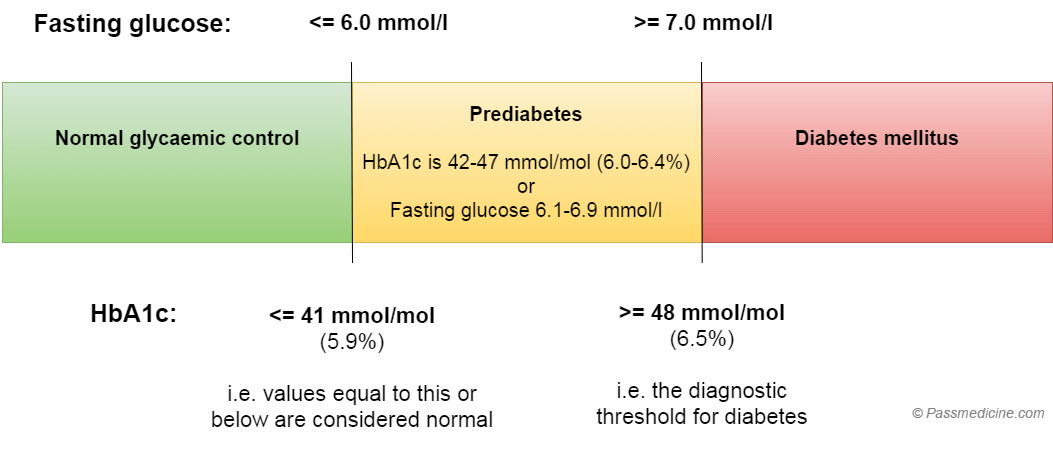 | |
Diagram showing the spectrum of diabetes diagnosis
Complications of diabetes
Acute metabolic osmotic emergencies
- Diabetic ketoacidosis (DKA)
- hyperosmolar hyperglycaemic state (HHS, previously termed HONK)
Ischaemic heart disease
- Angina
- Myocardial infarction
- TIA
- Stroke
- intermittent claudication
- Acutely ischaemic limbs
- distal limb ischaemia e.g. toes
- foot ulcers
Autonomic neuropathy
- Resting tachycardia, postural hypotension, cardiac ischaemia, sudden cardiac death
- Gastroparesis, constipation/diarrhoea, oesophageal dysmotility
- Erectile dysfunction, neuropathic bladder
- cranial neuropathies, entrapment and pressure neuropathies and radiculopathies.
- Sensory dysfunction (typically in glove and stocking distribution)
- Foot ulceration
- Charcot joint's
- Renail impairment (CKD)
- Blindness
Hypoglycaemia
Definition
Hypoglycaemia is a lower than normal blood-glucose concentration. It is defined by NICE as blood glucose <3.5 mmol/L. The RCEM advises a blood glucose level below 4.0 mmol/L in diabetic patients should prompt treatment for hypoglycaemia.True hypoglycaemia is defined by Whipple's triad and requires all three of the following:
- Signs and symptoms of low blood glucose
- A low blood plasma glucose concentration
- Relief of symptoms after correcting low blood glucose
What blood glucose level is hypoglycaemia?
Whilst NICE define hypoglycaemia in their clinical knowledge summary as blood glucose <3.5 mmol/L there is a large degree of inconsistency across the literature. The BNF and CDC for instance use a threshold of ≤ 3.9 mmol/L). Diabetes Uk advise that a blood glucose of 4.0 mmol/L should be the lowest acceptable blood glucose level for people with diabetes. The RCEM echo's diabetes UK and advises glucose levels below 4 mmol/L indicate hypoglycaemia and need treatment.
In children finding a consistent diagnosis is even more challenging. A blood glucose level ≤2.6 mmol/L is widely considered to confirm the diagnosis of hypoglycaemia but readings between 2.6 and 3.5 are often considered borderline.
Whilst NICE define hypoglycaemia in their clinical knowledge summary as blood glucose <3.5 mmol/L there is a large degree of inconsistency across the literature. The BNF and CDC for instance use a threshold of ≤ 3.9 mmol/L). Diabetes Uk advise that a blood glucose of 4.0 mmol/L should be the lowest acceptable blood glucose level for people with diabetes. The RCEM echo's diabetes UK and advises glucose levels below 4 mmol/L indicate hypoglycaemia and need treatment.
In diabetic patients glucose levels below 4 mmol/L indicate hypoglycaemia and need treatment.
In children finding a consistent diagnosis is even more challenging. A blood glucose level ≤2.6 mmol/L is widely considered to confirm the diagnosis of hypoglycaemia but readings between 2.6 and 3.5 are often considered borderline.
Hypoglycaemia
Hypoglycaemia most commonly occurs in diabetic patients. It may lead to brain damage or death so requires prompt treatment.
Hypoglycaemia most commonly occurs in diabetic patients. It may lead to brain damage or death so requires prompt treatment.
Signs & symptoms
| Adrenergic or autonomic | Neuroglycopenic | Non-specific |
|---|---|---|
| Sweating | Confusion | Hunger |
| Hunger | Coma | Headache |
| Tremor or shaking | Convulsions | Nausea |
| Hunger | Focal neurological deficits | |
| Nausea | Speech difficulties | |
| Pallor | Incoordination | |
| Tachycardia | Unusual behaviour including aggression |
Treatment options in adults
If able to take oral medication:
- Oral carbohydrate: 15-20g of a quick acting carbohydrate should be followed by a long acting carbohydrate. Soft drinks such as Lucozade may be used but the carbohydrate content should be checked carefully.
- Buccal Glucose Gel: Absorbed more quickly than complex carbohydrates and is easily administered. The patient should be able to swallow in order for it to be fully effective.
- Glucagon: Glucagon 1 mg IV, IM or SC. Useful in situations where behaviour, co-operation or other neuroglycopenic symptoms make oral or IV routes difficult. Repeated doses are not advised. Glucagon will be less effective in those with depleted glycogen reserves e.g. sulphonylurea treatment, malnourished, or excessive alcohol consumption.
- Dextrose: 10-20% dextrose (glucose) may be used. Typical doses are 75-80 ml 20% glucose or 150-160 ml of 10% glucose. 50% dextrose is highly irritant and risks extravasation injury.
Glucose levels should be re-checked 15 minutes after treatment. Treatment may be repeated following 10-15 minutes.
Treatment options in children
If able to take oral medication:- Glucose 5-20 g in liquid form (Glucogelµ, Dextrogelµ, or Rapiloseµ) or granulated sugar or sugar lumps. May be repeated after 10-15 minutes if required. Patient should be fed to prevent recurrence of hypoglycaemia.
- Glucagon (if child aged < 8, body weight < 25 kg dose is 500 microgram)
- If not effective in 10 minutes give IV glucose
- 2 mL/kg of 10% glucose IV as bolus followed by 10% glucose IV infusion at a rate of 5 mL/kg/hour
- Carbohydrates should be given as soon as possible after treatment
Glucose gel dose
The dose of 40% glucose gel is approximately 0.3 g/kg. Each 25g tube contains 10g of carbohydrate. The table below shows the number of tubes of glucose gel to use based on weight:
The bnf also suggests dosing by age as follows (keep in mind that children who weigh over 60kg should receive adult dose i.e. 20g / 2 tubes):
The dose of 40% glucose gel is approximately 0.3 g/kg. Each 25g tube contains 10g of carbohydrate. The table below shows the number of tubes of glucose gel to use based on weight:
| Weight up to | Dose in number of tubes |
|---|---|
| 20 kg | ½ tube |
| 30 kg | 1 tube |
| 40 kg | 1½ tubes |
| 50 kg | 1½ tubes |
| 60 kg | 2 tubes |
The bnf also suggests dosing by age as follows (keep in mind that children who weigh over 60kg should receive adult dose i.e. 20g / 2 tubes):
| Age | Dose |
|---|---|
| Children <5 | 5g or ½ tube |
| Child 5-11 years old | 10g or 1 tube |
| Child 12-17 years old | 15g or 1½ tubes |
Treatment of neonatal hypoglycaemia
- Treat with glucose IV infusion 10% given at a rate of 5 mL/kg/hour.
- An initial stat dose of 2 mL/kg over five minutes may be required if hypoglycaemia is severe enough to cause loss of consciousness or fitting.
- Mild asymptomatic persistent hypoglycaemia may respond to a single dose of glucagon.
If hypoglycaemia is caused by an oral anti-diabetic drug the patient should be admitted as the hypoglycaemic effects of these drugs may persist for 12-24 hours and ongoing glucose infusion or other therapies such as octreotide may be required
Patients who have a hypoglycaemic episode with a loss of warning symptoms should not drive. It is the doctor's duty to inform the patient of this and to explain their responsibility to notify the DVLA. This should be documented in the patient notes and wherever possible, written advice should be provided and the patient's GP informed.