Endocrine pancreas
The pancreas has both exocrine (digestive) and endocrine (hormonal) functions. The majority of pancreatic tissue (>95%) is dedicated to performing exocrine functions. The endocrine (hormone-producing) cells of the pancreas typically make up around 2% of the pancreas by weight but receive around 10-15% of blood flow. Humans typically have around 1 million islet cells.
The cells composing the endocrine portion of the pancreas are arranged in clusters known as pancreatic islets (also known as islets of Langerhans) and consist of the following cell types:
Insulin and glucagon
Insulin and glucagon play key roles in the regulation of blood glucose.
Beta cells are the insulin production units and typically located centrally within islets. Beta cells make up the majority of islets accounting for around 75% of each islet. Insulin is a peptide hormone secreted in response to a rise in plasma glucose levels. Insulin functions to regulate glucose movement from the blood into cells. It also has a number of other roles, including regulation of gluconeogenesis, glycolysis, lipolysis and lipogenesis.
Alpha cells are the production inits of glucagon. Alpha cells account for around 20% of islet cells. Glucagon is an antagonistic peptide hormone to insulin i.e. it acts to raise blood glucose levels. It also opposes the actions of insulin in regulating gluconeogenesis, glycolysis, lipolysis and lipogenesis.
Somatostatin, pancreatic polypeptide & ghrelin
The delta cell accounts for around 4% of islet cells and secretes the peptide hormone somatostatin. Somatostatin is also released by the hypothalamus and from the stomach and intestines. Somatostatin inhibits the release of both glucagon and insulin.
The PP cell (F cell) accounts for about 1% of islet cells and secretes pancreatic polypeptide hormone. It is thought to play a role in appetite, as well as in the regulation of pancreatic exocrine and endocrine secretions. Pancreatic polypeptide released following a meal may reduce further food consumption; however, it is also released in response to fasting.
Epsilon cells account for <1% of islet cells. Ghrelin is thought to induce hunger. Ghrelin levels rise during fasting and drop following food intake.
The cells composing the endocrine portion of the pancreas are arranged in clusters known as pancreatic islets (also known as islets of Langerhans) and consist of the following cell types:
| Cell type | Hormone produced |
|---|---|
| Alpha cells | Glucagon |
| Beta cells | Insulin |
| PP cells (gamma cells or F cells) | Pancreatic polypeptide |
| Delta cells | Somatostatin |
| Epsilon cells | Ghrelin |
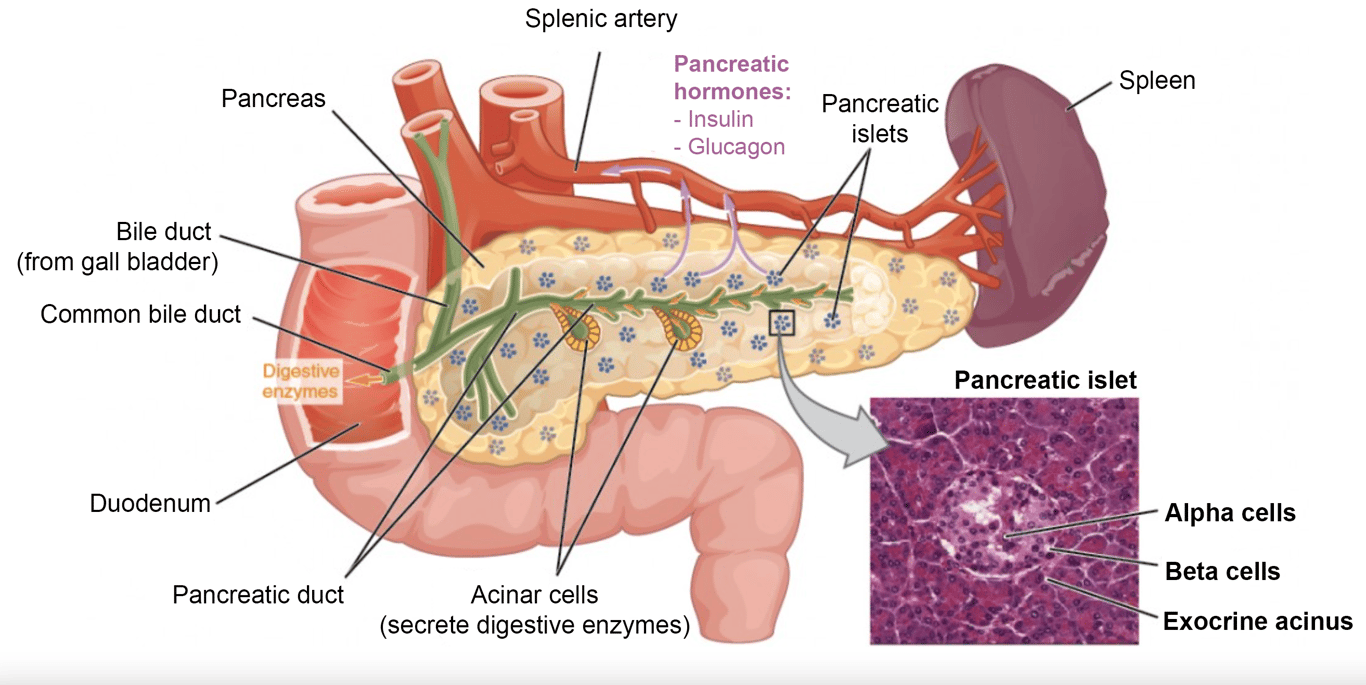 | |
Pancreas structure. Click on image to enlarge
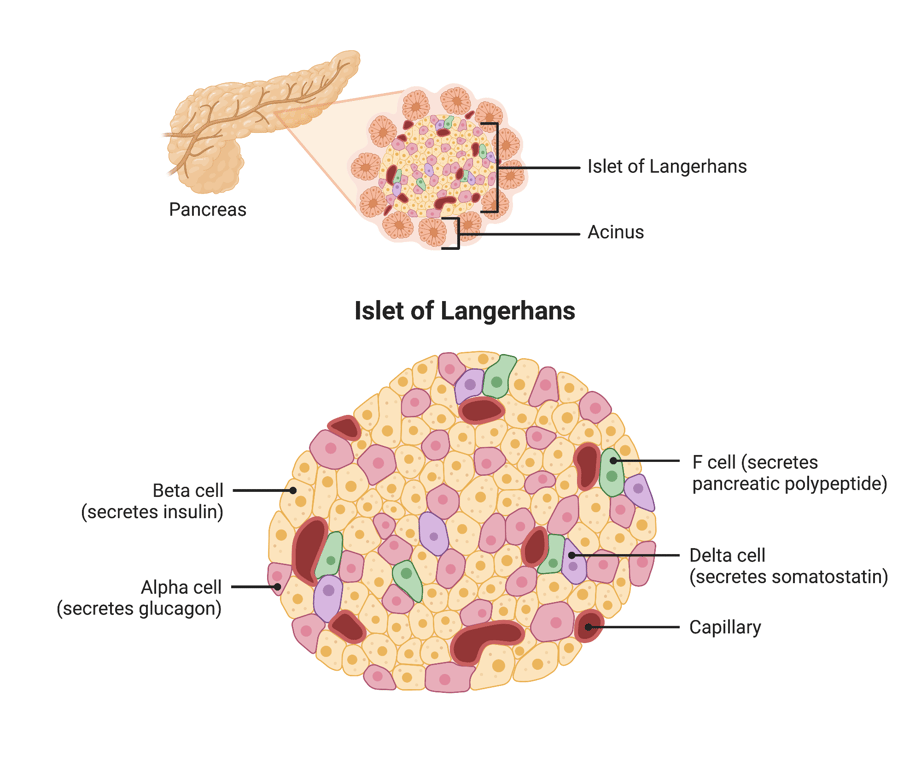 | |
Pancreatic islet structure. Click on image to enlarge
Insulin and glucagon
Insulin and glucagon play key roles in the regulation of blood glucose.
The RCEM consider normal blood glucose range 3.5 - 5 mmol/L
Beta cells are the insulin production units and typically located centrally within islets. Beta cells make up the majority of islets accounting for around 75% of each islet. Insulin is a peptide hormone secreted in response to a rise in plasma glucose levels. Insulin functions to regulate glucose movement from the blood into cells. It also has a number of other roles, including regulation of gluconeogenesis, glycolysis, lipolysis and lipogenesis.
Alpha cells are the production inits of glucagon. Alpha cells account for around 20% of islet cells. Glucagon is an antagonistic peptide hormone to insulin i.e. it acts to raise blood glucose levels. It also opposes the actions of insulin in regulating gluconeogenesis, glycolysis, lipolysis and lipogenesis.
Somatostatin, pancreatic polypeptide & ghrelin
The delta cell accounts for around 4% of islet cells and secretes the peptide hormone somatostatin. Somatostatin is also released by the hypothalamus and from the stomach and intestines. Somatostatin inhibits the release of both glucagon and insulin.
The PP cell (F cell) accounts for about 1% of islet cells and secretes pancreatic polypeptide hormone. It is thought to play a role in appetite, as well as in the regulation of pancreatic exocrine and endocrine secretions. Pancreatic polypeptide released following a meal may reduce further food consumption; however, it is also released in response to fasting.
Epsilon cells account for <1% of islet cells. Ghrelin is thought to induce hunger. Ghrelin levels rise during fasting and drop following food intake.