Syndrome of inappropriate antidiuretic hormone secretion (SIADH)
On this page
Definition
Syndrome of inappropriate antidiuretic hormone (SIADH) secretion is defined as euvolaemic, hypotonic hyponatraemia secondary to impaired free water excretion typically as a result of excessive antidiuretic hormone secretion.Excess ADH may be secreted from the posterior pituitary gland or an abnormal non-pituitary source.
Diagnostic features:
- Low plasma sodium concentration (<135 mmol/l)
- Low serum osmolality (<275 mOsm/kg)
- High urine osmolality (>100 mOsm/kg & greater than plasma osmolarity)
- Euvolaemia
- High urine sodium (>30 mmol/L)
- No other cause for hyponatraemia (diuretic use, hypothyroidism, cortisol deficiency, hyperproteinaemia, hyperlipidaemia or hyperglycaemia).
Antidiuretic hormone (ADH) is also known as arginine vasopressin (AVP). It is synthesised in the hypothalamus and secreted from the posterior pituitary. It promotes water and sodium resorption.
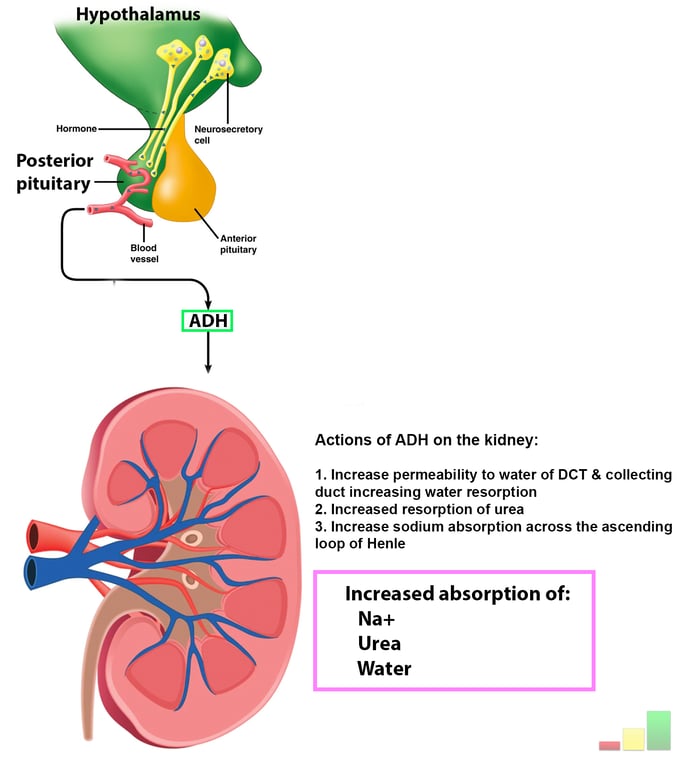 | |
As the name suggests the primary action of antidiuretic hormone is to prevent diuresis. It achieves this by increasing sodium and water resorption. Click on image to enlarge
Causes of SIADH
| Category | Examples |
|---|---|
| Malignancy |
|
| Neurological |
|
| Infections |
|
| Drugs |
|
| Respiratory |
|
| Other causes |
|
*the BNF states this has been reported with glimepiride and glipizide.
Diagnostic features summary
- Hyponatraemia.
- Low plasma osmolality
- Inappropriately elevated urine osmolality (>100 mOsmol/kg commonly and > plasma osmolarity)
- Urinary sodium >30 mmol/L
- Euvolaemia.
- Normal thyroid and adrenal function.
Signs & symptoms of hyponatraemia
- Nausea and vomiting.
- Headache.
- Confusion.
- Lethargy and fatigue.
- Restlessness and irritability.
- Muscle weakness, spasms or cramps.
- Drowsniess
- Seizures.
- Coma.
Management
- Correct hyponatreamia slowly to avoid precipitating central pontine myelinolysis
- Treat underlying cause where possible e.g. stop causative drugs
- Fluid restriction (typically 1000 ml/day for adults)
- Intravenous hypertonic saline (3% sodium chloride solution) is typically used in patients with neurological symptoms.
- Demeclocycline: blocks ADH receptors & reduces responsiveness of the collecting tubule cells to ADH
- ADH receptor antagonists (AKA vaptans or vasopressin receptor antagonists) such as tolvaptan are an option but have limited availability
Central pontine myelinolysis (osmotic demyelination syndrome) may occur with rapid correction of serum sodium in excess of 12 mmol/L/day.
If using hypertonic saline the serum sodium levels must be checked every 2 hours. The goal is to increase serum sodium slowly by up to 1 mmol/L/hour to a maximum of 10-12 mmol/L/day until neurological symptoms resolve.
If using hypertonic saline the serum sodium levels must be checked every 2 hours. The goal is to increase serum sodium slowly by up to 1 mmol/L/hour to a maximum of 10-12 mmol/L/day until neurological symptoms resolve.
Osmolality abnormalities & underlying causes
| Serum osmolality | Urine osmolality | Causes |
|---|---|---|
| Normal or increased | Increased | Dehydration Renal disease and uraemia Congestive heart failure Addison's disease Hypercalcaemia Diabetes mellitus/hyperglycaemia Hypernatraemia Alcohol ingestion Mannitol therapy |
| Normal or increased | Decreased | Diabetes insipidus |
| Decreased | Increased | SIADH |
| Decreased | Decreased (with no increase in fluid intake) | Overhydration Hyponatraemia Adrenocortical insufficiency Sodium loss (diuretic or a low-salt diet) |