Glucagon physiology
Glucagon, the hormonal antagonist to insulin, is released from the alpha cells of the Islets of Langerhans in the pancreas. It results in increased plasma glucose levels.
Glucagon release patterns typically mirror those of insulin. Hypoglycaemia is the main stimulant of glucagon release. Hypoglyacemia also triggers neural and adrenal release of catecholamines which activate β adrenoreceptors on α cells to augment glucagon release.
Glucagon acts on guanosine triphosphate binding protein (G-protein)-coupled receptors that stimulate the production of cyclic adenosine monophosphate (cAMP). In hepatocytes this causes inhibition of glycogen synthesis and activation of glycogen breakdown systems (glycogenolysis). Similar effects also occur in myocytes.
It should be noted that insulin inhibits glucagon release from α cells whereas glucagon stimulates the release of insulin from β cells. This ensures there is a basal level of insulin release regardless of blood glucose level.
Glucagon Summary
Glucagon release patterns typically mirror those of insulin. Hypoglycaemia is the main stimulant of glucagon release. Hypoglyacemia also triggers neural and adrenal release of catecholamines which activate β adrenoreceptors on α cells to augment glucagon release.
Glucagon acts on guanosine triphosphate binding protein (G-protein)-coupled receptors that stimulate the production of cyclic adenosine monophosphate (cAMP). In hepatocytes this causes inhibition of glycogen synthesis and activation of glycogen breakdown systems (glycogenolysis). Similar effects also occur in myocytes.
It should be noted that insulin inhibits glucagon release from α cells whereas glucagon stimulates the release of insulin from β cells. This ensures there is a basal level of insulin release regardless of blood glucose level.
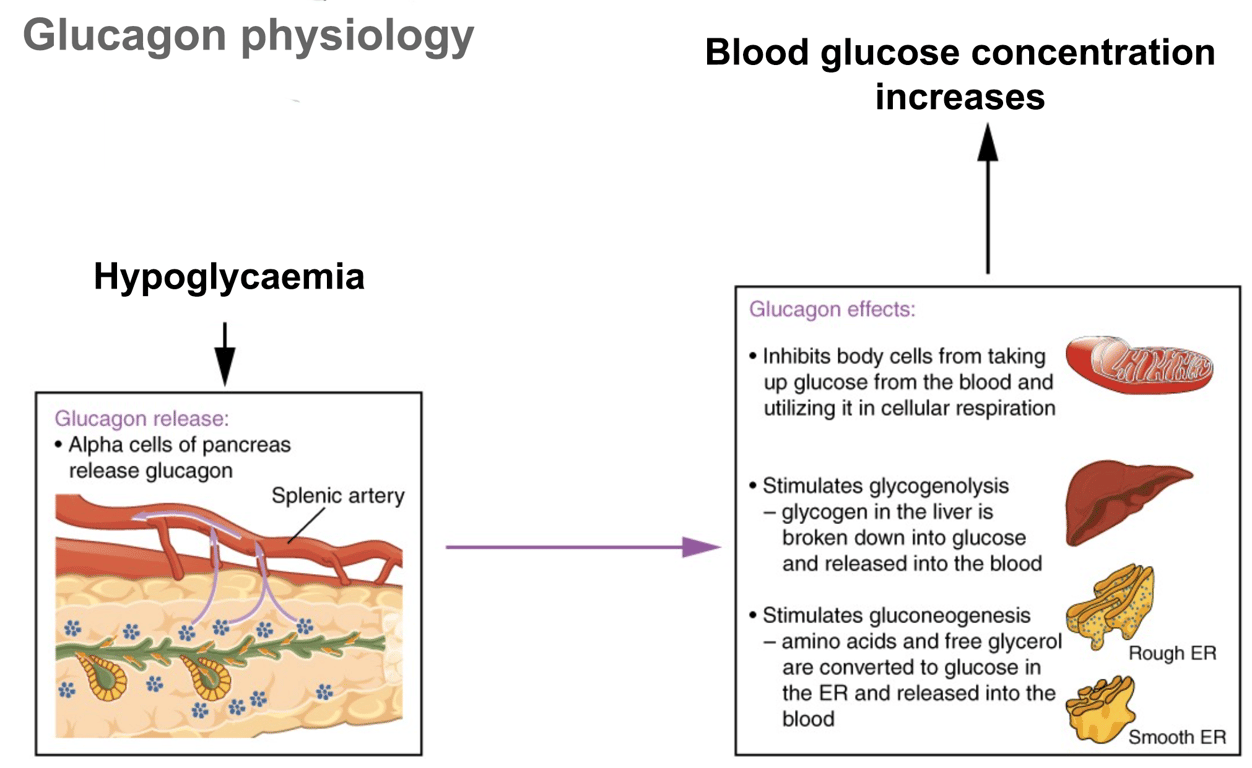 | |
Glucagon effects. Click on image to enlarge
Glucagon Key Facts
- Produced by the alpha cells in the islets of Langerhans in the pancreas.
- Primary effect is to increase plasma glucose concentration
- Glucagon should be used with caution in patients with insulinoma as it may cause rebound hypoglycaemia.
- Glucagon is contraindicated in patients with phaeochromocytoma
- Glucagon is ineffective in patients with chronic hypoglycaemia (e.g. due to chronic alcoholism) due to depleted glycogen stores.
Glucagon Summary
| Notes | Further detail | |
|---|---|---|
| Source | Alpha cells of the pancreatic islets | |
| Actions | Stimulates: Glycogenolysis Gluconeogenesis Lipolysis Ketogenesis Increased urea synthesis Inhibits: glycolysis glycogenesis | Glycogenolysis is the breakdown of glycogen to glucose (primarily in the liver) Gluconeogenesis is the conversion of carbon compounds into glucose Lipolysis is the conversion of triglycerides into free fatty acids & glycerol Ketogenesis is the production of ketone bodies by breaking down fatty acids and ketogenic amino acids, this typically occurs when other carbohydrate sources such as glucose are unavailable Glycolysis is the breakdown of glucose into pyruvate. Glycogenesis is the formation of glycogen from glucose In simple terms glucagon has the opposite metabolic effects to insulin |
| Regulation | Factors that increase secretion
Factors that decrease secretion
| Glucagon is used to rapidly reverse the effects of hypoglycaemia in diabetics |
Endocrine pancreas recap
The pancreas has exocrine and endocrine functions. The majority of pancreatic tissue is exocrine.
The hormones of the endocrine pancreas are produced in the islets of Langerhans. The pancreatic islets consist of 3 main cell types:
Note the pancreas also produces Gherlin from epsilon (γ) cells and pancreatic polypeptide from upsilon (F) cells but these account for <1% of islet cells and are beyond the scope of the examination.
The pancreas has exocrine and endocrine functions. The majority of pancreatic tissue is exocrine.
The hormones of the endocrine pancreas are produced in the islets of Langerhans. The pancreatic islets consist of 3 main cell types:
- α cells produce glucagon & account for ~ 20% of islet cells
- β cells produce insulin & account for ~ 75% of islet cells
- Δ cells produce somatostatin & account for ~ 5% of islet cells
Note the pancreas also produces Gherlin from epsilon (γ) cells and pancreatic polypeptide from upsilon (F) cells but these account for <1% of islet cells and are beyond the scope of the examination.
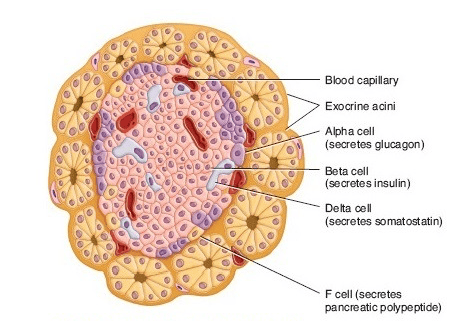 | |
Note the central collection of cells or islet consisting mostly of beta cells surrounded by the ductal or acinar (exocrine) cells