Diuretics
On this page
Osmotic diuretics
Osmotic diuretics cannot be effectively reabsorbed in the nephron. As water is reabsorbed the concentration of osmotic diuretics in tubular fluid increases which inhibits further water reabsorption.Osmotic diuretics include naturally occurring substances such as glucose and urea as well as medications such as mannitol. Hypernatremia is a risk.
Osmotic Diuresis is the increased urination due to certain non absorbable substances causing retention of water within the lumen in kidney tubules.
This occurs in uncontrolled diabetes mellitus when glucose saturation results in glucose remaining in the tubular fluid (urine) and subsequent water loss (diuresis).
This occurs in uncontrolled diabetes mellitus when glucose saturation results in glucose remaining in the tubular fluid (urine) and subsequent water loss (diuresis).
Loop Diuretics
Commonly prescribed loop diuretics in the UK include furosemide and bumetanide. Loop diuretics are the most potent diuretics.The mechanism of action of loop diuretics is inhibition of the NKCC2 or Na+-K+-2Cl- symporter in the thick ascending limb of the loop of Henle.
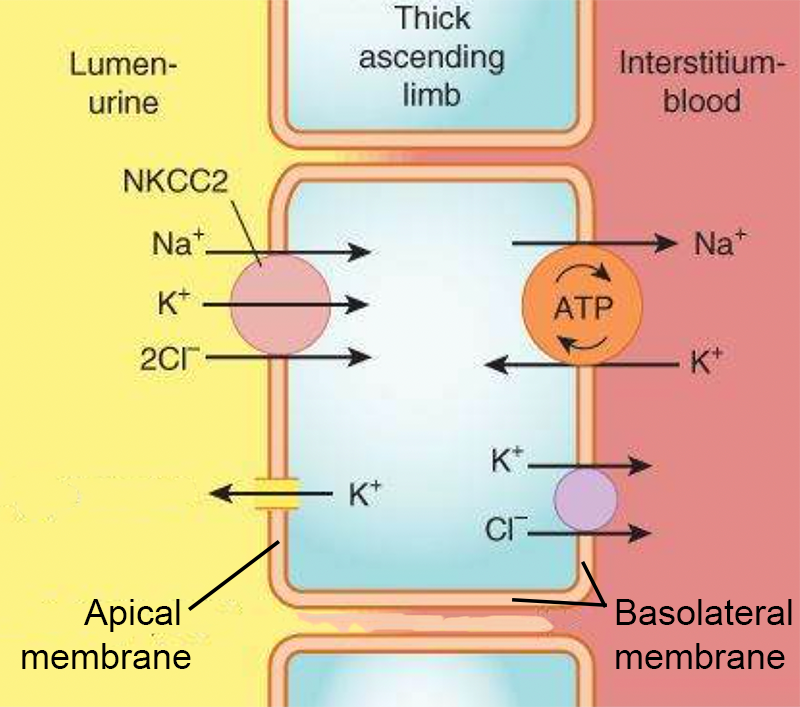 | |
Thick ascending limb of Loop of Henle. click on image to enlarge
As can be seen above the function of the Na+-K+-2Cl- symporter is to reabsorb Na+, K+ and Cl- ions from the tubule lumen into the tubule cells.
Loop diuretics block sodium, potassium, and chloride reabsorption, increasing their concentration within the tubular lumen. This results in higher osmolality of the tubular fluid and inhibits the development of high osmolality in the renal medulla. This results in more water remaining in the tubular fluid. There is increased loss of water alongside sodium, potassium and chloride ions in the urine as a result. Loop diuretics reduce the ability of the kidney to concentrate urine by this mechanism.
Note that the increased water content within the lumen increases flow and further enhances secretion of the above ions. There is a risk of both hypokalaemia and hyponatraemia.
It should be noted that the increased delivery of sodium ions to the principal cells of the collecting duct further enhances potassium secretion (as potassium is secreted in exchange for resorption of sodium). Hypokalaemia is therefore the most common metabolic side effect seen with use of loop diuretics.
Thiazide Diuretics
Thiazide diuretics such as bendroflumethiazide have traditionally been one of the most commonly prescribed antihypertensives in the UK. The mechanism of action of thiazide diuretics is inhibition of the Na+-Cl- cotransporter in the proximal distal convoluted tubule.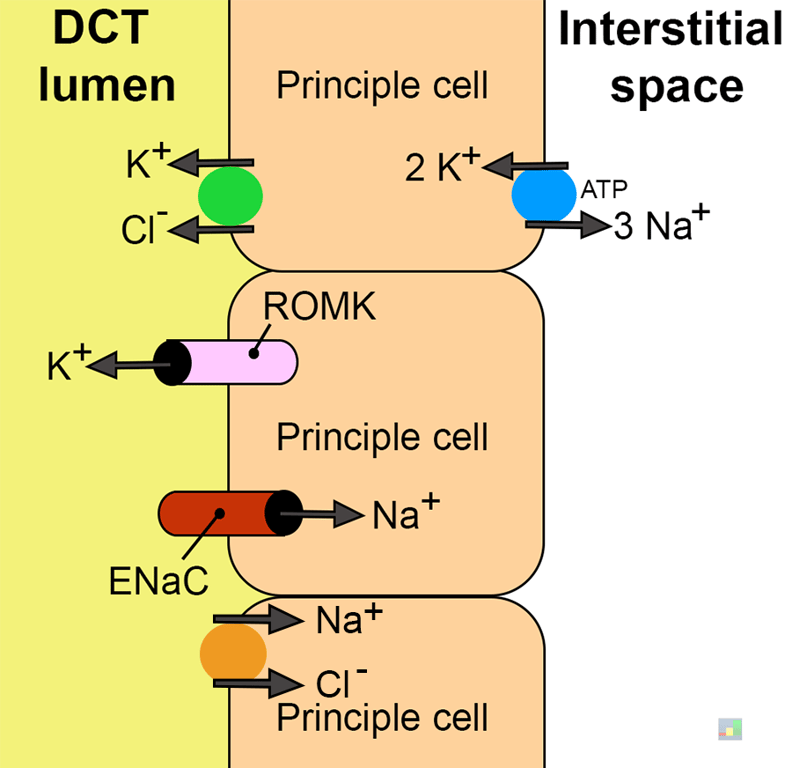 | |
Ion transport in the principle cells of the DCT. Click on image to enlarge
Because this transporter normally only reabsorbs about 5% of filtered sodium, these diuretics are less efficacious than loop diuretics in producing diuresis and natriuresis.
Both loop and thiazide diuretics increase sodium delivery to the distal segment of the distal tubule, which increases potassium loss and potentially causing hypokalaemia.
Increased Na+ in the distal tubule stimulates the aldosterone-sensitive sodium pump to increase sodium reabsorption in exchange for K+ and H+ ions, which are lost to the urine. Increased hydrogen ion loss can lead to metabolic alkalosis.
Reduced blood volume and arterial pressure activates the renin-angiotensin-aldosterone system. Increased aldosterone stimulates sodium reabsorption and increases potassium and hydrogen ion excretion into the urine.
Potassium-Sparing Diuretics
Potassium-sparing diuretics such as spironolactone, amiloride and eplerenone are also referred to as aldosterone antagonists.Aldosterone, a mineralocorticoid, binds to epithelial cells of the late distal tubule and collecting duct segment of the nephron to stimulate the retention of sodium and water. Aldosterone does this primarily by:
- Up-regulation and activation of the basolateral Na+-K+-ATPase pumps.
- Up-regulation of epithelial sodium channels (ENaCs) in the collecting duct
- Upregulation of medullary potassium channel (ROMK) in the thick ascending limb and medullary collecting duct
Aldosterone antagonists block aldosterone receptors so reducing Na+ ion reabsorption and K+ ion secretion in the distal nephron.