Renin-Angiotensin-Aldosterone System (RAAS)
The hormone renin triggers a cascade of events that ultimately leads to:
Renin release
Central venous pressure (CVP) reflects blood volume. A drop in central venous pressure is detected by atrial stretch receptors and triggers stimulation of the sympathetic nervous system. Sympathetic stimulation directly triggers renin secretion from granular (juxtaglomerular) cells and also stimulates peripheral vasoconstriction (including constriction of renal afferent arterioles). Decreased pressure in renal afferent arterioles and reduced NaCl delivery to the macula densa of the juxtaglomerular apparatus further stimulate renin release.
If blood volume falls to the point that homeostatic measures can no longer maintain arterial blood pressure this will be detected by baroreceptors in the carotid sinus and stimulate the baroreceptor reflex. The baroreceptor reflex is another trigger of sympathetic activity and will result in renin release as described above.
Renin
Angiotensin II
Aldosterone
- Increased electrolyte and water reabsorption
- Increased vascular resistance as a result of vasoconstriction.
Renin release
Central venous pressure (CVP) reflects blood volume. A drop in central venous pressure is detected by atrial stretch receptors and triggers stimulation of the sympathetic nervous system. Sympathetic stimulation directly triggers renin secretion from granular (juxtaglomerular) cells and also stimulates peripheral vasoconstriction (including constriction of renal afferent arterioles). Decreased pressure in renal afferent arterioles and reduced NaCl delivery to the macula densa of the juxtaglomerular apparatus further stimulate renin release.
If blood volume falls to the point that homeostatic measures can no longer maintain arterial blood pressure this will be detected by baroreceptors in the carotid sinus and stimulate the baroreceptor reflex. The baroreceptor reflex is another trigger of sympathetic activity and will result in renin release as described above.
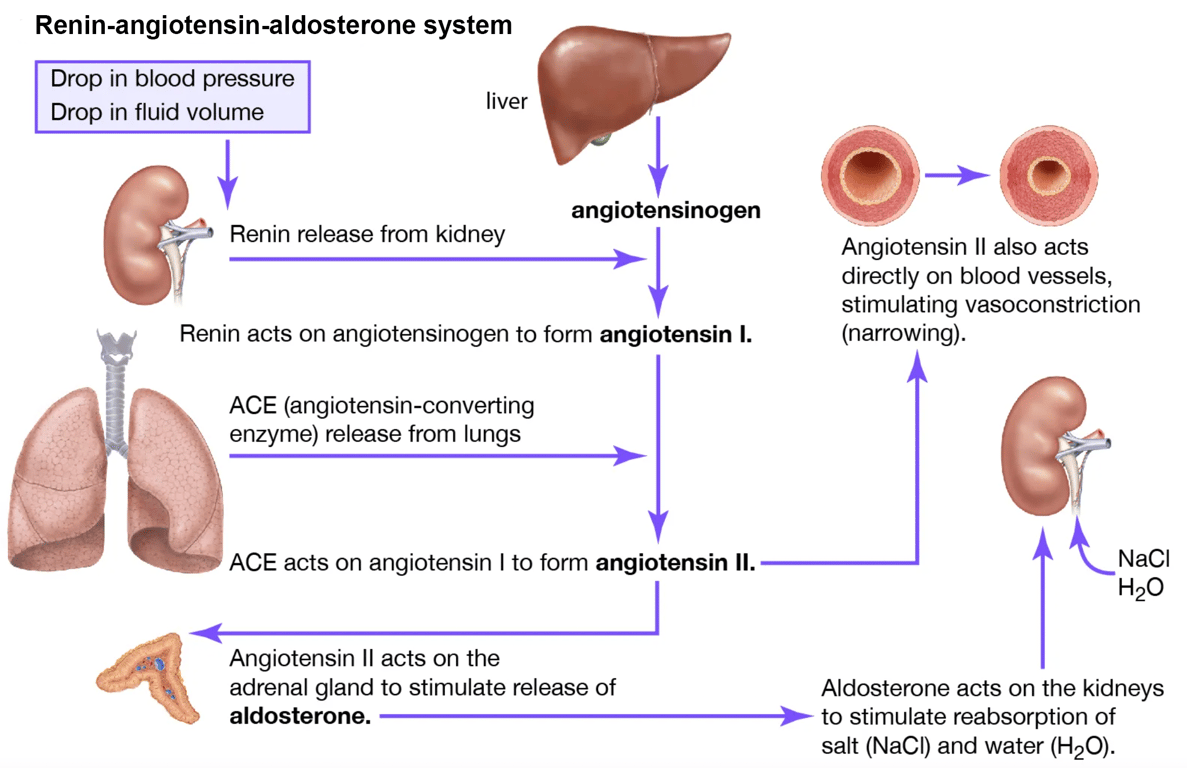 | |
The RAAS simple visual overview. click on image to enlarge
Renin
- an enzyme that is released by the renal juxtaglomerular (granular) cells in response to reduced renal perfusion
- Inadequate renal perfusion reduces GFR hence low GFR stimulates renin production
- Other factors that stimulate renin secretion include hyponatraemia (detected as reduced NaCl delivery to the macula densa), loss of wall pressure in the afferent glomerular arteriole & sympathetic nerve stimulation
- hydrolyses angiotensinogen to form angiotensin I
Angiotensin II
- angiotensin-converting enzyme (ACE) in the lungs converts angiotensin I → angiotensin II
- angiotensin II is the primary hormone for Na+ homeostasis & has a wide variety of actions:
- causes vasoconstriction of vascular smooth muscle leading to raised blood pressure and preferential vasoconstriction of efferent arterioles of the glomerulus → increased filtration fraction (FF) to preserve GFR. Remember that FF = GFR / renal plasma flow
- stimulates thirst (via the hypothalamus)
- stimulates aldosterone and ADH release
- increases proximal tubule Na+/H+ activity
Aldosterone
- released by the zona glomerulosa in response to raised angiotensin II, potassium, and ACTH levels
- causes retention of Na+ in exchange for K+/H+ in distal tubule
- aldosterone acts via protein synthesis so its effects take hours to work
ANP (atrial natriuretic peptide) is released by atrial myocytes when they are stretched as a result of increased blood volume. ANP causes increased excretion of Na+ ions and water via the following:
- Inhibition of ENaC in principal cells of the distal nephron
- Suppression of renin, aldosterone and ADH
- Renal vasodilation (increases GFR)
Adrenal cortex (mnemonic GFR - ACD)
- zona glomerulosa (on outside): mineralocorticoids, mainly aldosterone
- zona fasciculata (middle): glucocorticoids, mainly cortisol
- zona reticularis (on inside): androgens, mainly dehydroepiandrosterone (DHEA)