Loop of Henle
The loop of Henle and the distal nephron play an important role in allowing urine to be concentrated via the creation of high osmolality in the renal medulla.
The tubular filtrate is isotonic with plasma at the point where it enters the loop of Henle. The loop of Henle is able to generate high osmolality due to the following:
Thin descending limb
The thin descending limb is highly permeable to water on account of its aquaporin channels. The descending loop has low permeability to urea and ions so only small amounts of urea, Na+, and other ions. Urea concentration is higher in the interstitial fluid around the descending limb so urea is secreted into the tubule rather than reabsorbed in this section of the loop.
The majority of K+ ions that have entered the cells of the thick ascending limb leak back into the lumen via ROMK channels (renal outer medullary potassium channel). The positive charge of the K+ ions in the lumen helps drive reabsorption of other cations such as Ca2+, Na+ and Mg2+ through paracellular pathways via an electrical gradient. The reabsorption of these ions reduces the osmolality of the tubular fluid to ~90 mosmol/kg H2O whilst increasing the interstitial fluid osmolality to ~290 mosmol/kg H2O.
Countercurrent multiplier
The increasing osmolality of the interstitium draws water out of the tubule as the filtrate descends through the descending loop. it also causes some Na+ and K+ to diffuse in, concentrating the tubular fluid as it descends.
The descending tubular fluid travels in the opposite direction to even more concentrated fluid ascending from the hairpin of the loop. This counter current arrangement drives water reabsorption from the descending limb as water moves from areas of low osmolarity to areas of high osmolarity. It allows the kidneys to reabsorb around 99% of filtered water.
The counter current arrangement also causes Na+ and Cl- to diffuse out of the short thin ascending limb ascending limb, which is impermeable to water, to dilute the filtrate. Na+ and Cl- are then actively pumped out of the thick ascending limb which dilutes the filtrate further as it ascends
The blood supply to the renal medulla is from the vasa recta. The flow into the vasa recta mirrors the loop of Henle with arterial blood flowing down descending vessels and venous blood flowing in a counter current direction up ascending vessels. This arrangement helps maintain an osmotic gradient and is termed the countercurrent exchanger. The vasa recta also removes reabsorbed water which helps maintain the osmotic gradient.
The main function of the loop of Henle and distal nephron is to allow urine to be concentrated.
The tubular filtrate is isotonic with plasma at the point where it enters the loop of Henle. The loop of Henle is able to generate high osmolality due to the following:
- Different sections having different permabilities to water and solutes
- Active ion transport in the thick ascending limb
- Countercurrent multiplier
Plasma osmolality is ~290 mosmol/kg H20
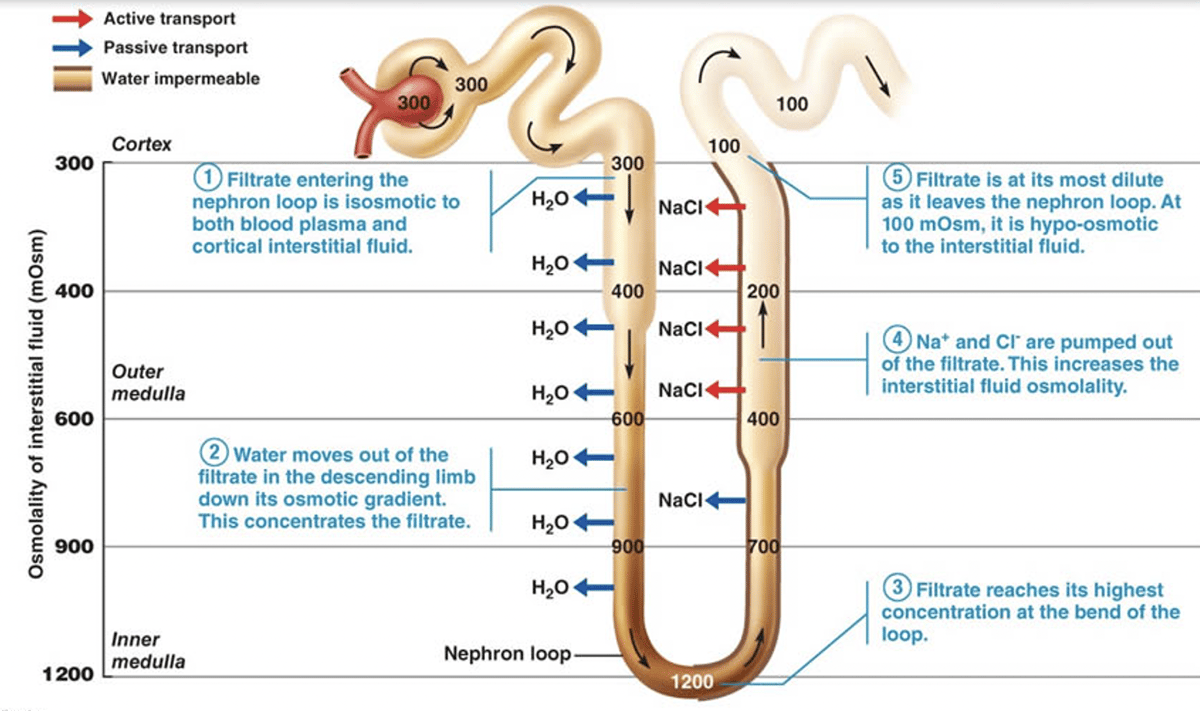 | |
Loop of Henle. click on image to enlarge
Thin descending limb
The thin descending limb is highly permeable to water on account of its aquaporin channels. The descending loop has low permeability to urea and ions so only small amounts of urea, Na+, and other ions. Urea concentration is higher in the interstitial fluid around the descending limb so urea is secreted into the tubule rather than reabsorbed in this section of the loop.
Thin ascending Limb
The thin ascending limb is impermeable to water as it lacks aquaporin channels. Na+ is reabsorbed passively via epithelial Na+ (eNaC) channels. Chloride ions ((Cl-) are also reabsorbed via Cl- channels.Thick ascending Limb
The thick ascending loop is also impermeable to water. The thick ascending loop actively pumps Na+ and Cl- ions out of the tubular fluid into the interstitium. Sodium is reabsorbed from the tubular filtrate into the cells of the thick ascending limb by the apical Na+-K+-2Cl- symporters. Sodium is actively pumped out of the cells across the basolateral membrane into the interstitium via Na+-K+-ATPase pumps. Chloride ions diffuse across the basolateral membrane.The majority of K+ ions that have entered the cells of the thick ascending limb leak back into the lumen via ROMK channels (renal outer medullary potassium channel). The positive charge of the K+ ions in the lumen helps drive reabsorption of other cations such as Ca2+, Na+ and Mg2+ through paracellular pathways via an electrical gradient. The reabsorption of these ions reduces the osmolality of the tubular fluid to ~90 mosmol/kg H2O whilst increasing the interstitial fluid osmolality to ~290 mosmol/kg H2O.
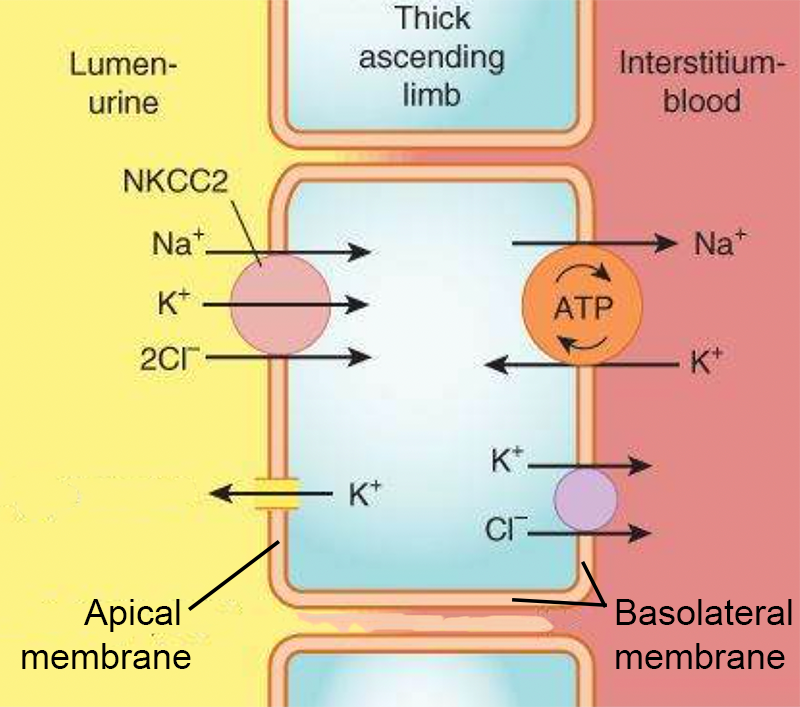 | |
Thick ascending limb of Loop of Henle. click on image to enlarge
Countercurrent multiplier
The increasing osmolality of the interstitium draws water out of the tubule as the filtrate descends through the descending loop. it also causes some Na+ and K+ to diffuse in, concentrating the tubular fluid as it descends.
The descending tubular fluid travels in the opposite direction to even more concentrated fluid ascending from the hairpin of the loop. This counter current arrangement drives water reabsorption from the descending limb as water moves from areas of low osmolarity to areas of high osmolarity. It allows the kidneys to reabsorb around 99% of filtered water.
The counter current arrangement also causes Na+ and Cl- to diffuse out of the short thin ascending limb ascending limb, which is impermeable to water, to dilute the filtrate. Na+ and Cl- are then actively pumped out of the thick ascending limb which dilutes the filtrate further as it ascends
Reabsorption in the loop of Henle
- 25% of filtered Na+ and Cl-
- 20% of filtered K+
- 15% of filtered water, Ca2+ and Mg2+
The blood supply to the renal medulla is from the vasa recta. The flow into the vasa recta mirrors the loop of Henle with arterial blood flowing down descending vessels and venous blood flowing in a counter current direction up ascending vessels. This arrangement helps maintain an osmotic gradient and is termed the countercurrent exchanger. The vasa recta also removes reabsorbed water which helps maintain the osmotic gradient.
Countercurrent multiplier and countercurrent exchanger
Countercurrent multiplication is something the tubule does to create the high interstitial osmolality and the large osmotic gradient between the renal medulla and the renal cortex. The countercurrent exchanger mechanism is something the vasa recta do to maintain this gradient.
Countercurrent multiplication is something the tubule does to create the high interstitial osmolality and the large osmotic gradient between the renal medulla and the renal cortex. The countercurrent exchanger mechanism is something the vasa recta do to maintain this gradient.