Proximal convoluted tubule
On this page
Functional adaptations
The cells of the proximal convoluted tubule (PCT) are columnar epithelium with the luminal surface having a brush border of microvilli. This greatly increase the surface area (by ~40 times) for absorption (resorption). The basolateral sides of the PCT cells contains interdigitations which increases the surface area for transport of substances and ions across the basolateral membrane. Tight junctions between cells of the PCT near the lumen limit diffusion between cell gaps.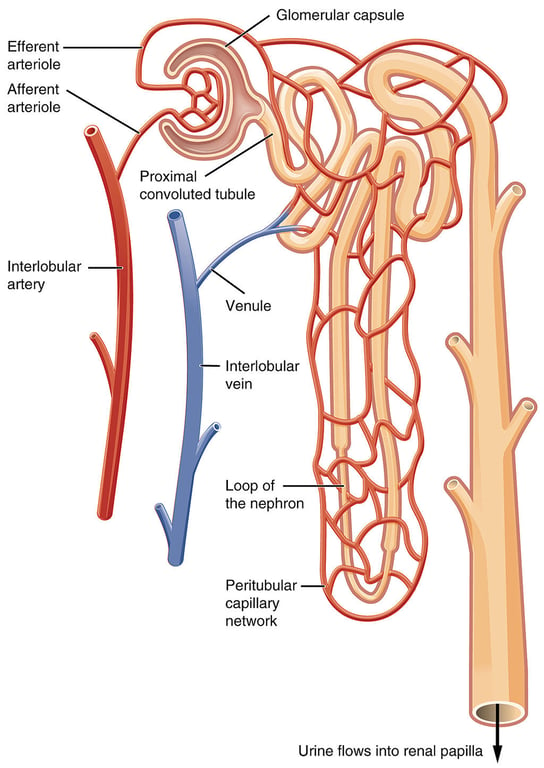 | |
Overview of nephron structure. click on image to enlarge
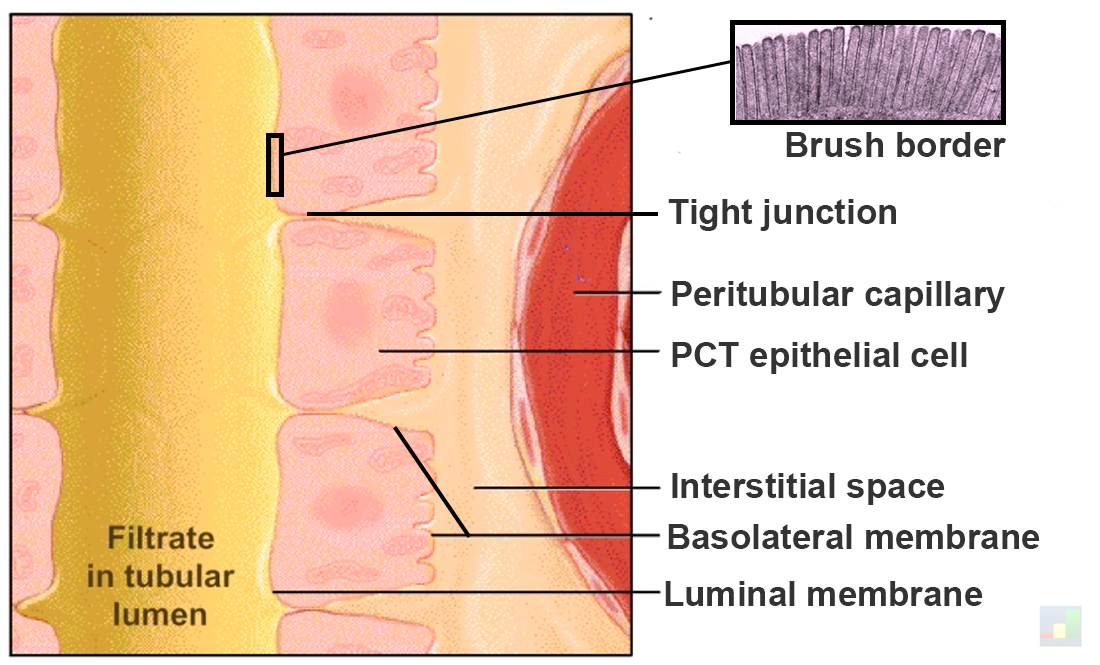 | |
Proximal convoluted tubule cellular layout. click on image to enlarge
The main function of the proximal tubule is reabsorption.
The PCT reabsorbs most glucose, amino acids, phosphate and bicarbonate together with approximately 60-70% of filtered Na+, K+, Ca2+, Cl-, urea and water.
The PCT reabsorbs most glucose, amino acids, phosphate and bicarbonate together with approximately 60-70% of filtered Na+, K+, Ca2+, Cl-, urea and water.
Sodium
Sodium is a key ion for transport across the PCT. This is because there is a large electrochemical gradient between the filtrate in the lumen and the cytosol of epithelial cells which favours the movement of Na+ from the filtrate into the epithelial cells.The sodium electrochemical gradient:
- Filtrate Na+ concentration is ~ 140 mmol/l
- Epithelial cell Na+ concentration is ~ 10-20 mmol/l
- Cytosol is negatively charged compared to filtrate which attracts positive Na+ ions
The movement of Na+ from the filtrate into the epithelial cells along its electrochemical gradient is used to drive secondary active transport of other substances.
80% of Na+ entering the epithelial cells is exchanged for H+ via the Na+-H+ antiporter. Secreted H+ is utilised to resorb HCO3-.
Na+ pumps (Na+-K+-ATPase pumps) on the basolateral surfaces pump Na+ ions out of the cell into the interstitial fluid. Much of this leaks backs into the tubule lumen between cellular gaps with ~20% diffusing into the capillaries.
Water
Na+ and HCO3- are transported from the tubule lumen into the interstitial fluid. This causes the osmolality of interstitial fluid to increase relative to the tubule lumen. The PCT is highly permeable to water and as such water follows the osmotic gradient and moves from the lumen into the interstitial fluid and is reabsorbed.Approximately 2/3 (70%) of water resorption by the kidneys occurs at the PCT
The reabsorption of water from the lumen increases the luminal concentrations of Cl-, K+, Ca2+ and urea. These diffuse along their concentration gradients into the interstitial fluid of the peritubular space mainly via paracellular pathways.
Paracellular pathways refer to transport through gaps between adjacent cells. Although tight junctions reduce the capacity for paracellular transport it still occurs.
The alternative pathway is transcellular transport. This describes a substance crossing through the luminal membrane of a cell into the cell cytosol then passing through the basolateral membrane into the interstitial fluid.
The alternative pathway is transcellular transport. This describes a substance crossing through the luminal membrane of a cell into the cell cytosol then passing through the basolateral membrane into the interstitial fluid.
The final 2/3 of the PCT is highly permeable to chloride ions (Cl-) and this facilitates Cl- reabsorption. This leaves the remaining filtrate in the lumen more positively charged which enhances the reabsorption of cations (positively charged ions) via their electrical gradient.
As these ions reabsorption is closely linked to water reabsorption the overall effect on Na+, Cl-, K+, Ca2+ and urea is that their concentrations are similar in the fluid leaving the PCT to that in the filtrate entering it (and similar to that of plasma). During the process of moving filtrate through the lumen of the PCT around 70% of the water entering the PCT is reabsorbed and around 70% of the above ions are reabsorbed with it.
Glucose
Glucose is reabsorbed by cotransport with Na+.across the luminal membrane then by diffusion across the basolateral membrane into the interstitial fluid.Other important substances
| Substance | Reabsorption |
|---|---|
| Amino acids | Reabsorbed by several Na+ symporters Symporters are specific for acidic, basic or neutral amino acids |
| Phosphate | Cotransported with Na+ across luminal membrane |
| Organic acids and bases (includes bile salts, urate, oxalate & drugs) | Cotransported with Na+ across basolateral membrane and diffuse into lumen for secretion in exchange for ions |
| Proteins | Small amounts of protein or peptide that pass through the renal corpuscle are reabsorbed via endocytosis |