Gastrointestinal physiology: Large intestine
On this page
The large intestine has 3 primary functions:
Ileocaecal sphincter
The ileocaecal sphincter (also known as the ileocaecal valve) is the junction between the small and large intestine. Approximately 1.5L of chyme will transit from the small intestine through the ileocaecal sphincter into the large intestine each day.
One of the main functions of the large intestine is the reabsorption of water and electrolytes. The 1.5L of chyme that enters the large intestine each day is reduced to around 150g of faeces which is composed of approximately 50g solid matter and 100ml water.
The large intestine has powerful smooth muscle and longitudinal muscle.
There are 3 bands of longitudinal muscle called taeniae coli. The contraction of the taeniae results in the formation of the haustra (small pouches caused by sacculation (sac formation) giving the colon its segmented appearance).
Chyme will typically remain in the colon for up to 20 hours. During this time a process called haustral shuttling moves chyme back and forth between haustra. This improves exposure of the chyme to the intestinal epithelium for absorption to occur.
In the distal colon contractions are slower and less propulsive which allows faeces to accumulate in the descending colon.
When a critical mass of faeces fills and stretches the rectum the desire to defecate is felt and the defecation reflex is initiated. The defecation reflex comprises contraction of the rectum, relaxation of the internal anal sphincter and initial contraction of the external anal sphincter followed by relaxation due to increased peristaltic activity of the sigmoid colon and increased rectal pressure. Faeces are expelled upon external anal sphincter relaxation. Contraction of abdominal wall muscles and relaxation of pelvic wall muscles occurs during the defecation reflex.
The defecation reflex may be over ridden by higher brain centres. Voluntary control allows the individual to stop anal sphincter relaxation. Prolonged rectal distension eventually leads to reverse peristalsis emptying the rectal contents into the colon until the next mass movement occurs.
The Na-K-ATPase pumps are located in the basolateral and lateral membranes of the colonic epithelial cells.
Na+ is extruded from the cell by the pump into the extracellular space. Na+ and Cl- ions are held in the extracellular space and prevented from diffusing into the lumen by tight junctions. This leaves a hypertonic solution close to the luminal surface which results in water diffusing from the lumen across the epithelial membrane.
There is a net movement of K+ and bicarbonate ions from the blood into the large intestine lumen due to the potential difference set up by the asymmetrical absorption of Na+ and Cl- ions.
- Absorbing water and electrolytes
- Producing and absorbing vitamins
- Formation and movement of faecal matter for elimination
Ileocaecal sphincter
The ileocaecal sphincter (also known as the ileocaecal valve) is the junction between the small and large intestine. Approximately 1.5L of chyme will transit from the small intestine through the ileocaecal sphincter into the large intestine each day.
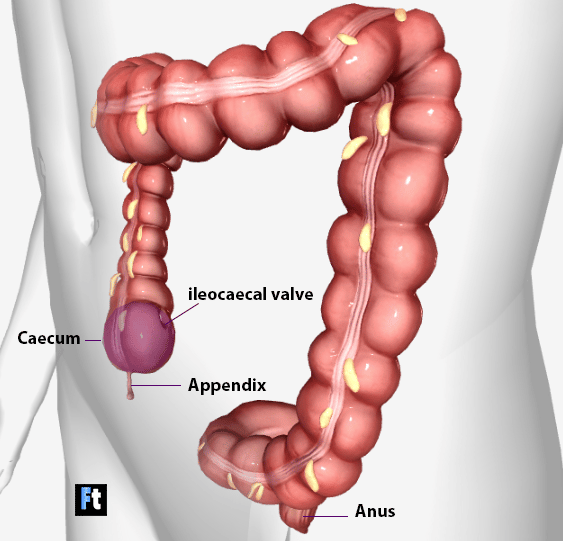 | |
Illustration of position of caecum highlighted
When the terminal ileum becomes distended this triggers the ileoceacal sphincter to open. When the caecum becomes distended the ileoceacal sphincter closes.
One of the main functions of the large intestine is the reabsorption of water and electrolytes. The 1.5L of chyme that enters the large intestine each day is reduced to around 150g of faeces which is composed of approximately 50g solid matter and 100ml water.
Taeniae coli
Movement of faeces through the large intestine is achieved by the co-ordinated action of the muscle layers of the large intestine.The large intestine has powerful smooth muscle and longitudinal muscle.
There are 3 bands of longitudinal muscle called taeniae coli. The contraction of the taeniae results in the formation of the haustra (small pouches caused by sacculation (sac formation) giving the colon its segmented appearance).
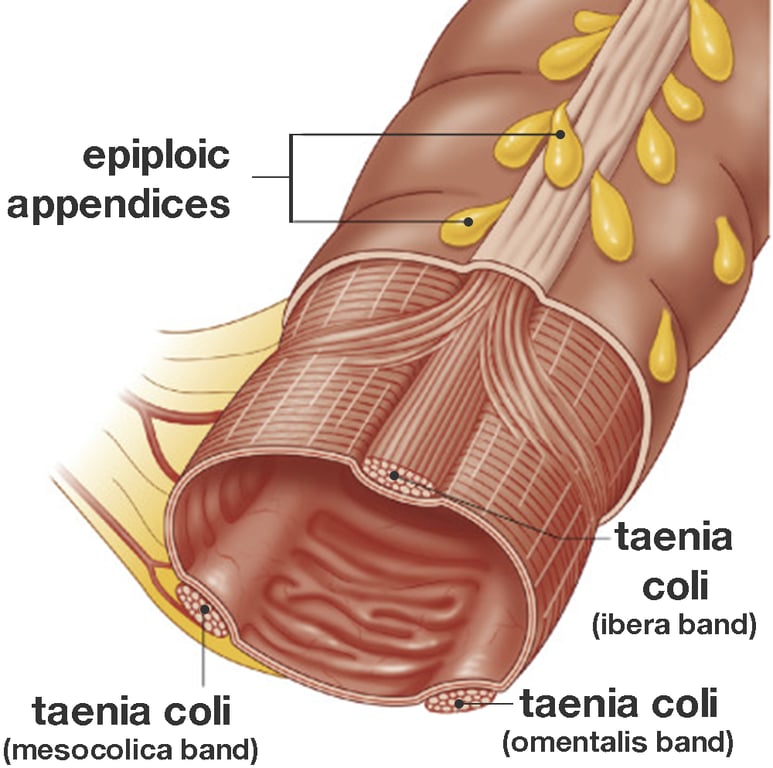 | |
Illustration of the taeniae coli. click on image to enlarge
Autonomic innervation
Innervation of the large intestine is via parasympathetic and sympathetic fibres as follows:
These parasympathetic fibres innervate intramural nerve plexuses
Sympatheic innervation of the rectum and anal canal are via the inferior hypogastric plexus.
Parasympathetic stimulation causes segmental contraction whereas sympathetic stimulation inhibits colonic muscle contraction
Innervation of the large intestine is via parasympathetic and sympathetic fibres as follows:
Parasympathetic innervation
- Caecum, ascending colon and transverse colon innervated by parasympathetic branches of the vagus
- Descending colon, sigmoid colon, rectum and anal canal are innervated by parasympathetic branches of pelvic nerves from the sacral spinal cord
These parasympathetic fibres innervate intramural nerve plexuses
Sympathetic innervation
Sympathetic innervation is via the superior mesenteric, inferior mesenteric and superior hypogastric plexusesSympatheic innervation of the rectum and anal canal are via the inferior hypogastric plexus.
Parasympathetic stimulation causes segmental contraction whereas sympathetic stimulation inhibits colonic muscle contraction
Anal sphincters
Internal and external anal sphincters keep the anal canal closed until defecation is required. They are under both reflex and voluntary control. The internal anal sphincter is composed of circular smooth muscle. The external anal sphincter is composed of striated muscle which is innervated by the pudendal nerveMovement of chyme
Movement of chyme through the colon involves a combination of mixing and propulsion. The mixing movement is referred to as haustration.Chyme will typically remain in the colon for up to 20 hours. During this time a process called haustral shuttling moves chyme back and forth between haustra. This improves exposure of the chyme to the intestinal epithelium for absorption to occur.
In the distal colon contractions are slower and less propulsive which allows faeces to accumulate in the descending colon.
Mass Movement
Mass movement refers to periods where there is a significant increase in propulsive intensity within the colon. This occurs several times a day and functions to propel faeces from the proximal colon into the distal colon.Mass movement within the colon is triggered by distension in the stomach and duodenum.
Distension of the stomach and duodenum triggers a series of reflex pathways that initiate mass movement. This occurs shortly after eating a meal.
Distension of the stomach and duodenum triggers a series of reflex pathways that initiate mass movement. This occurs shortly after eating a meal.
When a critical mass of faeces fills and stretches the rectum the desire to defecate is felt and the defecation reflex is initiated. The defecation reflex comprises contraction of the rectum, relaxation of the internal anal sphincter and initial contraction of the external anal sphincter followed by relaxation due to increased peristaltic activity of the sigmoid colon and increased rectal pressure. Faeces are expelled upon external anal sphincter relaxation. Contraction of abdominal wall muscles and relaxation of pelvic wall muscles occurs during the defecation reflex.
The defecation reflex may be over ridden by higher brain centres. Voluntary control allows the individual to stop anal sphincter relaxation. Prolonged rectal distension eventually leads to reverse peristalsis emptying the rectal contents into the colon until the next mass movement occurs.
Water resorption from chyme
When chyme enters the colon it is isotonic. The colon reabsorbs more water than electrolytes. For the colon to do this it must reabsorb water against a concentration gradient.In the colon water reabsorption against a concentration gradient is achieved via the
Na+-K+-ATPase
Na+-K+-ATPase
The Na-K-ATPase pumps are located in the basolateral and lateral membranes of the colonic epithelial cells.
Na+ is extruded from the cell by the pump into the extracellular space. Na+ and Cl- ions are held in the extracellular space and prevented from diffusing into the lumen by tight junctions. This leaves a hypertonic solution close to the luminal surface which results in water diffusing from the lumen across the epithelial membrane.
There is a net movement of K+ and bicarbonate ions from the blood into the large intestine lumen due to the potential difference set up by the asymmetrical absorption of Na+ and Cl- ions.
Colonic bacteria
Most bacteria within the GI tract are found in the large intestine (primarily due to stomach acid destroying bacteria in the stomach). Bacteria in the intestine are predominantly anaerobic and serve a number of functions:- Synthesis of vitamin K and several B vitamins (thiamine (B1), riboflavin (B2), pantothenic acid (B5), biotin (B7) and cobalamin (B12))
- Breakdown of bilirubin (colonic bacteria deconjugate and metabolise bilirubin into urobilinogen, which can be oxidised to form urobilin and stercobilin)
- Breakdown of primary to secondary bile acids
- Breakdown of cholesterol, food additives and some drugs