Gastrointestinal physiology: Defecation reflex
On this page
When the volume of faeces within the rectum increases beyond a critical level the desire to defecate is experienced. This distension of the rectal wall triggers the defecation reflex.
There is also a co-ordinated contraction of abdominal wall muscles and relaxation of pelvic wall muscles which allows peristaltic waves to push faeces through the anal canal.
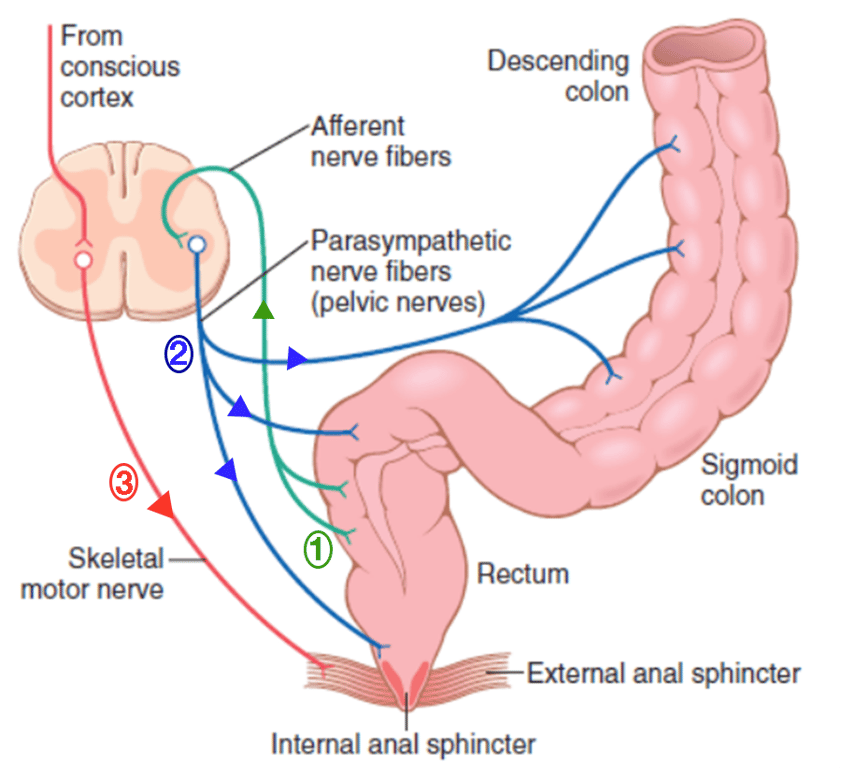 | |
1. Mass movement of faeces into the rectum distends stretch receptors in the wall of the rectum which sends impulses to the spinal cord. 2. Parasympathetic stimulation relaxes the internal anal sphincter. 3. The external anal sphincter is innervated by somatic nerves from the Inferior anal branch of the Pudendal nerve (S2,3,4) and is under conscious control which allows conscious control of defecation
Conscious control of defecation
The final stage of the defecation reflex is under conscious control.If defecation is not desired:
Voluntary contraction of the external sphincter can delay defecation. If this occurs and the rectum remains distended for a prolonged period of time a reverse peristalsis wave will occur that pushes the rectal faeces back into the colon and removes the urge to defecate until the next mass movement of faeces occurs.If defecation is desired:
Impulses are sent to the external anal sphincter via the pudendal nerve which allow relaxation of the external sphincter so faeces can be expelled.There is also a co-ordinated contraction of abdominal wall muscles and relaxation of pelvic wall muscles which allows peristaltic waves to push faeces through the anal canal.