Gastrointestinal physiology: The liver & enterohepatic circulation
Liver functional anatomy
The liver is made up anatomically of four lobes: right, left, caudate, and quadrate. The functional units of the liver are called lobules. These hexagonal structures are built around a central vein which is a tributary of the hepatic veins.At the 6 corners of each lobule are portal canals where the portal triads are located. The portal triad refers to the combination of hepatic artery branch, hepatic portal vein branch and bile (hepatic) duct. The portal triad also contains lymphatic vessels and parasympathetic vagus nerve fibres.
Arterial and venous flow between hepatocytes is facilitated by sinusoids before draining into the central veins. The central veins drain to the hepatic vein.
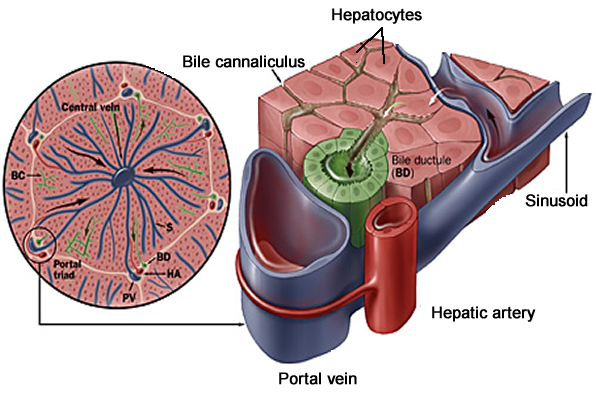 | |
Illustration of the anatomy of the liver lobules
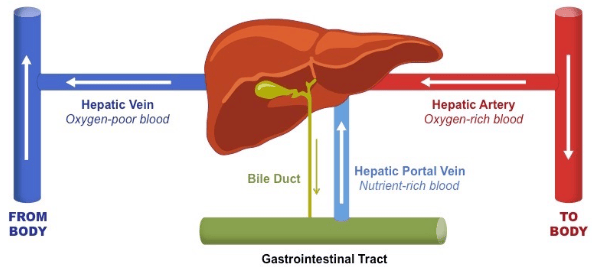 | |
Overview of the blood flow to and from the liver
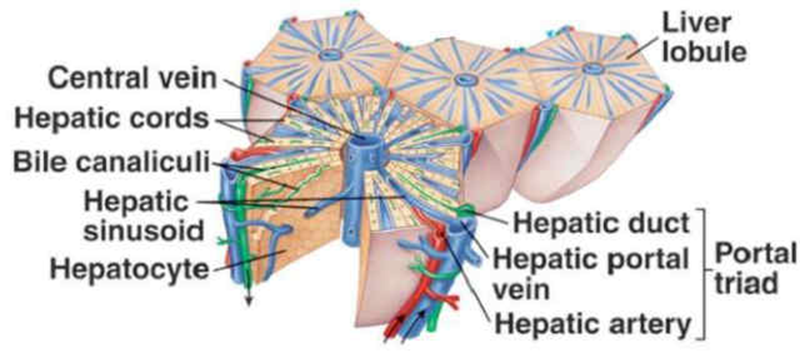 | |
Arrangement of liver lobules
Enterohepatic circulation
Enterohepatic circulation or recirculation refers to substances including some drugs that are circulated from the liver to the bile, followed by entry into the small intestine, absorption by the enterocyte and transported back to the liver.
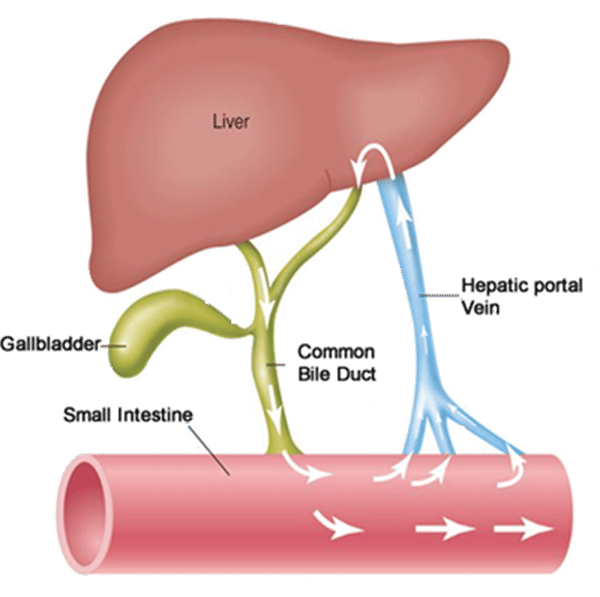 | |
Enterohepatic circulation. Click on image to enlarge
Origin and constituents of hepatic bile
In the liver hepatocytes produce and secrete hepatic bile. Hepatic bile is isotonic and has an ionic composition similar to plasma. This bile consists of:
- Water
- Bile salts
- Bile acids
- Bile pigments
- Cholesterol
- Lecithin
- Mucus
Bile acids are conjugated with taurine or glycine residues to give anions called bile salts.
Primary bile acids are those synthesised from cholesterol by the liver. Secondary bile acids result from bacterial actions in the colon
Primary bile acids are those synthesised from cholesterol by the liver. Secondary bile acids result from bacterial actions in the colon
As bile passes along the bile duct the epithelial cells alter the bile by adding bicarbonate and water. The bile that has been altered is referred to as the acid-independent fraction. The acid-independent fraction is produced as it is required
95% of bile that is discharged into the duodenum is reabsorbed via active transporters in the terminal ileum. The reabsorbed bile salts are returned to the liver by the portal circulation where they are recycled.
The adult liver produces 500-1000ml of bile per day which is discharged directly into the duodenum or stored in the gallbladder. In the gallbladder water is reabsorbed making the bile more concentrated.
Bile production is stimulated by:
- Bile salts
- Gastrin
- Secretin
- Glucagon
Bile release is stimulated by:
- Cholecystokinin (CCK)
- Vagus nerve stimulation