Cardiovascular physiology: Baroreceptor reflex
On this page
The baroreceptor reflex describes one of the key homeostatic mechanisms that maintains a consistent blood pressure.
The baroreceptor reflex is a rapid acting negative feedback loop in which the body reacts to a drop or elevation in systemic blood pressure by reflexively adjusting the heart rate, heart contractility and vascular resistance.
Baroreceptors are most sensitive between 80-150 mmHg and are more sensitive if there is wide pulse pressure. They will equilibriate to a new 'normal' blood pressure if a blood pressure is maintained for a number of hours and are therefore said to show adaptation. These baroreceptors are therefore most important at buffering short term changes in BP rather than long term blood pressure maintenance.
Baroreceptors are stretch receptors located in vessel walls. Stretching of the vessels causes an increase in baroreceptor firing whilst a drop in blood pressure causes the baroreceptors to reduce firing.
Changes in baroreceptor firing are detected by the medulla oblongata which effects changes via the autonomic nervous system.
In addition to the above rapid compensatory measures above the autonomic nervous system will also stimulate the slower acting renin-angiotensin system to conserve sodium and water which increases intravascular volume.
The baroreceptor reflex is a rapid acting negative feedback loop in which the body reacts to a drop or elevation in systemic blood pressure by reflexively adjusting the heart rate, heart contractility and vascular resistance.
Baroreceptors
Baroreceptors are specialised neurones primarily located in the aortic arch and carotid sinus. They are stretch receptors. The carotid sinus baroreceptor axons travel within the glossopharyngeal nerve (CN IX) whilst the aortic arch baroreceptor axons travel within the vagus nerve (CN X).Baroreceptors are most sensitive between 80-150 mmHg and are more sensitive if there is wide pulse pressure. They will equilibriate to a new 'normal' blood pressure if a blood pressure is maintained for a number of hours and are therefore said to show adaptation. These baroreceptors are therefore most important at buffering short term changes in BP rather than long term blood pressure maintenance.
Baroreceptors are stretch receptors located in vessel walls. Stretching of the vessels causes an increase in baroreceptor firing whilst a drop in blood pressure causes the baroreceptors to reduce firing.
Changes in baroreceptor firing are detected by the medulla oblongata which effects changes via the autonomic nervous system.
Response to a drop in blood pressure
If the blood pressure drops there will be reduced stretching of the vessels containing the baroreceptors. This causes reduced firing of the baroreceptors. The medulla detects this and effects the following rapid compensatory measures by increasing sympathetic activity and decreasing parasympathetic activity:- ↑ arteriolar constriction (increase total peripheral resistance)
- ↑ venoconstriction (increase central venous pressure)
- ↑ Heart rate (increase cardiac output)
- ↑ Contractility (increase cardiac output)
In addition to the above rapid compensatory measures above the autonomic nervous system will also stimulate the slower acting renin-angiotensin system to conserve sodium and water which increases intravascular volume.
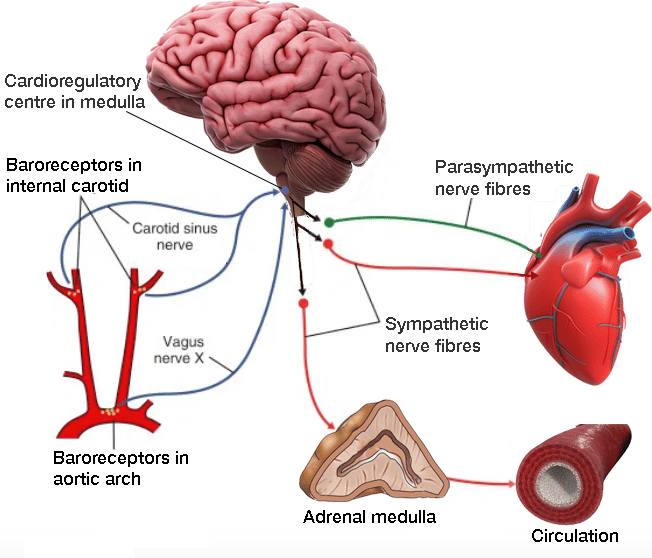 | |
Illustration of the baroreceptor reflex
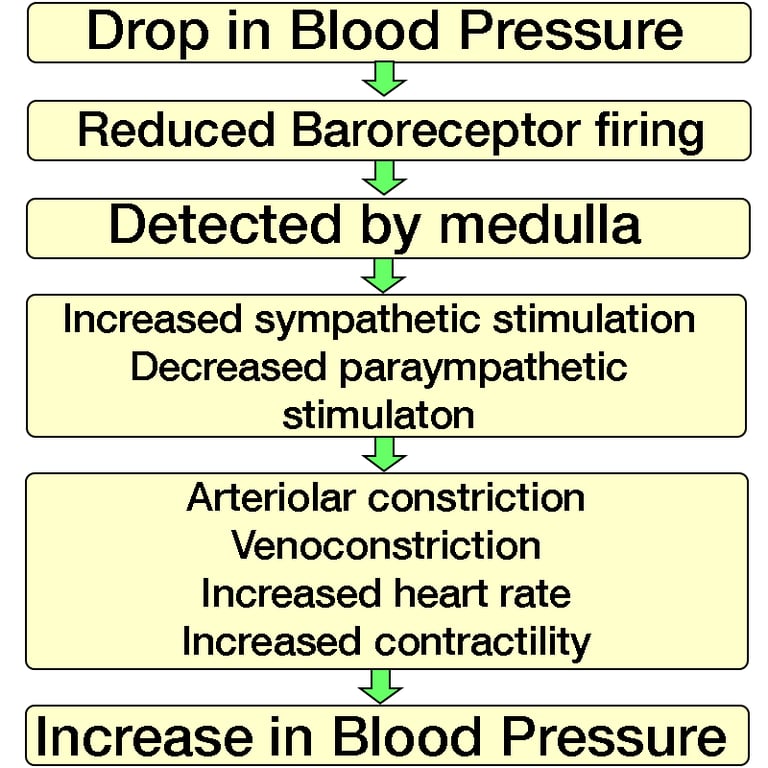 | |
Baroreceptor reflex response to drop in BP
Clinical relevance: postural hypotension
When we stand from a supine position blood drains with gravity and pools in the veins of the legs. This causes a drop in CVP, cardiac output and MAP. Baroreceptors become less stretched and stop firing which is detected up by the medulla. The medulla then initiates the compensatory measures described above.
Presyncope or syncope is occasionally experienced if cerebral perfusion falls due to the compensatory mechanisms not responding quickly enough.