Cardiovascular physiology: Einthoven's triangle
On this page
Background
In electrocardiography there are 3 lead systems that make up the ECG:- Precordial or Chest leads: V1- V6
- Limb leads: I, II and III
- Augmented limb leads: aVR, aVL, and aVF
The leads detect depolarisation as electrical current moves through the heart.
It should be noted that on a 12 lead ECG only 10 leads are placed on the patient i.e. 6 chest leads and 4 limb leads. The right leg limb lead is used to ground the system and does not record anything. This leaves 9 leads that generate 12 traces.
Einthoven's triangle
The electrodes placed on the right arm, left arm and left leg form the points of what is known as Einthoven's triangle. It is an inverted equilateral triangle centred around the heart: | |
The limb leads (I, II and III) each represent the voltage between two electrodes and as such are bipolar.
| Lead | ECG electrodes used | Details |
|---|---|---|
| Lead I | Left arm Right arm | Voltage between the (positive) LA electrode and negative right arm (RA) electrode Voltage lead I = Sum of LA and RA |
| Lead II | Left leg Right arm | Voltage between the (positive) left leg (LL) electrode and negative right arm (RA) electrode: Voltage lead II = Sum of LL and RA |
| Lead III | Left arm Left leg | Voltage between the (positive) left leg (LL) electrode and negative left arm (LA) electrode: Voltage lead II = Sum of LL and LA |
Einthoven's Law
Lead II's complex is equal to the sum of the corresponding complexes in Leads I and III i.e.Lead II = Lead I + Lead III
Augmented leads
The augmented leads (aVR, aVL, and aVF) are derived from the same three electrodes as leads I, II, and III, but they use Goldberger's central terminal as their negative pole. Goldberger's central terminal is a combination of inputs from two limb electrodes.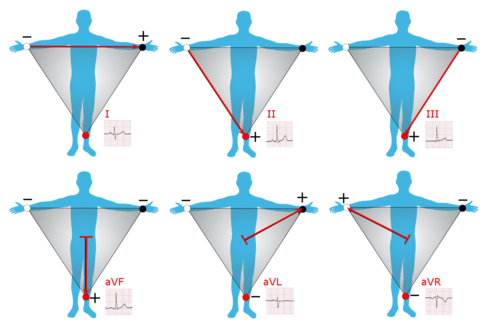 | |