Respiratory physiology: Carbon dioxide transport
On this page
Carbon dioxide transport in the blood
Carbon dioxide (CO2) is transported in the blood in three ways:1. As bicarbonate as part of the bicarbonate buffer system (60-80%)
2. Bound to proteins including haemoglobin (20-30%)
3. Dissolved in solution (5-10%)
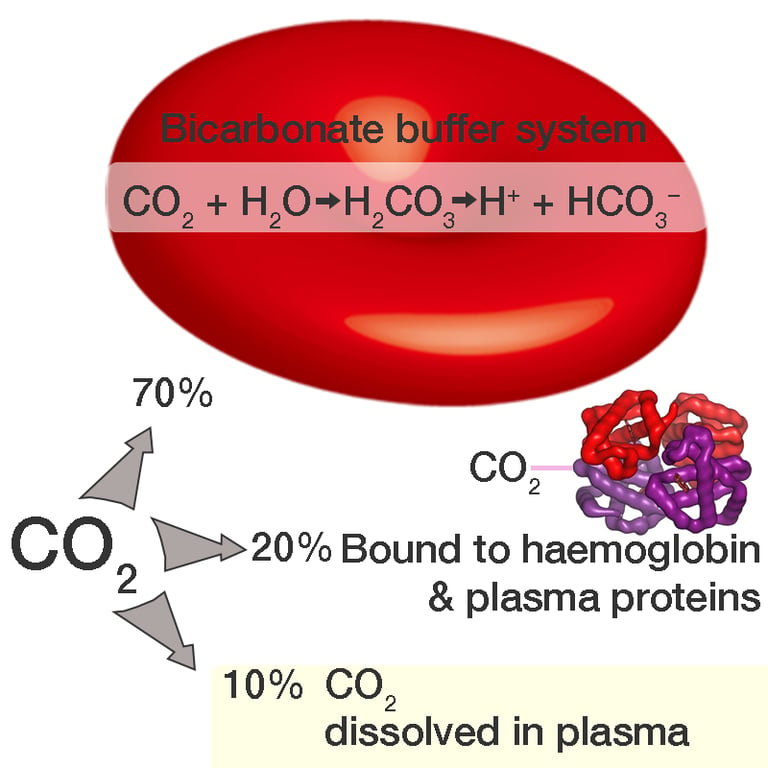 | |
Illustration of CO2 transport in the blood
Bicarbonate buffer system
In red cells carbon dioxide is combined with water to form carbonic acid under the action of carbonic anhydrase. The carbonic acid then dissociates into hydrogen and bicarbonate ions. This is shown by the equation below
- CO2 + H2O → H2CO3 → H+ + HCO3ˆ’
Once the above reaction is complete bicarbonate ions move from the red blood cell into the plasma via a chloride-bicarbonate exchanger in a process known as chloride shift. The hydrogen ions combine with deoxyhaemoglobin.
Protein bound
Around 20-30% of CO2 is transported bound to proteins forming carbamino compounds. High CO2 concentrations promote direct binding to amino acids and the amine groups of haemoglobin to create carbaminohaemoglobin.Haldane effect
Oxygenation of blood in the lungs displaces CO2 from haemoglobin which increases the removal of carbon dioxide. The decreased binding of CO2 in the blood due to increased oxygen levels is known as the Haldane effect.This explains haemoglobins ability to carry more CO2 in deoxygenated tissues.
For any given pCO2 the CO2 content of oxygenated blood is less than that of deoxygenated blood