Thoracic movements in respiration
Thoracic movement during inspiration
- Ribs elevated during inspiration
- Muscle contraction results in the ribs being elevated upwards
- The anterior part of the ribs move upwards towards the static 1st rib and the sternum moves forwards increasing anteroposterior thoracic diameter. This is termed 'pump handle' movement. It is best seen laterally and applies primarily to the movement of the true ribs (1-7)
- The lateral part of the ribs swing out and up, increasing transverse diameter, and this is termed 'bucket handle' movement. This is best seen anteriorly and describes the primary movement of the false ribs (those that are not connected directly to the sternum i.e. 8-10)
- In quiet respiration inspiration is primarily brought about by external intercostal muscle contraction and diaphragm contraction.
| Movement | Action | Primary joints involved | Effect on thorax volume |
|---|---|---|---|
| Pump handle | Upward and forward movement of anterior section of ribs/sternum | costovertebral joints 2 to 6 | Increase AP diameter |
| Bucket handle | Upward and outward movement of lateral section of ribs | costovertebral joints 7 to 10 | Increase transverse diameter |
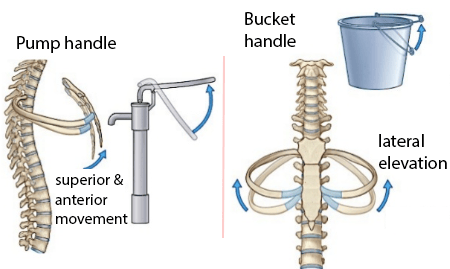 | |
Pump handle and bucket handle movement of ribcage
Video showing 'pump handle' and 'bucket handle' movement of ribcage
Thoracic movement during expiration
- Expiration is normally passive
- Achieved by muscle relaxation and recoil of lung tissue