Pharynx: Innervation
The pharynx is a hollow muscular tube forming part of the aero-digestive tract that connects the oral and nasal cavities to the larynx and oesophagus. It extends from the skull base to the inferior border of the cricoid cartilage (C6 spinal level)
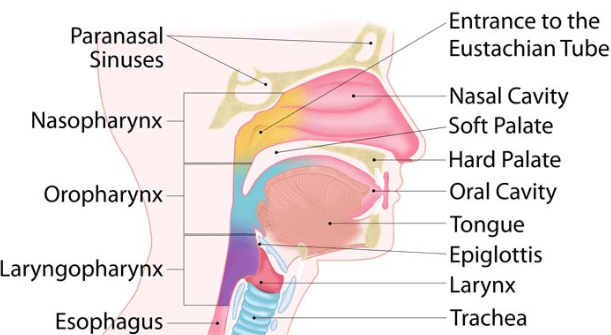
Image showing the three sections of the pharynx
Sensory supply
Each section has a different sensory supply:
Motor supply
Motor supply to the pharynx is via the pharyngeal plexus. The plexus is formed via branches of the vagus and glossopharyngeal nerve. As can be seen from the table below all of the muscles of the pharynx are innervated by the vagus nerve (CN X) except for stylopharyngeus muscle which is innervated by the glossopharyngeal nerve (CN IX)
Seretomotor
Mucus secretion is stimulated via parasympathetic fibres from the pterygopalatine ganglion
Image showing muscles of the pharynx
Image showing the three sections of the pharynx
 | |
Sensory supply
Each section has a different sensory supply:
| Section of pharynx | Sensory nerve supply |
|---|---|
| Nasopharynx | Maxillary nerve (CN V2) |
| Oropharynx | Glossopharyngeal nerve (CN IX) |
| Laryngopharynx | Vagus nerve (CN X) |
Motor supply
Motor supply to the pharynx is via the pharyngeal plexus. The plexus is formed via branches of the vagus and glossopharyngeal nerve. As can be seen from the table below all of the muscles of the pharynx are innervated by the vagus nerve (CN X) except for stylopharyngeus muscle which is innervated by the glossopharyngeal nerve (CN IX)
| Muscle | Layer | Innervation |
|---|---|---|
| Inferior constrictor muscle | outer circular | vagus nerve (CN X) |
| Middle constrictor muscle | outer circular | vagus nerve (CN X) |
| Superior constrictor muscle | outer circular | vagus nerve (CN X) |
| Stylopharyngeus muscle | inner longitudinal | glossopharyngeal nerve (CN IX) |
| Salpingopharyngeus muscle | inner longitudinal | vagus nerve (CN X) |
| Palatopharyngeus muscle | inner longitudinal | vagus nerve (CN X) |
Seretomotor
Mucus secretion is stimulated via parasympathetic fibres from the pterygopalatine ganglion
Image showing muscles of the pharynx
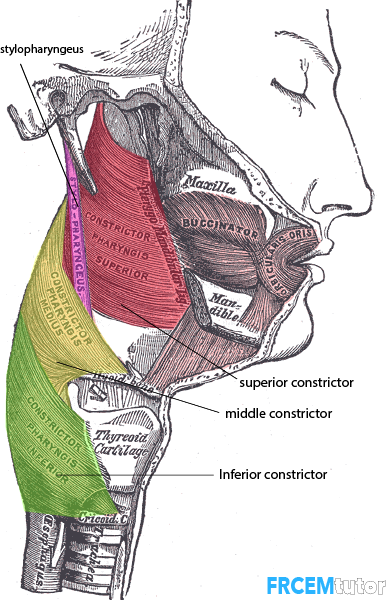 | |
Lateral view
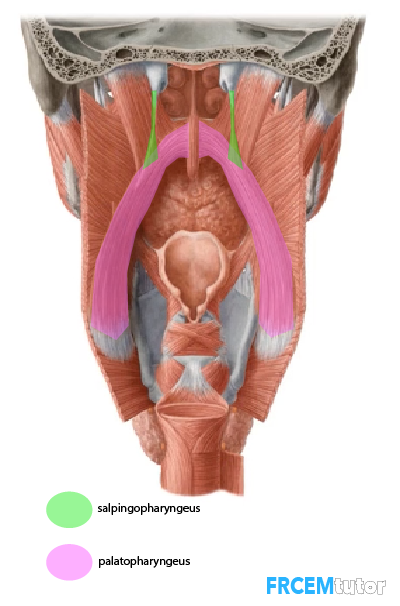 | |
Dorsal view with overlying constrictors cut