Pterygopalatine ganglion
Key Points
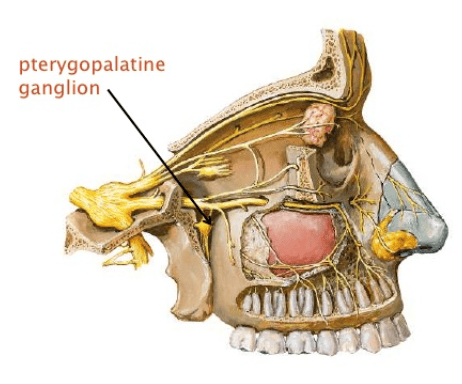
- The pterygopalatine ganglion (sphenopalatine ganglion) is a parasympathetic ganglion found in the pterygopalatine fossa.
- Provides secretomotor innervation to lacrimal glands, mucus glands of posterosuperior nasal cavity, nasopharynx and the palate
- Blood flow to the nasal mucosa, in particular the venous plexus of the concha (turbinates) is regulated by the pterygopalatine ganglion.
- The largest of four parasympathetic ganglia of the head and neck. The others are the submandibular ganglion, the otic ganglion and the ciliary ganglion.
 | |
Pre-ganglionic fibres
- The ganglion receives pre-ganglionic fibres from the salivatory nucleus via the greater petrosal nerve (a branch of the facial nerve)
Post-ganglionic fibres
- Fibres exit the ganglion via branches of the maxillary nerve (maxillary division of trigeminal nerve V2)
What does parasympathetic stimulation do?
- Parasympathetic stimulation causes flow of saliva*
- Parasympathetic stimulation causes nasal mucosa dilatation
- Parasympathetic stimulation causes lacrimation
Clinical sequelae of pterygopalatine ganglion injury
- A patient who has damaged their pterygopalatine ganglion either through trauma or disease will likely suffer with dry eyes, dry nose/sinuses, dry mouth and dry throat.
- *It should be noted that although the pterygopalatine ganglion stimulates mucus glands in the palate, nasal cavity and pharynx it is not the ganglion that stimulates the major salivary glands (see below)
Summary of the parasympathetic ganglions
| Ganglion | Pre-ganglionic fibres | Post-ganglioin fibres | Target organ |
|---|---|---|---|
| Pterygopalatine | Superior salivatory nucleus via the greater petrosal nerve (branch of facial nerve) | Maxillary division of trigeminal | Lacrimal gland Nasopharynx Palate Nasal cavity |
| Submandibular ganglion | Superior salivatory nucleus via the chorda tympani (branch of facial nerve) | Fibres travel directly to target organs | Sublingual glands Submandibular glands |
| Otic ganglion | Inferior salivatory nucleus via lesser petrosal nerve (branch of glossopharyngeal nerve) | auriculotemporal nerve | Parotid gland |
| Ciliary ganglion | oculomotor nerve | short ciliary nerves | Sphincter pupilliae Ciliary muscles |