Soft Palate
On this page
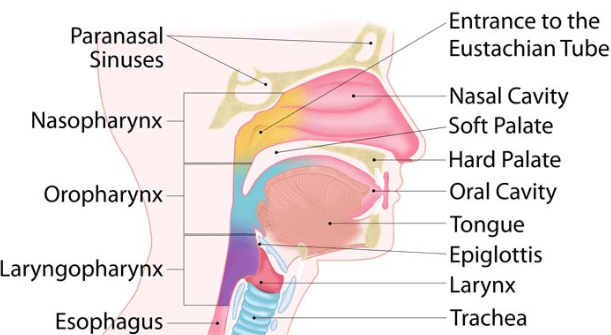
The soft palate is a piece of soft tissue extending posteriorly from the hard palate that comprises five paired muscles and a covering mucus membrane.
Uvula
The uvula is a flap of tissue that hangs from the posterior edge of the soft palate. It contains mucoglandular as well as fibrous and muscular tissues.
The fibrous and muscular tissue is involved in closing off the nasopharynx from the mouth during speech, deglutition and during the gag reflex.
It is a reflex arc. The sensory limb is mediated predominantly by CN IX (glossopharyngeal nerve) the motor response by CN X (Vagus).
Extra information
The RCEM syllabus advises that details of the muscles of the palate is not required for the exam but for those who are interested or wish to have a deeper understanding the five paired muscles are:
Innervation
Its nerve innervation mimics that of the nasopharynx:| Innervation | Nerve |
|---|---|
| Motor supply to muscles | Pharyngeal plexus (except tensor veli palatini) |
| Sensory supply | Maxillary division of trigeminal (via palatine branches) |
| Secretomotor fibres | Pterygopalatine ganglion |
Uvula
The uvula is a flap of tissue that hangs from the posterior edge of the soft palate. It contains mucoglandular as well as fibrous and muscular tissues.
The fibrous and muscular tissue is involved in closing off the nasopharynx from the mouth during speech, deglutition and during the gag reflex.
Gag reflex
The gag reflex is stimulated by touching the back of the tongue, throat or uvula and results in a brief elevation of the soft palate and bilateral contraction of pharyngeal muscles. Its function is to prevent choking.It is a reflex arc. The sensory limb is mediated predominantly by CN IX (glossopharyngeal nerve) the motor response by CN X (Vagus).
 | |
Extra information
The RCEM syllabus advises that details of the muscles of the palate is not required for the exam but for those who are interested or wish to have a deeper understanding the five paired muscles are:
- tensor veli palatini
- levator veli palatini€‹
- palatopharyngeus
- palatoglossus
- muscle of the uvula