Anticholingeric Toxidrome
A toxidrome refers to a set of symptoms and signs which occur following overdose of a particular class of drug. Commonly seen toxidromes are cholinergic, anticholingeric, sympathomimetic, opiate, serotonin and sedative.
Anticholingeric compounds (e.g. atropine, tricyclic antidepressants, antihistamines) antagonise the effects of acetylcholine at muscarinic and nicotinic receptors.
The anticholinergic toxidrome typically causes:
Anticholingeric compounds (e.g. atropine, tricyclic antidepressants, antihistamines) antagonise the effects of acetylcholine at muscarinic and nicotinic receptors.
The anticholinergic toxidrome typically causes:
- Dry skin
- Hyperthermia
- Hypertension
- Constipation
- Urinary retention
- Dilated pupils
- Tachycardia
- Agitated (hyperactive) delirium
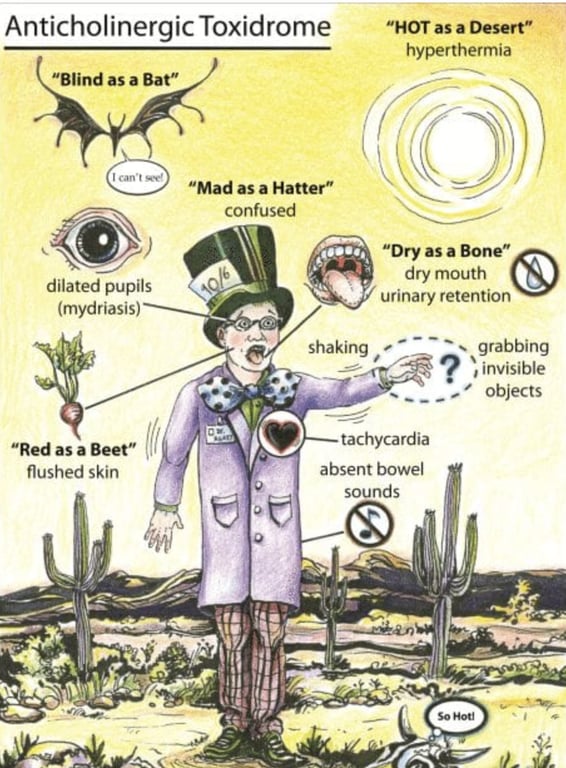 | |
Cartoon illustration of the anticholinergic toxidrome. Click on image to enlarge
The anticholingeric toxidrome can be remembered by the phrase 'red as a beet, dry as a bone, blind as a bat, mad as a hatter, and hot as a hare'.
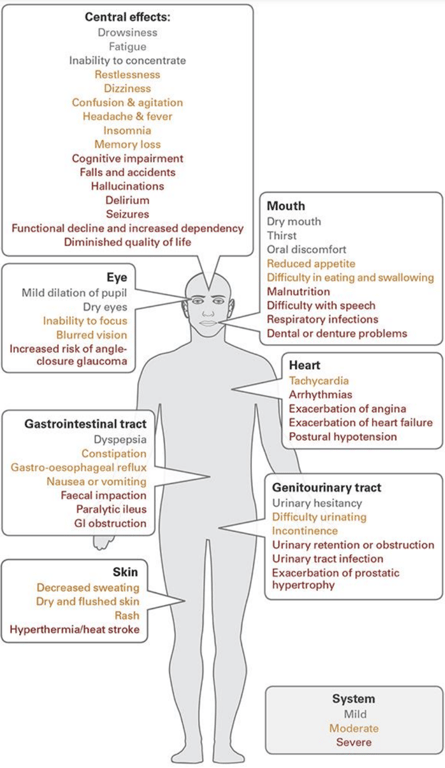 | |
Anticholinergic burden on systems. Click on image to enlarge