Osmosis, osmolarity and osmolality
On this page
Definition
Osmosis is the passive movement of water through a semipermeable membrane from an area of lower solute concentration to an area of higher solute concentration i.e. it moves along an osmotic gradient.Background
Biological membranes are semi-permeable in they allow free movement of water through them but restrict solutes. The differing solute concentrations either side of a semi-permeable membrane creates an osmotic gradient by way of the differences in osmotic potentialOsmotic potential is expressed as osmolarity or osmolality:
The osmolarity of plasma is around 290 mosmo/kg water
- Osmolarity: osmoles of solute per litre solution.
- Osmolality: osmoles of solute per kg solvent.
The osmolarity of plasma is around 290 mosmo/kg water
Osmolarity
Plasma osmolarity is calculated by:
2[Na+] + 2[K+] + [Glucose] + [Urea]
where all values are in mmol/l
A normal osmolality is 270-310 milli-osmoles per kg
The osmol gap usually refers to the difference between measured osmolality and calculated osmolarity.
Plasma osmolarity is calculated by:
2[Na+] + 2[K+] + [Glucose] + [Urea]
where all values are in mmol/l
Osmolality
Osmolality is not typically calculated but is measured on an analytical instrument called an osmometerA normal osmolality is 270-310 milli-osmoles per kg
Osmolality vs osmolarity
Osmolality and osmolarity are measures that are technically different, but functionally the same for normal use. Whereas osmolality (with an l) is a measure of the osmoles (Osm) of solute per kilogram of solvent (osmol/kg or Osm/kg), osmolarity (with an r) is defined as the number of osmoles of solute per liter (L) of solution (osmol/L or Osm/L). Osmolarity may also use mmol/L as unitsThe osmol gap usually refers to the difference between measured osmolality and calculated osmolarity.
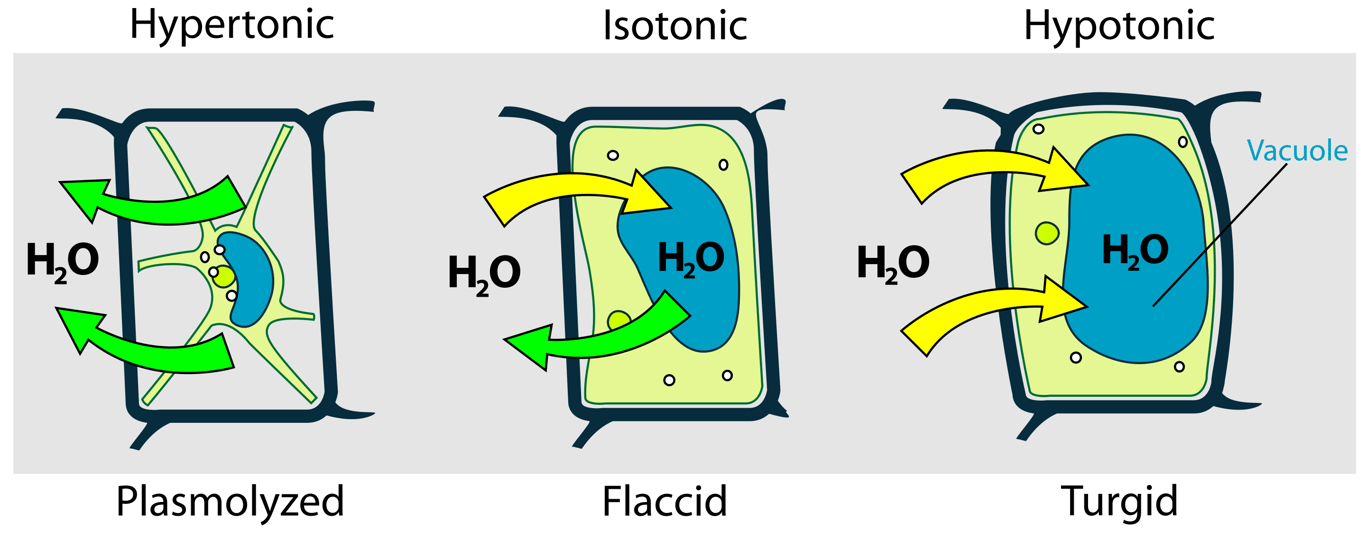
Fluids of the same osmotic potential are said to be isotonic. A more concentrated fluid, i.e. higher osmotic potential is said to be hypertonic compared to a fluid of lower potential which is termed hypotonic.
Maintenance of plasma osmolality is vital for regulation of blood volume. Ingesting fluids of differing osmotic potentials has differing effects on water distribution in the body. Hypertonic fluids enter the interstitial fluid and make it more concentrated drawing water into it from cells resulting in cell shrinkage. Hypotonic fluids enter the interstitial fluid and dilute it causing water to move into cells which swell.
 | |
Click on image to enlarge
Crystalloid osmotic pressure & oncotic pressure
Dissolved ions & small molecules such as glucose and urea diffuse easily across the capillary membrane. These crystalloid molecules generate an osmotic pressure. Crystalloid osmotic pressure is typically the same either side of the capillary wall.
Proteins exert oncotic pressure (or colloidal pressure). Proteins are too large to easily diffuse through capillary walls. Oncotic pressure within plasma is 25-28mmHg. Oncotic pressure causes interstitial fluid movement into the blood capillaries. Usually, the interstitial fluid contains metabolic wastes and CO2. Hence, oncotic pressure helps the removal of metabolic wastes from tissues.