Conduction of the action potential
On this page
Action potentials can occur in excitable cells. An action potential is a local event leading to depolarisation, or reversal in polarity, where the inside of the cell becomes positively charged relative to the outside (in neurones this is typically a change from -70mV to +40mV).
Electronic depolarisation causes voltage gated Na+ channels to open followed by voltage gated K+ channels i.e. an action potential occurs in the adjacent cell. This process continues as the action potential propagates along the nerve segment until it reaches the end.
This type of conduction, seen in unmyelinated nerve fibres, where depolarisation spreads to the immediately adjacent cell is called continuous conduction.
Note that the refractory period of already activated cells prevents the impulse flowing backwards.
Saltatory conduction is rapid and conserves energy as much smaller areas of axon use energy to power repolarization via active pumping of Na+ and K+.
Conduction in unmyelinated nerve fibres
The outside of the resting cell membrane is typically positively charged with respect to the inside. The negative charge of the action potential is drawn to the positive charge of adjacent resting cells. This induces a local current orelectronic depolarisation
Electronic depolarisation causes voltage gated Na+ channels to open followed by voltage gated K+ channels i.e. an action potential occurs in the adjacent cell. This process continues as the action potential propagates along the nerve segment until it reaches the end.
This type of conduction, seen in unmyelinated nerve fibres, where depolarisation spreads to the immediately adjacent cell is called continuous conduction.
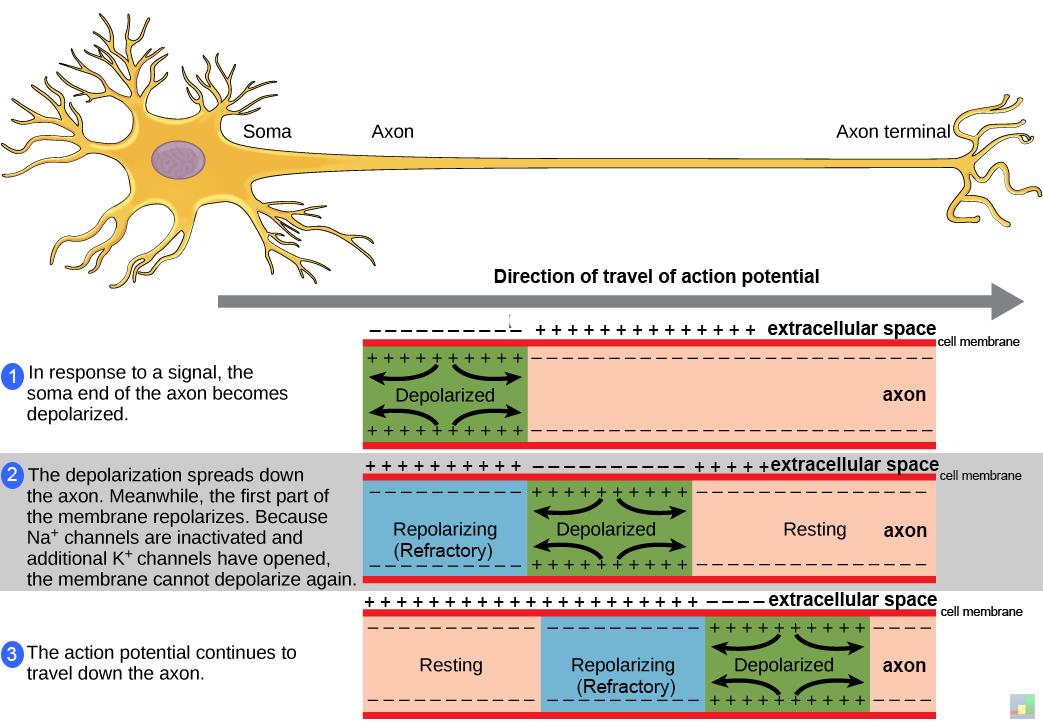 | |
Nerve conduction in unmyelinated fibres. click on image to enlarge
Note that the refractory period of already activated cells prevents the impulse flowing backwards.
Conduction in myelinated nerve fibres
The principle of conduction in myelinated nerve fibres is similar to that of continuous conduction which is described above. Myelinated fibres are insulated by myelin. The areas covered by myelin cannot be depolarised. The small areas that lack myelin are called nodes of Ranvier. Depolarisation therefore jumps from one node to another in a process called saltatory conduction.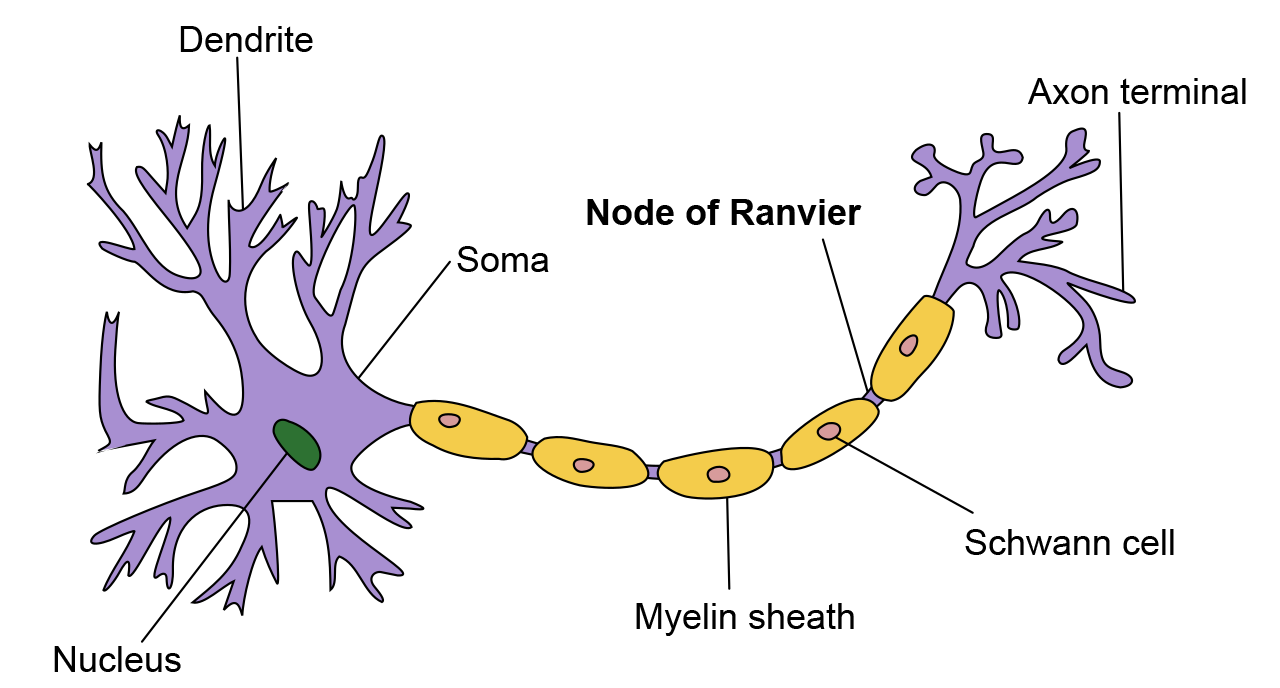 | |
Myelinated nerve fibres. Image highlighting myelin sheath with gaps between myelinated Schwann cells: nodes of Ranvier. click on image to enlarge
Conduction in myelinated fibres is up to 50 times faster than in unmyelinated nerve
Saltatory conduction is rapid and conserves energy as much smaller areas of axon use energy to power repolarization via active pumping of Na+ and K+.
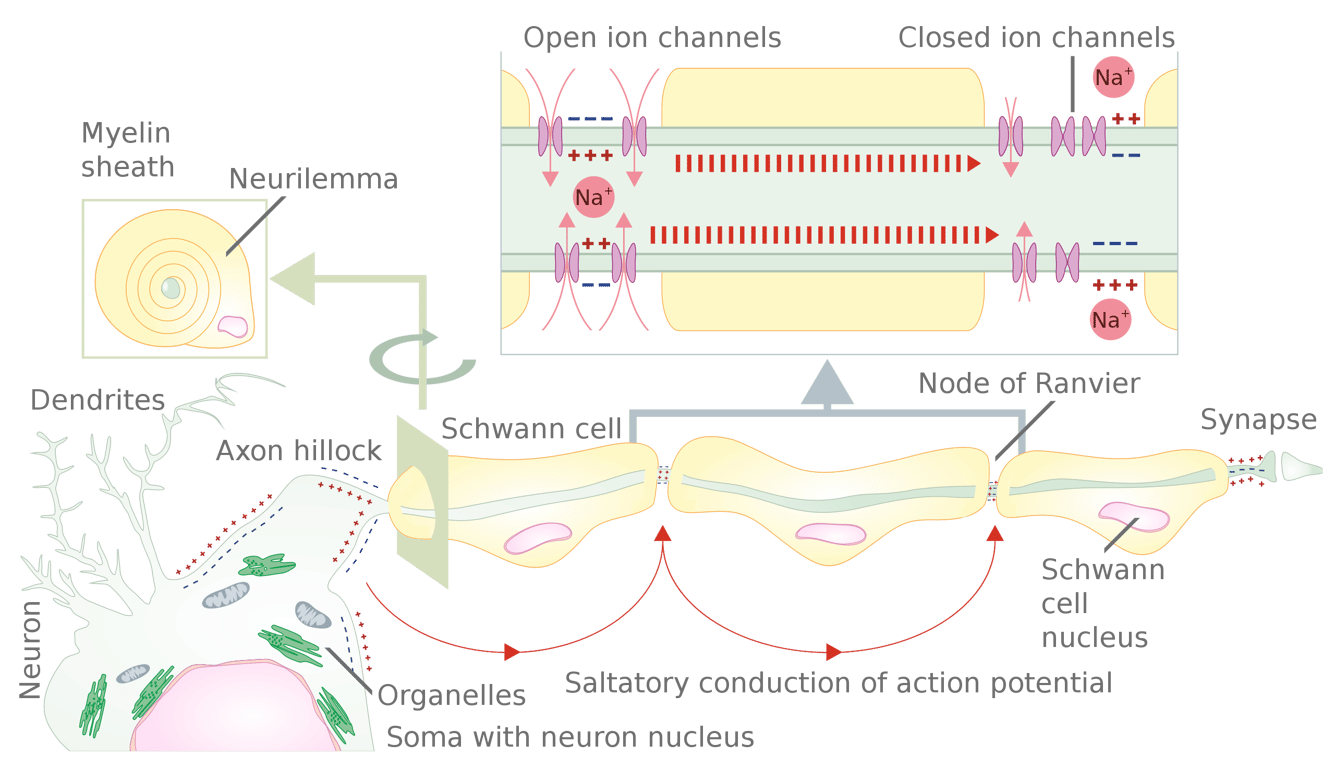 | |
Conduction in myelinated fibres: saltatory conduction. click on image to enlarge
Key Points
- Myelinated nerve fibres have gaps called nodes of Ranvier, the nerve impulse is passed from one node to the next which is known as saltatory conduction.
- Propagation along a nerve is based upon an all or nothing principle.
- An increase in the size of a nerve diameter increases the nerves conduction speed.
- Unidirectional flow occurs in both myelinated and un-myelinated nerve fibres and is the result of the refractory period of an ionic gate meaning once a depolarisation has occurred the ion channel cannot be immediately restimulated.