Innate immune system: Phagocytes
Neutrophils, macrophages and monocytes are the key phagocytic cells in the immune system that work to eliminate pathogens through phagocytosis. They are all derived from myeloblasts. Note that monocytes are a type of white blood cell that circulate in the bloodstream, and when they migrate into tissues, they differentiate into macrophages.
Neutrophils: The most abundant type of white blood cell, typically accounting for 50-70% of all white cells in humans. Neutrophils are short-lived (average 6–8 hours in circulation, up to a few days in tissues) granulocytes and are highly mobile. They act as 'first responders' to infection, rapidly migrating to sites of inflammation in response to chemoattractants, such as complement proteins (e.g., C5a) and cytokines (e.g., IL-8, TNF-α), in a process called chemotaxis. Neutrophils can destroy pathogens via:
Macrophages: Develop from monocytes, which originate from myeloid progenitors in the bone marrow. Macrophages are long-lived and present in all tissues, where they differentiate into tissue-resident macrophages (e.g., Kupffer cells in the liver, alveolar macrophages in the lungs, microglia in the brain). Macrophages play a dual role in innate immunity (nonspecific defence) and adaptive immunity (antigen presentation). They engulf pathogens through phagocytosis, trapping them in a phagosome, which then fuses with a lysosome to form a phagolysosome. Inside the phagolysosome, digestive enzymes (e.g., lysozyme, proteases) and reactive oxygen/nitrogen species degrade the pathogen. Additionally, macrophages present antigens via MHC class II molecules to activate T cells, linking innate and adaptive immunity.
Role of Opsonins in Enhancing Phagocytosis
Opsonins are molecules that tag pathogens for easier recognition and ingestion by neutrophils and macrophages. Key opsonins include:
Opsonization significantly improves efficiency of phagocytosis by providing a stronger attachment between the pathogen and phagocyte.
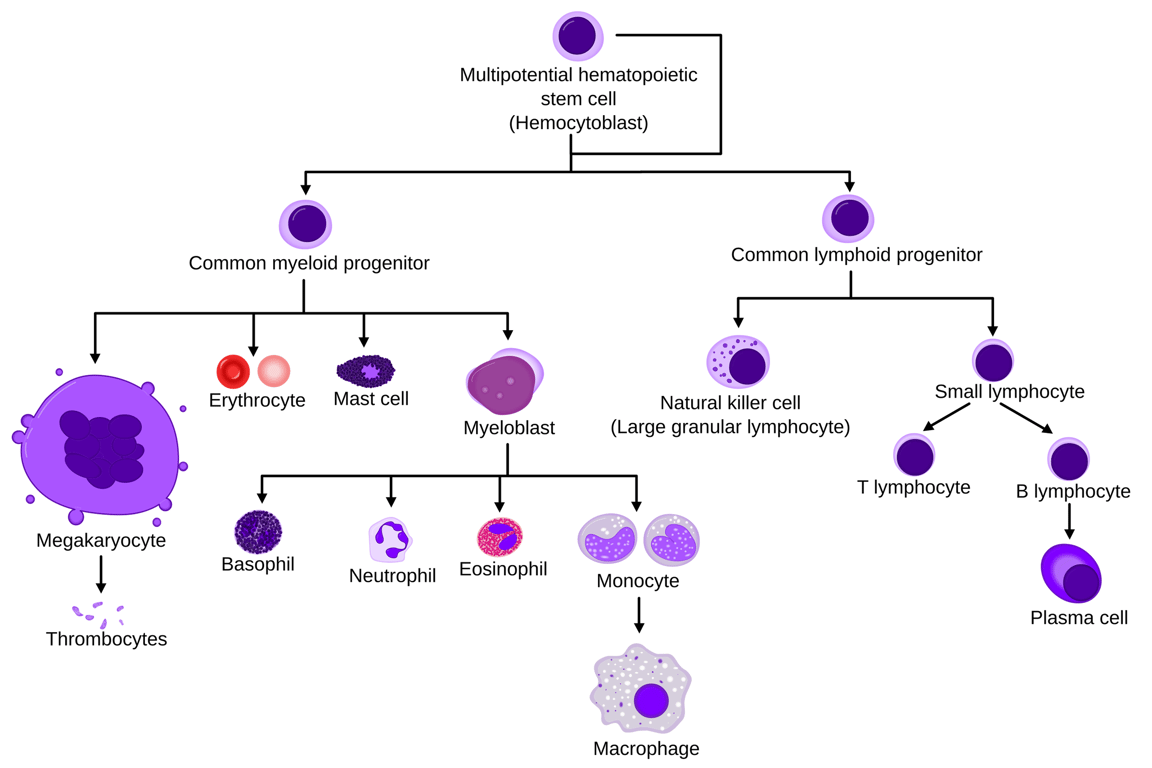 | |
white blood cell lines. Click on image to enlarge
Neutrophils: The most abundant type of white blood cell, typically accounting for 50-70% of all white cells in humans. Neutrophils are short-lived (average 6–8 hours in circulation, up to a few days in tissues) granulocytes and are highly mobile. They act as 'first responders' to infection, rapidly migrating to sites of inflammation in response to chemoattractants, such as complement proteins (e.g., C5a) and cytokines (e.g., IL-8, TNF-α), in a process called chemotaxis. Neutrophils can destroy pathogens via:
- Phagocytosis (ingestion and digestion).
- Degranulation (release of antimicrobial enzymes and reactive oxygen species).
- Neutrophil extracellular traps (NETs) (web-like structures composed of DNA and proteins that trap and kill microbes).
Macrophages: Develop from monocytes, which originate from myeloid progenitors in the bone marrow. Macrophages are long-lived and present in all tissues, where they differentiate into tissue-resident macrophages (e.g., Kupffer cells in the liver, alveolar macrophages in the lungs, microglia in the brain). Macrophages play a dual role in innate immunity (nonspecific defence) and adaptive immunity (antigen presentation). They engulf pathogens through phagocytosis, trapping them in a phagosome, which then fuses with a lysosome to form a phagolysosome. Inside the phagolysosome, digestive enzymes (e.g., lysozyme, proteases) and reactive oxygen/nitrogen species degrade the pathogen. Additionally, macrophages present antigens via MHC class II molecules to activate T cells, linking innate and adaptive immunity.
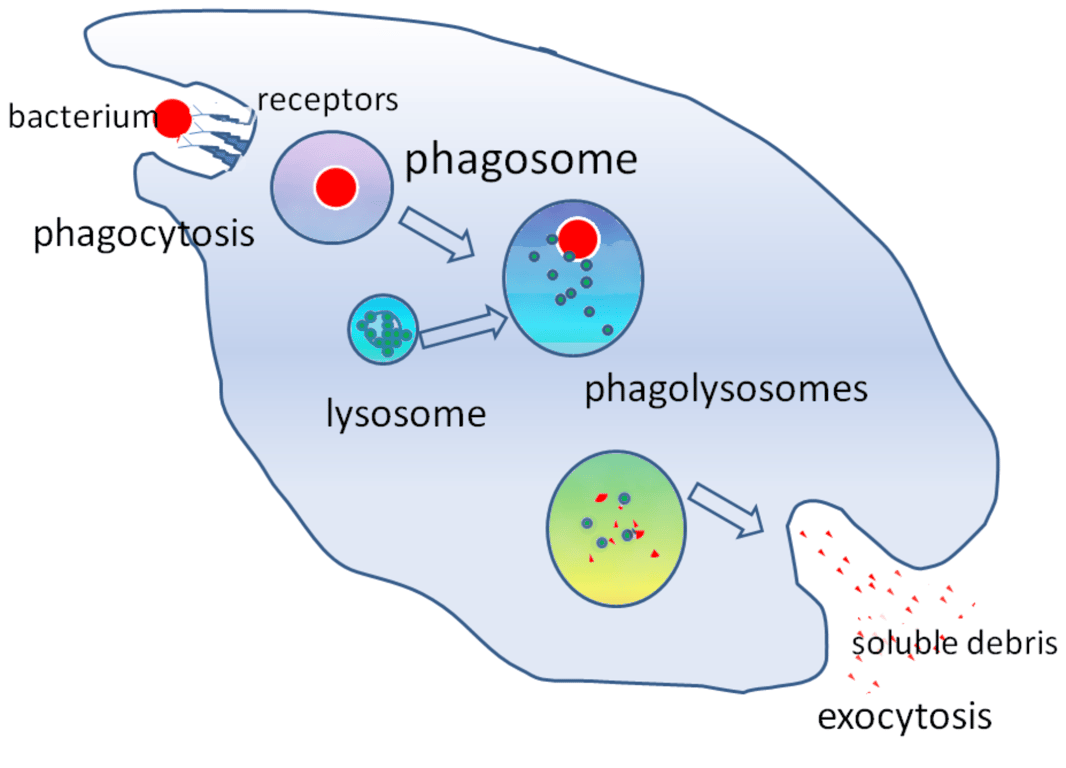 | |
Phagocytosis. Click on image to enlarge
Granulocytes are cells in the innate immune system characterised by the presence of granules in their cytoplasm. They include:
- Basophils
- Eosinophils
- Neutrophils
- Mast cells
Role of Opsonins in Enhancing Phagocytosis
Opsonins are molecules that tag pathogens for easier recognition and ingestion by neutrophils and macrophages. Key opsonins include:
- Antibodies (IgG): Bind to pathogens and interact with Fc receptors on phagocytes.
- Complement proteins (C3b): Coat pathogens and bind to complement receptors on phagocytes, enhancing uptake.
Opsonization significantly improves efficiency of phagocytosis by providing a stronger attachment between the pathogen and phagocyte.
Effects of splenectomy on macrophage function
The spleen plays a crucial role in filtering bloodborne pathogens and housing specialised macrophages. Following splenectomy the body loses a key macrophage reservoir, especially those targeting encapsulated bacteria e.g., Streptococcus pneumoniae, Neisseria meningitidis and Haemophilus influenzae. Macrophages are produced and housed by other organs such as the liver and bone marrow but these are less effective at clearing encapsulated bacteria.
Splenectomy significantly increases the risk of severe infection. This is sometimes referred to as overwhelming post-splenectomy infection (OPSI). This is the rationale for enhanced vaccination and prophylactic antibiotic use in splenectomy patients.