Protein structure
Normal protein function is essential for life. Homeostatic mechanisms exist to protect the form and function of proteins.
The primary function of most proteins is to bind to other molecules and proteins. Protein binding is governed by protein structure.
Primary structure refers to the amino acid sequence of a protein. Primary structure changes are often the result of gene mutations and can have significant effects on protein function
Protein secondary structure is the local spatial conformation of the polypeptide backbone excluding the side chains. Secondary structure elements typically spontaneously form as an intermediate before the protein folds into its three dimensional tertiary structure.
A proteins tertiary structure refers to a proteins shape i.e. how the amino acid chain is folded and how it bonds to itself. Tertiary structure changes in response to changes to the local environment such as pH, temperature, pressure, electrolyte concentrations and osmolality. It is this folded and adjustable shape that allows proteins to act as receptors.
Folding is a complex process which sees a protein achieve its lowest energy conformation. It is overseen by molecular chaperones such as heat shock proteins. Misfolded proteins can accumulate and damage cell function e.g. in Alzheimer's there is misfolding of the amyloid-β protein which results in amyloid plaque accumulation. Healthy tissues will typically detect and destroy misfolded proteins.
Excessive changes in the environment can cause an irreversible change in a proteins shape called denaturing. Homeostasis serves to prevent this.
Quaternary structure refers to the structure of proteins which are themselves composed of two or more smaller protein chains (also referred to as subunits). Not all proteins will have a quaternary structure.
The primary function of most proteins is to bind to other molecules and proteins. Protein binding is governed by protein structure.
Protein structure
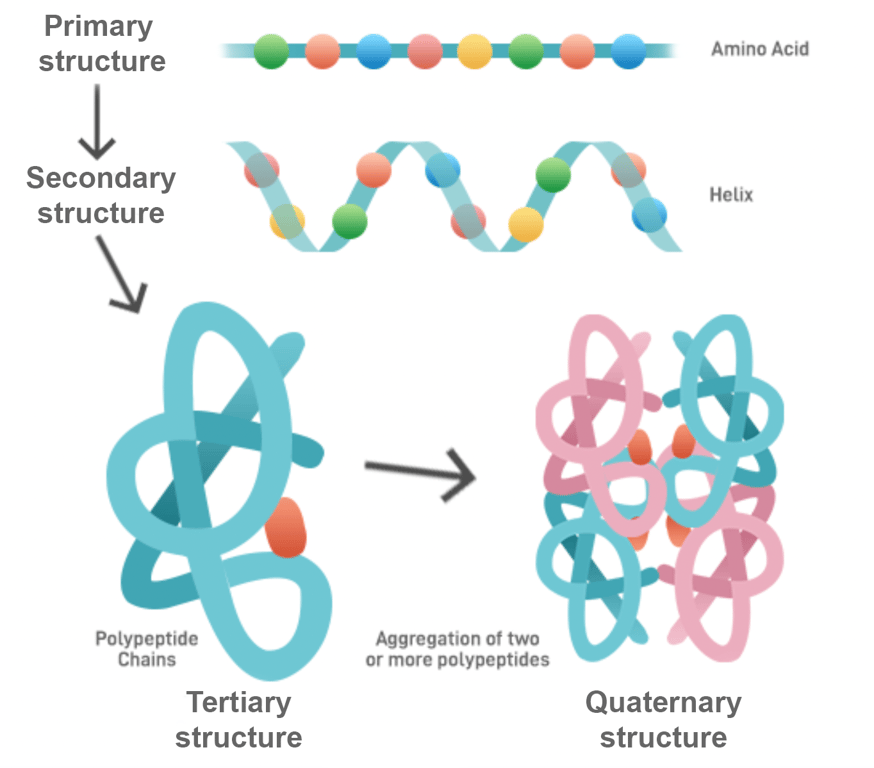 | |
Protein structure. Click on image to enlarge
Primary structure refers to the amino acid sequence of a protein. Primary structure changes are often the result of gene mutations and can have significant effects on protein function
Protein secondary structure is the local spatial conformation of the polypeptide backbone excluding the side chains. Secondary structure elements typically spontaneously form as an intermediate before the protein folds into its three dimensional tertiary structure.
Note that you are unlikely to be asked about secondary structure (which refers to highly regular local sub-structures on the polypeptide chain) and quaternary structure (three-dimensional structure of a multi-subunit protein and how the subunits fit together).
Primary and tertiary structure are the most important concepts to understand for the exam
Primary and tertiary structure are the most important concepts to understand for the exam
A proteins tertiary structure refers to a proteins shape i.e. how the amino acid chain is folded and how it bonds to itself. Tertiary structure changes in response to changes to the local environment such as pH, temperature, pressure, electrolyte concentrations and osmolality. It is this folded and adjustable shape that allows proteins to act as receptors.
Folding is a complex process which sees a protein achieve its lowest energy conformation. It is overseen by molecular chaperones such as heat shock proteins. Misfolded proteins can accumulate and damage cell function e.g. in Alzheimer's there is misfolding of the amyloid-β protein which results in amyloid plaque accumulation. Healthy tissues will typically detect and destroy misfolded proteins.
Excessive changes in the environment can cause an irreversible change in a proteins shape called denaturing. Homeostasis serves to prevent this.
Quaternary structure refers to the structure of proteins which are themselves composed of two or more smaller protein chains (also referred to as subunits). Not all proteins will have a quaternary structure.