Homeostasis
On this page
Physiological control mechanisms typically follow a common basic structure. The parameter being controlled is known as a 'variable' and homeostatic mechanisms are responsible for tightly regulating various physiological variables. The predominant mode of regulation is through negative feedback. The components of a negative feedback system are shown below:
The term 'negative feedback' arises from the fact that effectors always act in the opposite direction to the detected change.
The 'set point' implies a single optimum value for each physiological variable but in reality there is usually a range within which physiological processes can function normally. This range is referred to as the set point, and it allows for some tolerance in physiological systems.
The set point can be adjusted in certain systems based on physiological requirements. An example is during infection where compounds called pyrogens are produced and circulate to the hypothalamus resetting the bodies thermostat to a higher value.
It's important to note that all negative feedback systems share a common operational feature: they induce oscillations in the controlled variable. This occurs because there is a delay in the system's detection and response to a variable change. The delay causes the variable to overshoot the set point slightly, activating the opposite restorative mechanism, resulting in smaller oscillations.
Over time, these oscillations settle within the optimal range for physiological function. Typically, these oscillations have minimal visible effects. However, in cases where unusually long delays are introduced, the oscillations can become extreme e.g Cheyne-Stokes' Breathing
Negative Feedback System Components:
| Component | Description |
|---|---|
| Detectors | Often neural receptor cells that measure the variable in question |
| Comparator | Typically a neural assembly in the central nervous system that receives input from detectors and compares signals to the desired level or set point |
| Effectors | Muscular and/or glandular tissue that is activated by the comparator to restore the variable to its set point |
The term 'negative feedback' arises from the fact that effectors always act in the opposite direction to the detected change.
Negative feedback systems are key to maintaining homeostasis. Receptors detect changes in a physiological variable, a comparator receives this information and initiates an effector to change the variable in question (in the opposite direction to the change)
| Example of negative feedback: Temperature control |
|---|
| When the blood temperature exceeds 37ºC the brain initiates mechanism to reduce core temperature such as sweating. If the core temperature then drops to 35ºC the brain will initiate mechanisms to increase core temperature such as involuntary muscle contractions (shivering) |
The 'set point' implies a single optimum value for each physiological variable but in reality there is usually a range within which physiological processes can function normally. This range is referred to as the set point, and it allows for some tolerance in physiological systems.
The set point can be adjusted in certain systems based on physiological requirements. An example is during infection where compounds called pyrogens are produced and circulate to the hypothalamus resetting the bodies thermostat to a higher value.
A set point is not a single value but a narrow range within which physiological systems will operate within.
It's important to note that all negative feedback systems share a common operational feature: they induce oscillations in the controlled variable. This occurs because there is a delay in the system's detection and response to a variable change. The delay causes the variable to overshoot the set point slightly, activating the opposite restorative mechanism, resulting in smaller oscillations.
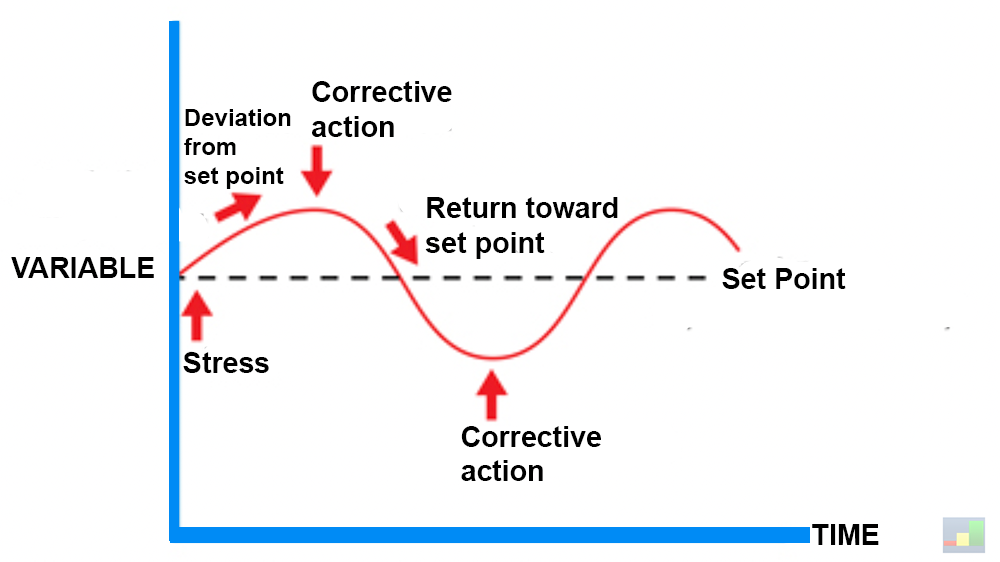 | |
Oscillations around the set point. click on image to enlarge
Over time, these oscillations settle within the optimal range for physiological function. Typically, these oscillations have minimal visible effects. However, in cases where unusually long delays are introduced, the oscillations can become extreme e.g Cheyne-Stokes' Breathing
| Example of oscillations around set point: Cheyne-Stokes' Breathing |
|---|
| Patients with congestive heart failure may exhibit a condition called Cheyne-Stokes' breathing. This condition involves periods of deep breathing interspersed with periods of no breathing (apnea). It is partially caused by the slow flow of blood from the lungs to the brain, resulting in a significant delay in the detection and actioning of blood CO2 levels |
Negative feedback systems cause oscillations in the variables they control due to time delay in detecting & effecting a change in a variable.
Positive Feedback
In contrast to negative feedback, some physiological responses employ positive feedback, which leads to rapid amplification. Here are a couple of examples:- Initiation of an action potential: Sodium entry causes depolarization, which further increases sodium entry, leading to additional depolarization.
- Hormone level escalation in reproduction.
Some homeostatic mechanisms use positive feedback systems or amplification such as generation of action potentials. This system is regarded as more unstable and requires a mechanism to break the feedback loop such as time delay in repolarizing or child birth.