Crohn's disease
Crohn's disease is a form of inflammatory bowel disease. It commonly affects the terminal ileum and colon but may be seen anywhere from the mouth to anus.
Pathology
Crohn's disease typically presents in late adolescence or early adulthood. Features include:
Questions regarding the 'extra-intestinal' features of inflammatory bowel disease are common:
Pathology
- cause is unknown but there is a strong genetic susceptibility
- inflammation occurs in all layers, down to the serosa. This is why patients with Crohn's are prone to strictures, fistulas and adhesions
Crohn's disease typically presents in late adolescence or early adulthood. Features include:
- presentation may be non-specific symptoms such as weight loss and lethargy
- diarrhoea: the most prominent symptom in adults. Crohn's colitis may cause bloody diarrhoea
- abdominal pain: the most prominent symptom in children
- perianal disease: e.g. Skin tags or ulcers
- extra-intestinal features are more common in patients with colitis or perianal disease
Questions regarding the 'extra-intestinal' features of inflammatory bowel disease are common:
| Common to both Crohn's disease (CD) and Ulcerative colitis (UC) | Notes | |
|---|---|---|
| Related to disease activity | Arthritis: pauciarticular, asymmetric Erythema nodosum Episcleritis Osteoporosis | Arthritis is the most common extra-intestinal feature in both CD and UC Episcleritis is more common in CD |
| Unrelated to disease activity | Arthritis: polyarticular, symmetric Uveitis Pyoderma gangrenosum Clubbing Primary sclerosing cholangitis | Primary sclerosing cholangitis is much more common in UC Uveitis is more common in UC |
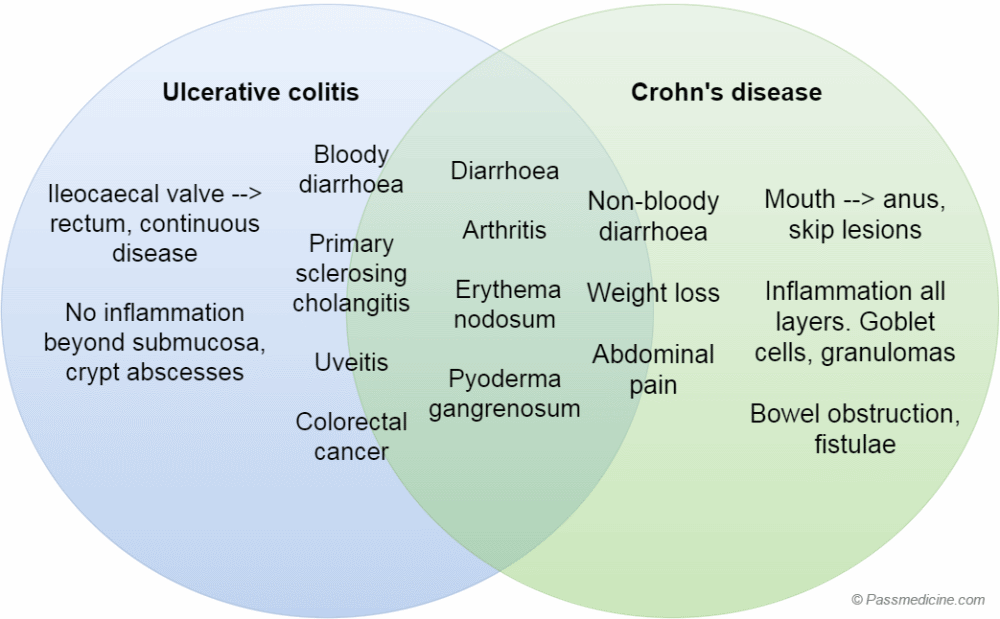 | |
Venn diagram showing shared features and differences between ulcerative colitis and Crohn's disease. Note that whilst some features are present in both, some are much more common in one of the conditions, for example colorectal cancer in ulcerative colitis