Tetralogy of Fallot
Tetralogy of Fallot (TOF) is the most common cause of cyanotic congenital heart disease*. It typically presents at around 1-2 months, although may not be picked up until the baby is 6 months old
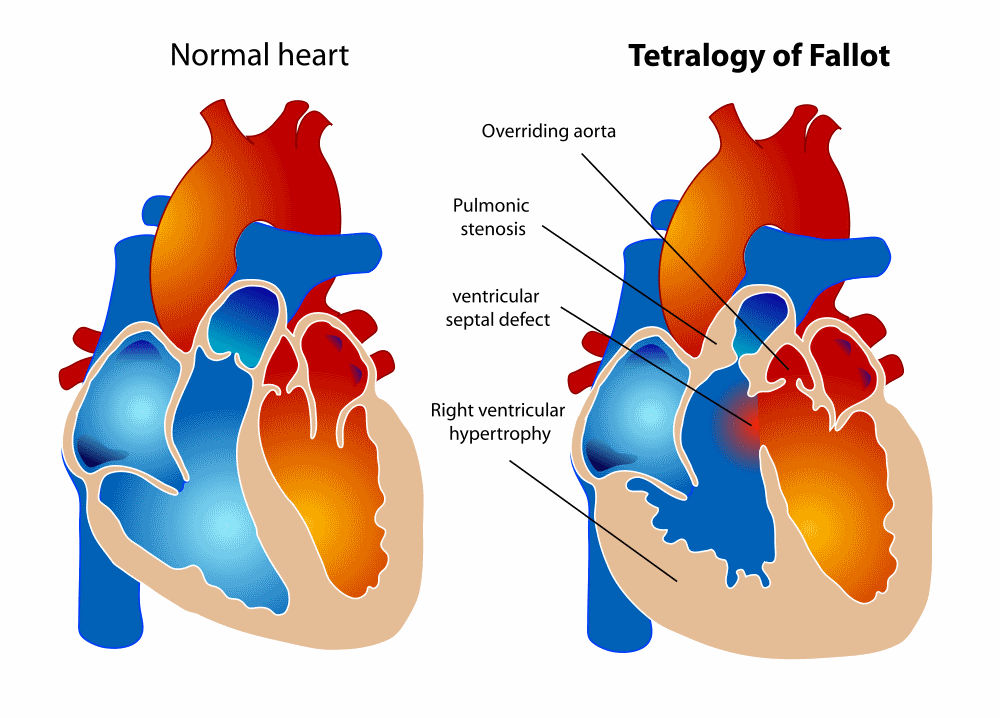
TOF is a result of anterior malalignment of the aorticopulmonary septum. The four characteristic features are:
The severity of the right ventricular outflow tract obstruction determines the degree of cyanosis and clinical severity
Other features
Management
*however, at birth transposition of the great arteries is the more common lesion as patients with TOF generally present at around 1-2 months
TOF is a result of anterior malalignment of the aorticopulmonary septum. The four characteristic features are:
- ventricular septal defect (VSD)
- right ventricular hypertrophy
- right ventricular outflow tract obstruction, pulmonary stenosis
- overriding aorta
 | |
The severity of the right ventricular outflow tract obstruction determines the degree of cyanosis and clinical severity
Other features
- cyanosis
- causes a right-to-left shunt
- ejection systolic murmur due to pulmonary stenosis (the VSD doesn't usually cause a murmur)
- a right-sided aortic arch is seen in 25% of patients
- chest x-ray shows a 'boot-shaped' heart, ECG shows right ventricular hypertrophy
Management
- surgical repair is often undertaken in two parts
- cyanotic episodes may be helped by beta-blockers to reduce infundibular spasm
*however, at birth transposition of the great arteries is the more common lesion as patients with TOF generally present at around 1-2 months