Systemic sclerosis
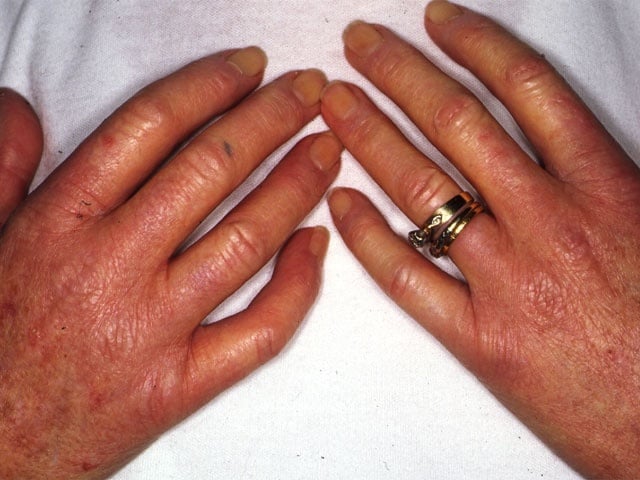
Systemic sclerosis is a condition of unknown aetiology characterised by hardened, sclerotic skin and other connective tissues. It is four times more common in females
There are three patterns of disease:
Limited cutaneous systemic sclerosis
Diffuse cutaneous systemic sclerosis
Scleroderma (without internal organ involvement)
Antibodies
There are three patterns of disease:
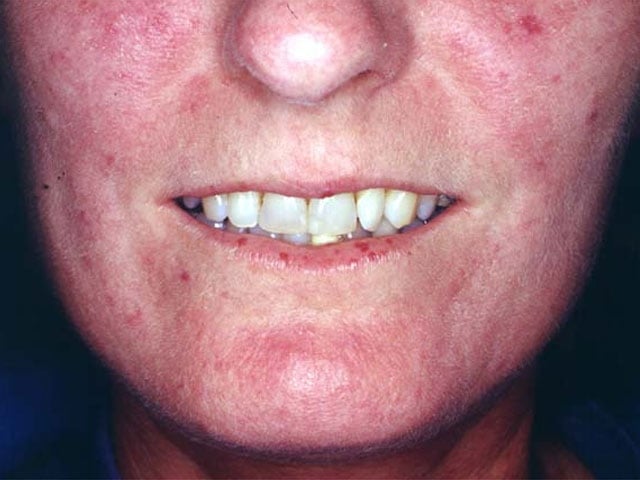
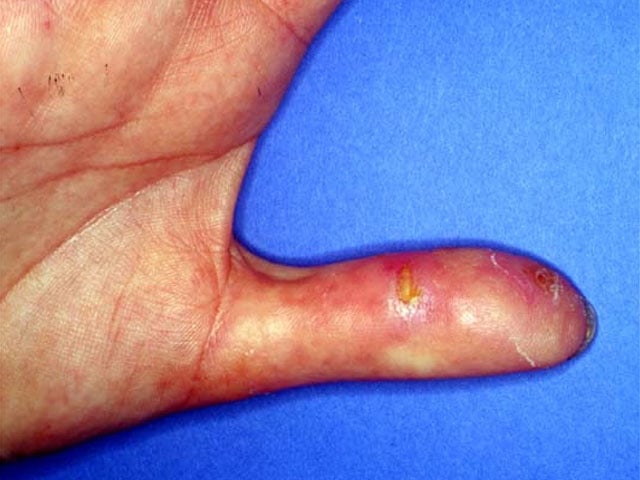
Limited cutaneous systemic sclerosis
- Raynaud's may be first sign
- scleroderma affects face and distal limbs predominately
- associated with anti-centromere antibodies
- a subtype of limited systemic sclerosis is CREST syndrome: Calcinosis, Raynaud's phenomenon, oEsophageal dysmotility, Sclerodactyly, Telangiectasia
Diffuse cutaneous systemic sclerosis
- scleroderma affects trunk and proximal limbs predominately
- associated with scl-70 antibodies
- hypertension, lung fibrosis and renal involvement seen
- poor prognosis
Scleroderma (without internal organ involvement)
- tightening and fibrosis of skin
- may be manifest as plaques (morphoea) or linear
 | |
| © Image used on license from DermNet NZ | |
 | |
| © Image used on license from DermNet NZ | |
 | |
| © Image used on license from DermNet NZ | |
Antibodies
- ANA positive in 90%
- RF positive in 30%
- anti-scl-70 antibodies associated with diffuse cutaneous systemic sclerosis
- anti-centromere antibodies associated with limited cutaneous systemic sclerosis