Thyroid disorders: a very basic introduction
On this page
Disorders of thyroid function are very commonly encountered in clinical practice. Around 2% of the UK population has hypothyroidism (an under active thyroid gland) whilst around 1% have thyrotoxicosis (an over active gland). Both hypothyroidism and hyperthyrodism (also known as thyrotoxicosis) are around 10 times more common in women than men.
The thyroid gland is one of the largest endocrine organs in the body. It is a bi-lobed structure which is found in the anterior neck. As with many endocrine organs, it is part of a hypothalamus-pituitary-end organ system with negative feedback cycles to maintain normal circulating levels of the hormone, in this case thyroxine and triiodothyronine.
On a simple level the hypothalamus secretes thyrotropin-releasing hormone (TRH) which stimulates the anterior pituitary to secrete thyroid-stimulating hormone (TSH). This then acts on the thyroid gland increasing the production of thyroxine (T4) and triiodothyronine (T3), the two main thyroid hormones. These then act on a wide variety of tissues, helping to regulate the use of energy sources, protein synthesis, and controls the body's sensitivity to other hormones.
Hypothyroidism may be classified as follows:
Whilst there are a number of causes thyrotoxicosis the vast majority are primary in nature. Congenital thyrotoxicosis is not seen and secondary hyperthyroidism is rare, account for less than 1% of cases.
The majority of thyroid problems seen in the developed world are a consequence of autoimmunity.
The table below shows the different autoimmune problems which cause thyroid dysfunction:
It should be remembered that a lot of the conditions mentioned above don't always cause either hypothyroidism or hyperthyroidism, there is sometimes some overlap, as shown below:
Thyroid disorders can present in a large variety of ways. Often (but not always) the symptoms present are the opposite depending on whether the thyroid gland is under or over active, for example hypothyroidism may result in weight gain whilst thyrotoxicosis normally leads to weight loss
Investigations and diagnosis
The principle investigation is 'thyroid function tests', or TFTs for short:
The table below shows how thyroid function tests are interpreted:
A number of thyroid autoantibodies can be tested for (remember the majority of thyroid disorders are autoimmune). The 3 main types are:
There is significant overlap between the type of antibodies present and particular diseases, but generally speaking TSH receptor antibodies are present in around 90-100% of patients with Graves' disease and anti-TPO antibodies are seen in around 90% of patients with Hashimoto's thyroiditis
Other tests include:
Treatment
This clearly depends on the cause. For patients with hypothyrodism thyroxine is given in the form of levothyroxine to replace the underlying deficiency.
Patients with thyrotoxicosis may be treated with:
Structure and function
The thyroid gland is one of the largest endocrine organs in the body. It is a bi-lobed structure which is found in the anterior neck. As with many endocrine organs, it is part of a hypothalamus-pituitary-end organ system with negative feedback cycles to maintain normal circulating levels of the hormone, in this case thyroxine and triiodothyronine.
On a simple level the hypothalamus secretes thyrotropin-releasing hormone (TRH) which stimulates the anterior pituitary to secrete thyroid-stimulating hormone (TSH). This then acts on the thyroid gland increasing the production of thyroxine (T4) and triiodothyronine (T3), the two main thyroid hormones. These then act on a wide variety of tissues, helping to regulate the use of energy sources, protein synthesis, and controls the body's sensitivity to other hormones.
How are thyroid problems classified?
Hypothyroidism may be classified as follows:
- primary hypothyroidism: there is a problem with the thyroid gland itself, for example an autoimmune disorder affecting thyroid tissue (see below)
- secondary hypothyroidism: usually due to a disorder with the pituitary gland (e.g.pituitary apoplexy) or a lesion compressing the pituitary gland
- congenital hypothyroidism: due to a problem with thyroid dysgenesis or thyroid dyshormonogenesis
Whilst there are a number of causes thyrotoxicosis the vast majority are primary in nature. Congenital thyrotoxicosis is not seen and secondary hyperthyroidism is rare, account for less than 1% of cases.
What causes thyroid problems?
The majority of thyroid problems seen in the developed world are a consequence of autoimmunity.
The table below shows the different autoimmune problems which cause thyroid dysfunction:
| Hypothyroidism | Thyrotoxicosis | |
|---|---|---|
| Most common cause | Hashimoto's thyroiditis
| Graves' disease
|
| Other causes | Subacute thyroiditis (de Quervain's)
Riedel thyroiditis
Postpartum thyroiditis Drugs
Iodine deficiency
| Toxic multinodular goitre
Drugs
|
It should be remembered that a lot of the conditions mentioned above don't always cause either hypothyroidism or hyperthyroidism, there is sometimes some overlap, as shown below:
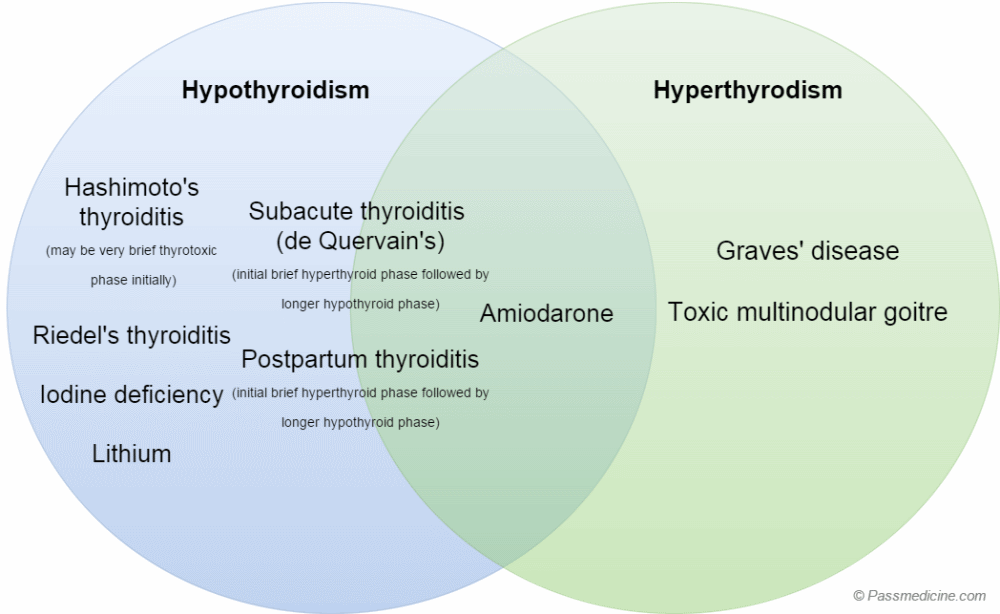 | |
Venn diagram showing how different causes of thyroid dysfunction may manifest. Note how many causes of hypothyroidism may have an initial thyrotoxic phase.
Symptoms and signs
Thyroid disorders can present in a large variety of ways. Often (but not always) the symptoms present are the opposite depending on whether the thyroid gland is under or over active, for example hypothyroidism may result in weight gain whilst thyrotoxicosis normally leads to weight loss
| Feature | Hypothyroidism | Thyrotoxicosis |
|---|---|---|
| General | Weight gainLethargy Cold intolerance | Weight loss'Manic', restlessness Heat intolerance |
| Cardiac | - | Palpitations, may even provoke arrhythmias e.g. atrial fibrillation |
| Skin | Dry (anhydrosis), cold, yellowish skin Non-pitting oedema (e.g. hands, face) Dry, coarse scalp hair, loss of lateral aspect of eyebrows | Increased sweating Pretibial myxoedema: erythematous, oedematous lesions above the lateral malleoli Thyroid acropachy: clubbing |
| Gastrointestinal | Constipation | Diarrhoea |
| Gynaecological | Menorrhagia | Oligomenorrhea |
| Neurological | Decreased deep tendon reflexes Carpal tunnel syndrome | AnxietyTremor |
Investigations and diagnosis
The principle investigation is 'thyroid function tests', or TFTs for short:
- these primarily look at serum TSH and T4 levels
- T3 can be measured but is only useful clinically in a small number of cases
- remember that TSH and T4 levels will often be 'opposite' in cases of primary hypo- or hyperthyroidism. For example in hypothyroidism the T4 level is low (i.e. not enough thyroxine) but the TSH level is high, because the hypothalamus/pituitary has detected low levels of T4 and is trying to get the thyroid gland to produce more
- TSH levels are more sensitive than T4 levels for monitoring patients with existing thyroid problems and are often used to guide treatment
The table below shows how thyroid function tests are interpreted:
| Diagnosis | TSH | Free T4 | Notes |
|---|---|---|---|
| Thyrotoxicosis (e.g. Graves' disease) | Low | High | |
| Primary hypothyroidism (e.g. Hashimoto's thyroiditis) | High | Low | |
| Secondary hypothyroidism | Low | Low | |
| Sick euthyroid syndrome | Low | Low | Common in hospital inpatients. Changes are reversible upon recovery from the systemic illness and no treatment is usually needed |
| Subclinical hypothyroidism | High | Normal | This is a common finding and represents patients who are 'on the way' to developing hypothyroidism but still have normal thyroxine levels. Note how the TSH levels, as mentioned above, are a more sensitive and early marker of thyroid problems |
| Poor compliance with thyroxine | High | Normal | Patients who are poorly compliant may only take their thyroxine in the days before a routine blood test. The thyroxine levels are hence normal but the TSH 'lags' and reflects longer term low thyroxine levels |
A number of thyroid autoantibodies can be tested for (remember the majority of thyroid disorders are autoimmune). The 3 main types are:
- Anti-thyroid peroxidase (anti-TPO) antibodies
- TSH receptor antibodies
- Thyroglobulin antibodies
There is significant overlap between the type of antibodies present and particular diseases, but generally speaking TSH receptor antibodies are present in around 90-100% of patients with Graves' disease and anti-TPO antibodies are seen in around 90% of patients with Hashimoto's thyroiditis
Other tests include:
- nuclear scintigraphy; toxic multinodular goitre reveals patchy uptake
Treatment
This clearly depends on the cause. For patients with hypothyrodism thyroxine is given in the form of levothyroxine to replace the underlying deficiency.
Patients with thyrotoxicosis may be treated with:
- propranolol: this is often used at the time of diagnosis to control thyrotoxic symptoms such as tremor
- carbimazole: blocks thyroid peroxidase from coupling and iodinating the tyrosine residues on thyroglobulin → reducing thyroid hormone production. Agranulocytosis is an important adverse effect to be aware of
- radioiodine treatment