Hypothalamus-Pituitary Axis
On this page
The hypothalamus is a division of the diencephalon that is principally involved in homeostasis.
Anatomically it is located in close proximity to the hypothalamus with which it is closely related. The hypothalamus secretes a number of releasing hormones which trigger the release of hormones from the anterior pituitary. The hormones of the posterior pituitary (ADH and oxytocin) are actually synthesised in the hypothalamus then transported to the posterior pituitary and stored pending release.
The table below shows the major nuclei of the hypothalamus:
Anatomically it is located in close proximity to the hypothalamus with which it is closely related. The hypothalamus secretes a number of releasing hormones which trigger the release of hormones from the anterior pituitary. The hormones of the posterior pituitary (ADH and oxytocin) are actually synthesised in the hypothalamus then transported to the posterior pituitary and stored pending release.
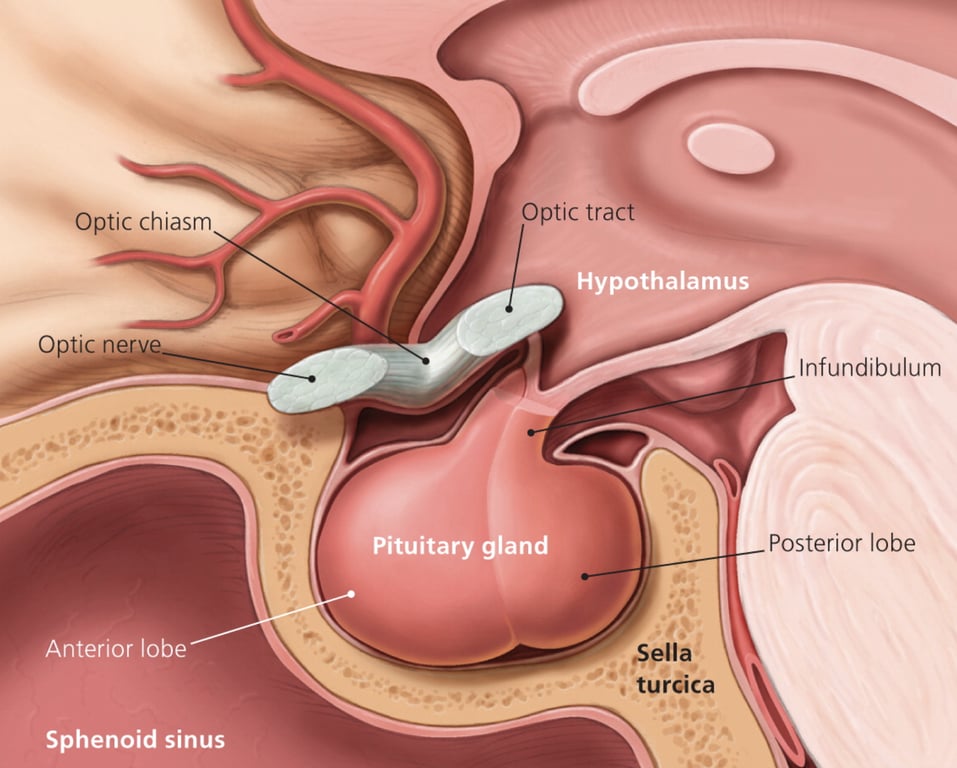 | |
Pituitary gland and relation to hypothalamus and optic chiasm. click on image to enlarge
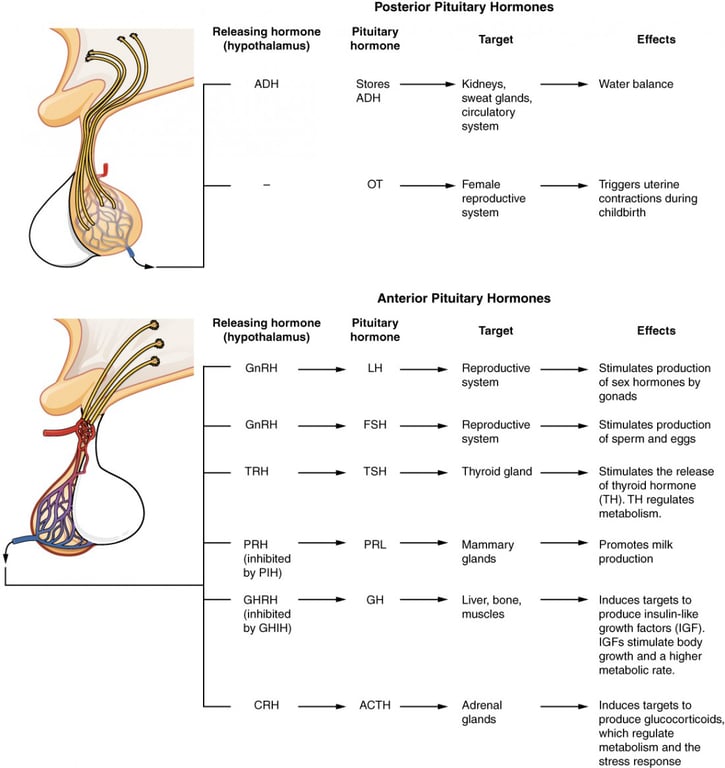 | |
Hypothalamus-Pituitary axis. *note the posterior pituitary hormones are synthesised in the hypothalamus itself so do not require releasing hormone stimulation. Click on image to enlarge
Disorders of pituitary function
Pituitary disorders may be broadly categorised into deficiency disorders related to underproduction of pituitary hormones or excess production of pituitary hormones. Pituitary tumours may cause over or underproduction of pituitary hormones. Head injuries, autoimmune conditions, vascular disease and infection are other causes of pituitary dysfunction.| Hormone | Deficiency | Excess |
|---|---|---|
| ADH | Central (cranial) diabetes insipidus | SIADH |
| Oxytocin | Depression symptoms | Emotional lability |
| FSH and LH | Hypogonadism Infertility Failure of secondary sexual characteristic development Low testosterone causing low muscle mass and bone density | Infertility Ovarian hyperstimulation Oligomenorrhea Cystic ovaries |
| TSH | Secondary hypothyroidism | Secondary hyperthyroidism |
| Prolactin | Insufficient lactation Subfertility Delayed puberty Menstrual disorders | Anovulatory infertility, Amenorrhea or oligomenorrhea Galactorrhea (lactation not associated with pregnancy) |
| Growth hormone | Pituitary dwarfism in children Decreased muscle mass Decreased bone density Increased central adipose tissue Increased LDL to HDL cholesterol ratio Tiredness and depression | Acromegaly in adults or gigantism in children |
| Cortisol | Adrenal insufficiency | Cushing syndrome |
Dopamine
Dopamine is a hormone released by several areas of the brain, most notably the substantia nigra, ventral tegmental area and the hypothalamus.
Dopamine has many roles including pain modulation, neuronal functioning, arousal and sexual gratification. It is also an inhibitor of prolactin.
Dopamine is a hormone released by several areas of the brain, most notably the substantia nigra, ventral tegmental area and the hypothalamus.
Dopamine has many roles including pain modulation, neuronal functioning, arousal and sexual gratification. It is also an inhibitor of prolactin.
Melanocyte-stimulating hormones (MSH)
MSH is produced by the anterior pituitary. MSH and ACTH share the same precursor molecule (proopiomelanocortin or POMC) which is cleaved into ACTH and MSH. Conditions where ACTH is raised, such as pregnancy, Cushing disease and primary adrenal insufficiency, typically feature hyperpigmentation as a result of ACTH binding to melanocytes and raised MSH.The nuclei of the hypothalamus
The hypothalamus is made up of groups of nuclei. There are 3 main nuclei areas:- Anterior (Supraoptic) nuclei
- Middle (Tuberal) Nuclei
- Posterior (Mammillary) Nuclei
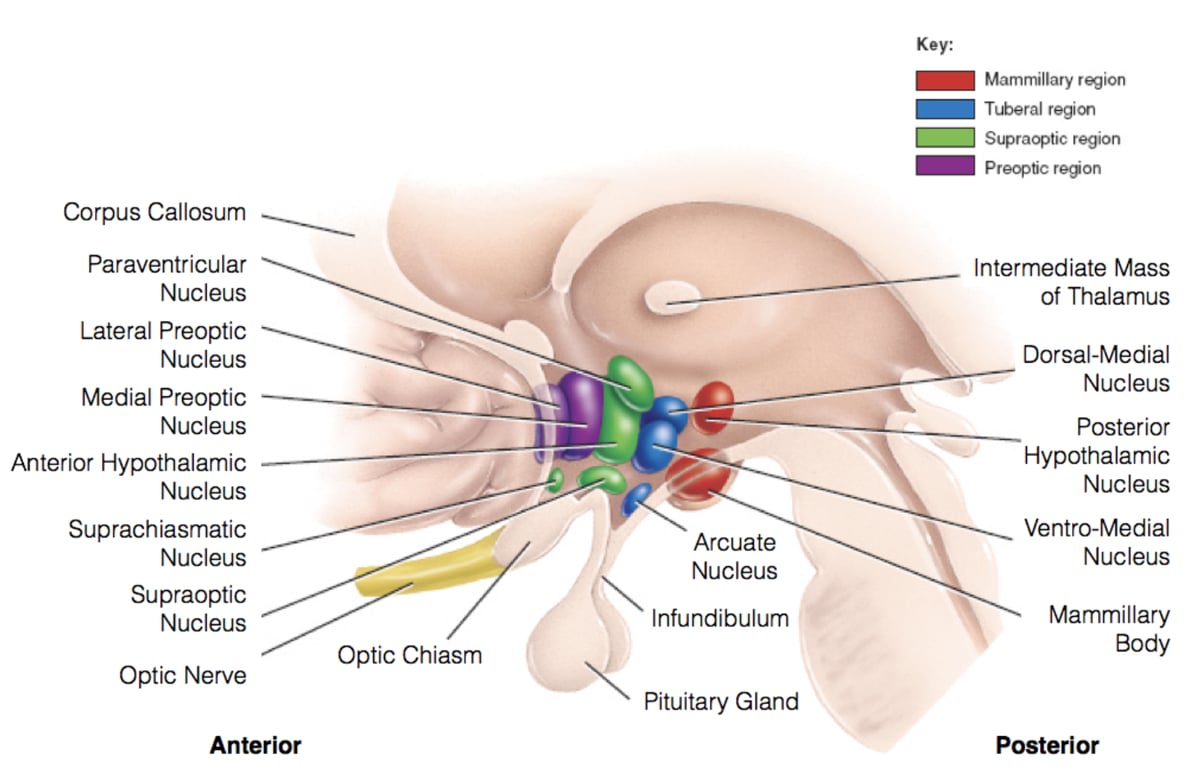 | |
Nuclei of the hypothalamus. Click on image to enlarge
The table below shows the major nuclei of the hypothalamus:
| Region | Area | Nucleus | Functions |
|---|---|---|---|
| Anterior (supraoptic) | Preoptic | Preoptic nucleus | Thermoregulation |
| Anterior (supraoptic) | Medial | Medial preoptic nucleus | Regulates the release of gonadotropic hormones from the adenohypophysis Contains the sexually dimorphic nucleus, which releases GnRH, differential development between sexes is based upon in utero testosterone levels Thermoregulation |
| Anterior (supraoptic) | Medial | Supraoptic nucleus | Vasopressin release Oxytocin release |
| Anterior (supraoptic) | Medial | Paraventricular nucleus | thyrotropin-releasing hormone release corticotropin-releasing hormone release oxytocin release vasopressin release somatostatin round |
| Anterior (supraoptic) | Medial | Anterior hypothalamic nucleus | thermoregulation panting sweating thyrotropin inhibition |
| Anterior (supraoptic) | Medial | Suprachiasmatic nucleus | Circadian rhythms |
| Anterior (supraoptic | Lateral | Lateral nucleus | Lateral hypothalamus functions:
|
| Middle (tuberal) | Medial | Dorsomedial hypothalamic nucleus | blood pressure heart rate GI stimulation |
| Middle (tuberal) | Medial | Ventromedial nucleus | satiety neuroendocrine control |
| Middle (tuberal) | Medial | Arcuate nucleus | Growth hormone-releasing hormone (GHRH) feeding Dopamine-mediated prolactin inhibition |
| Middle (tuberal) | Lateral | Lateral nucleus | Lateral hypothalamus functions:
|
| Middle (tuberal) | Lateral | Lateral tuberal nuclei | |
| Posterior (mammillary) | medial | Mammillary nuclei (part of mammillary bodies) | memory |
| Posterior (mammillary) | medial | Posterior nucleus | Increase blood pressure pupillary dilation shivering ADH release |
| Posterior (mammillary) | lateral | Lateral nucleus | Lateral hypothalamus functions:
|
| Posterior (mammillary) | lateral | Tuberomammillary nucleus | arousal (wakefulness and attention) feeding and energy balance learning memory sleep |