Clostridioides difficile (previously Clostridium difficile)
On this page
Background
Clostridioides difficile (previously known as Clostridium difficile) is a Gram positive, anaerobic, spore-forming, bacillus (rod) that is commonly encountered in hospital practice. C. difficile is quite common, with about 3% of adults and up to two-thirds of babies carrying the bacteria asymptomatically as part of the normal intestinal flora.Pathophysiology
Some strains produce exotoxins - Toxin A and Toxin B. These exotoxins cause intestinal damage which may lead to the development of pseudomembranous colitis. C.difficile develops when the normal gut flora are suppressed by broad-spectrum antibiotics. Clindamycin is historically associated with causing C.difficile but the aetiology has evolved significantly over the years. Second and third generation cephalosporins are now the leading cause but several antibiotics are known to be causative.Clostridioides difficile produces two key exotoxins:
Both toxins inactivate Rho GTPases, leading to cytoskeletal breakdown. Toxin B is now considered the primary virulence factor.
- Toxin A (enterotoxin): Disrupts the intestinal epithelial barrier, increases fluid secretion, and promotes inflammation, contributing to diarrhoea.
- Toxin B (cytotoxin): More potent than Toxin A, it damages colonic mucosal cells by disrupting the cytoskeleton, leading to cell death and pseudomembrane formation.
Both toxins inactivate Rho GTPases, leading to cytoskeletal breakdown. Toxin B is now considered the primary virulence factor.
The most commonly implicated antibiotics in C. difficile infection are clindamycin, cephalosporins (in particular second‑ and third‑generation cephalosporins), quinolones, co‑amoxiclav and aminopenicillins.
Clinical features
- Diarrhoea
- Abdominal pain
- Abdominal distension
- Raised white blood cell count is characteristic
- Fever
Complications
- Pseudomembranous colitis
- Toxic megacolon
- Perforation of the colon
- Peritonitis
- Dehydration and acute kidney injury
- Sepsis
- Death
Diagnosis
Diagnosis is made via detection of C.difficile toxin (CDT) in the stool.
Management
Patient's with C.diff may require general supportive care in terms of fluid and electrolyte supplementation. Any causative antibiotics should be stopped. Antibiotics effective against C.diff are the mainstay of medical treatment (see table 1 below). A minority of patients who are severely unwell may benefit from emergency colectomy.
Patients with C.diff should be managed using standard precautions to reduce the risk of transmission which includes appropriate hand washing, patient isolation, use of personal protective equipment (PPE), and diligent cleaning and disinfection of surfaces. Note C.diff spores are resistant to most alcohol based hand sanitiser so soap and water is preferred for hand washing.
Table 1: Antibiotics for adults aged 18 years and over as per NICE guidance 2021
| Treatment | Antibiotic, dosage and course length |
|---|---|
| First-line antibiotic for a first episode of mild, moderate or severe C. difficile infection | Vancomycin: 125 mg orally four times a day for 10 days |
| Second-line antibiotic for a first episode of mild, moderate or severe C. difficile infection if vancomycin is ineffective | Fidaxomicin: 200 mg orally twice a day for 10 days |
| Antibiotics for C. difficile infection if first- and second-line antibiotics are ineffective | Local microbiology advice advised. Specialists may initially offer: Vancomycin: Up to 500 mg orally four times a day for 10 days With or without Metronidazole: 500 mg intravenously three times a day for 10 days |
| Antibiotic for a further episode of C. difficile infection within 12 weeks of symptom resolution (relapse) | Fidaxomicin: 200 mg orally twice a day for 10 days |
| Antibiotics for a further episode of C. difficile infection more than 12 weeks after symptom resolution (recurrence) | Vancomycin: 125 mg orally four times a day for 10 days Or Fidaxomicin: 200 mg orally twice a day for 10 days |
| Antibiotics for life-threatening C. difficile infection | Urgent specialist advice advised, may require surgery. Antibiotics that specialists may initially offer are: Vancomycin: 500 mg orally four times a day for 10 days With Metronidazole: 500 mg intravenously three times a day for 10 days |
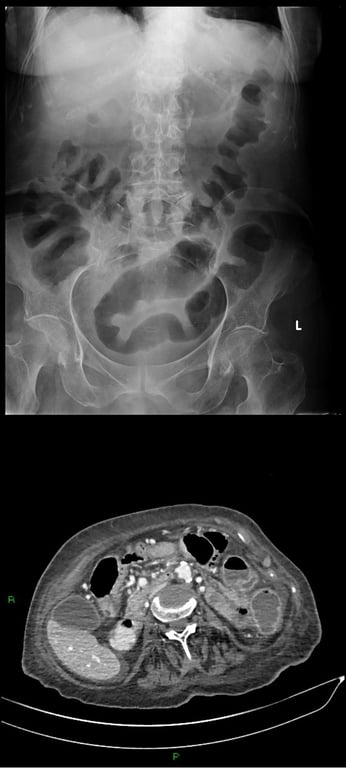 | |
| © Image used on license from Radiopaedia | |
Elderly lady with infectious colitis secondary to Clostridium difficile. On the abdominal film note the loss of bowel wall architecture and thumb-printing consistent with colitis. The CT from the same patient is enhanced by oral contrast. There is moderate free fluid in pelvis and peritoneum. The colon is oedematous throughout with enhancing walls, but of normal calibre. The sigmoid colon is smooth and featureless. Small bowel, liver, spleen, kidneys, adrenals and pancreas are normal.