SLE: renal complications
WHO classification
Class IV (diffuse proliferative glomerulonephritis) is the most common and severe form. Renal biopsy characteristically shows the following findings:
Management
- class I: normal kidney
- class II: mesangial glomerulonephritis
- class III: focal (and segmental) proliferative glomerulonephritis
- class IV: diffuse proliferative glomerulonephritis
- class V: diffuse membranous glomerulonephritis
- class VI: sclerosing glomerulonephritis
Class IV (diffuse proliferative glomerulonephritis) is the most common and severe form. Renal biopsy characteristically shows the following findings:
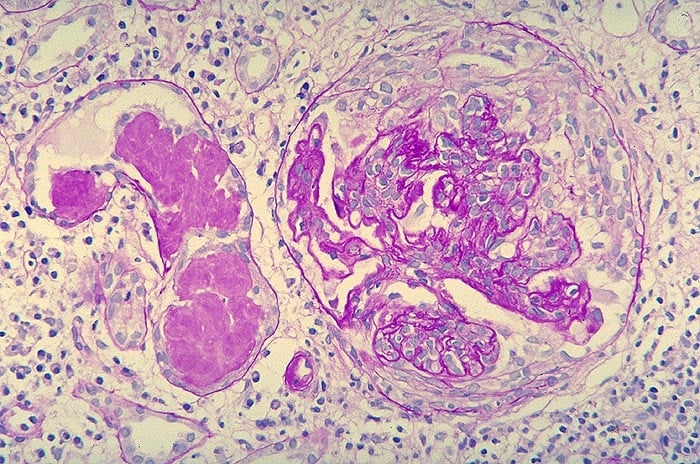
- glomeruli shows endothelial and mesangial proliferation, 'wire-loop' appearance
- if severe, the capillary wall may be thickened secondary to immune complex deposition
- electron microscopy shows subendothelial immune complex deposits
- granular appearance on immunofluorescence
 | |
| © Image used on license from PathoPic | |
Diffuse proliferative SLE. Proliferation of endothelial and mesangial cells. The thickening of the capillary wall results in a 'wire-loop' appearance. Some crescents are present.
Management
- treat hypertension
- corticosteroids if clinical evidence of disease
- immunosuppressants e.g. azathiopine/cyclophosphamide