Osteoporosis: management
NICE guidelines were updated in 2008 on the secondary prevention of osteoporotic fractures in postmenopausal women.
Key points include
Treatment criteria for patients not taking alendronate
Unfortunately, a number of complicated treatment cut-off tables have been produced in the latest guidelines for patients who do not tolerate alendronate
These take into account a patients age, theire T-score and the number of risk factors they have from the following list:
It is very unlikely that examiners would expect you to have memorised these risk tables so we've not included them in the revision notes but they may be found by following the NICE link. The most important thing to remember is:
Supplementary notes on treatment
Bisphosphonates
Vitamin D and calcium
Raloxifene - selective oestrogen receptor modulator (SERM)
Strontium ranelate
Denosumab
Teriparatide
Hormone replacement therapy
Hip protectors
Falls risk assessment
Key points include
- treatment is indicated following osteoporotic fragility fractures in postmenopausal women who are confirmed to have osteoporosis (a T-score of - 2.5 SD or below). In women aged 75 years or older, a DEXA scan may not be required 'if the responsible clinician considers it to be clinically inappropriate or unfeasible'
- vitamin D and calcium supplementation should be offered to all women unless the clinician is confident they have adequate calcium intake and are vitamin D replete
- alendronate is first-line
- around 25% of patients cannot tolerate alendronate, usually due to upper gastrointestinal problems. These patients should be offered risedronate or etidronate (see treatment criteria below)
- strontium ranelate and raloxifene are recommended if patients cannot tolerate bisphosphonates (see treatment criteria below)
Treatment criteria for patients not taking alendronate
Unfortunately, a number of complicated treatment cut-off tables have been produced in the latest guidelines for patients who do not tolerate alendronate
These take into account a patients age, theire T-score and the number of risk factors they have from the following list:
- parental history of hip fracture
- alcohol intake of 4 or more units per day
- rheumatoid arthritis
It is very unlikely that examiners would expect you to have memorised these risk tables so we've not included them in the revision notes but they may be found by following the NICE link. The most important thing to remember is:
- the T-score criteria for risedronate or etidronate are less than the others implying that these are the second line drugs
- if alendronate, risedronate or etidronate cannot be taken then strontium ranelate or raloxifene may be given based on quite strict T-scores (e.g. a 60-year-old woman would need a T-score < -3.5)
- the strictest criteria are for denosumab
Supplementary notes on treatment
Bisphosphonates
- alendronate, risedronate and etidronate are all licensed for the prevention and treatment of post-menopausal and glucocorticoid-induced osteoporosis
- all three have been shown to reduce the risk of both vertebral and non-vertebral fractures although alendronate, risedronate may be superior to etidronate in preventing hip fractures
- ibandronate is a once-monthly oral bisphosphonate
Vitamin D and calcium
- poor evidence base to suggest reduced fracture rates in the general population at risk of osteoporotic fractures - may reduce rates in frail, housebound patients
Raloxifene - selective oestrogen receptor modulator (SERM)
- has been shown to prevent bone loss and to reduce the risk of vertebral fractures, but has not yet been shown to reduce the risk of non-vertebral fractures
- has been shown to increase bone density in the spine and proximal femur
- may worsen menopausal symptoms
- increased risk of thromboembolic events
- may decrease risk of breast cancer
Strontium ranelate
- 'dual action bone agent' - increases deposition of new bone by osteoblasts (promotes differentiation of pre-osteoblast to osteoblast) and reduces the resorption of bone by inhibiting osteoclasts
- concerns regarding the safety profile of strontium have been raised recently. It should only be prescribed by a specialist in secondary care
- due to these concerns the European Medicines Agency in 2014 said it should only be used by people for whom there are no other treatments for osteoporosis
- increased risk of cardiovascular events: any history of cardiovascular disease or significant risk of cardiovascular disease is a contraindication
- increased risk of thromboembolic events: a Drug Safety Update in 2012 recommended it is not used in patients with a history of venous thromboembolism
- may cause serious skin reactions such as Stevens Johnson syndrome
Denosumab
- human monoclonal antibody that inhibits RANK ligand, which in turn inhibits the maturation of osteoclasts
- given as a single subcutaneous injection every 6 months
- initial trial data suggests that it is effective and well tolerated
Teriparatide
- recombinant form of parathyroid hormone
- very effective at increasing bone mineral density but role in the management of osteoporosis yet to be clearly defined
Hormone replacement therapy
- has been shown to reduce the incidence of vertebral fracture and non-vertebral fractures
- due to concerns about increased rates of cardiovascular disease and breast cancer it is no longer recommended for primary or secondary prevention of osteoporosis unless the woman is suffering from vasomotor symptoms
Hip protectors
- evidence to suggest significantly reduce hip fractures in nursing home patients
- compliance is a problem
Falls risk assessment
- no evidence to suggest reduced fracture rates
- however, do reduce rate of falls and should be considered in management of high risk patients
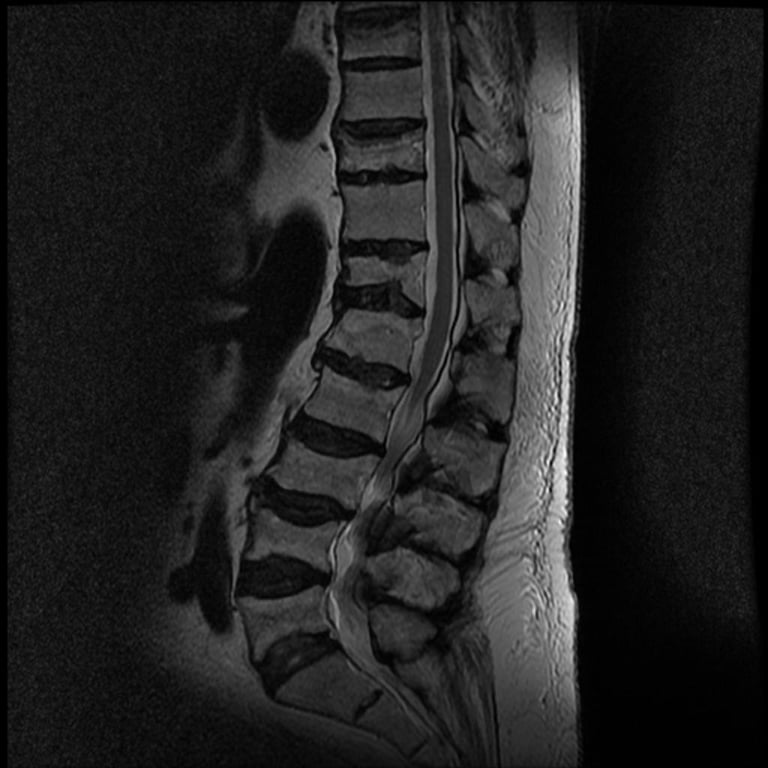 | |
| © Image used on license from Radiopaedia | |
MRI showing osteoporotic fractures of the 8th and 10th thoracic vertebrae.