Rubella
Rubella, also known as German measles, is a viral infection caused by the togavirus. Following the introduction of the MMR vaccine it is now rare with most years yielding no conformed cases in the UK. If contracted during pregnancy there is a risk of congenital rubella syndrome.
Spread
Clinical features
Complications
Investigation
Management
Epidemiology
- outbreaks more common around winter and spring
- incubation period is 14-21 days
- individuals are infectious from 7 days before symptoms appear to 4 days after the onset of the rash
Spread
- Primarily spread via droplet spread from respiratory secretions
- Less commonly spread by direct contact with an infected person
- Transplacental spread to fetus
Clinical features
- prodrome e.g. low grade fever
- rash: maculopapular, initially on face before spreading to whole body, usually fades by 3rd-5th day
- lymphadenopathy: suboccipital and postauricular
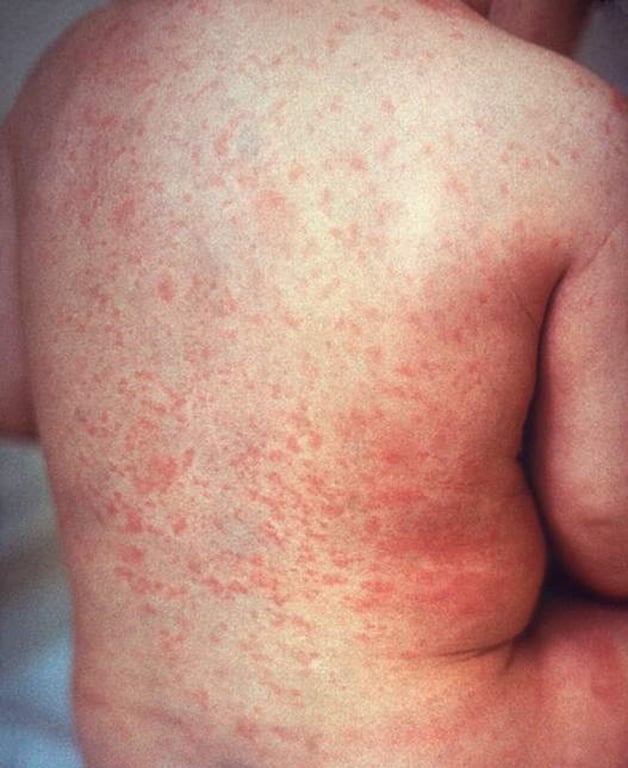 | |
The maculopapular rash in a patient with rubella. Click on image to enlarge
Complications
- arthritis
- thrombocytopenia
- encephalitis
- myocarditis
- congenital rubella syndrome if contracted in pregnancy (see below)
Rubella in pregnancy
If contracted during pregnancy there is a risk of congenital rubella syndrome.
Risk:
Features of congenital rubella syndrome:
Diagnosis:
If contracted during pregnancy there is a risk of congenital rubella syndrome.
Risk:
- In first 8-10 weeks risk of damage to fetus is as high as 90%
- Fetal damage is rare after 16 weeks
Features of congenital rubella syndrome:
- sensorineural deafness
- congenital cataracts
- congenital heart disease (e.g. patent ductus arteriosus)
- growth retardation
- hepatosplenomegaly
- purpuric skin lesions
- 'salt and pepper' chorioretinitis
- microphthalmia
- cerebral palsy
Diagnosis:
- IgM antibodies are raised in women recently exposed to the virus
Investigation
- Serological or PCR testing is gold standard investigation
- Local Health Protection Unit (HPU) will provide testing kit
Management
- No specific treatment
- Antipyretics for fever
- Advise on exclusion from school for 5 days from onset of rash
- Infection in pregnancy should prompt referral to obstetrics
- Notifiable disease requires notification of local authority or UKHSA health protection team
Key Points
- Incubation period is 2 to 3 weeks (remember incubation period for measles, mumps and rubella are all around 2 weeks!)
- Congenital infection is associated significant cardiovascular and neurological defects as well as increased risk of fetal death.
- Rubella (German measles) rash usually starts behind the ears. Measles also usually starts on the head.
- Rubella & Measles are both infective until around 4 days after the rash appears.
- MMR vaccination schedule: MMR is given twice, at 12 months and preschool (usually age 4).