Statins
On this page
Statins inhibit the action of HMG-CoA reductase (also known as 3-hydroxy-3-methylglutaryl co-enzyme A reductase), the rate-limiting enzyme in hepatic cholesterol synthesis.
Inhibition of HMG CoA reductase reduces low density lipoprotein cholesterol (LDL-C) levels by slowing down the production of cholesterol in the liver and increasing the liver's ability to remove the LDL-C already in the blood. Statins are less effective than fibrates in reducing triglyceride levels.
For primary prevention of CVD, high-intensity statin treatment (atorvastatin 20 mg daily) should be considered in people (without the need for a formal risk assessment):
For secondary prevention of CVD, high-intensity statin treatment (atorvastatin 80 mg daily) should be advised in people with existing CVD e.g. myocardial infarction, angina, stroke, transient ischaemic attack or peripheral arterial disease.
Contraindications
Inhibition of HMG CoA reductase reduces low density lipoprotein cholesterol (LDL-C) levels by slowing down the production of cholesterol in the liver and increasing the liver's ability to remove the LDL-C already in the blood. Statins are less effective than fibrates in reducing triglyceride levels.
Indications
For primary prevention of CVD, high-intensity statin treatment (atorvastatin 20 mg daily) should be offered to people:- Aged 84 years and younger if their estimated 10-year risk of developing CVD using the QRISK3 assessment tool is 10% or more.
- With type 1 diabetes (without the need for a formal risk assessment) who are aged more than 40 years, have had diabetes for more than 10 years or have established nephropathy, or have other CVD risk factors.
- With chronic kidney disease, or familial hypercholesterolaemia (without the need for a formal risk assessment).
For primary prevention of CVD, high-intensity statin treatment (atorvastatin 20 mg daily) should be considered in people (without the need for a formal risk assessment):
- With type 1 diabetes.
- Aged 85 years of age or older, taking into account the benefits and risks of treatment and any comorbidities that make treatment appropriate.
For secondary prevention of CVD, high-intensity statin treatment (atorvastatin 80 mg daily) should be advised in people with existing CVD e.g. myocardial infarction, angina, stroke, transient ischaemic attack or peripheral arterial disease.
The aim of treatment in secondary prevention is to achieve an LDL-C level of 2.0 mmol per litre or less, or non-HDL-C levels of 2.6 mmol per litre or less.
Statins should be taken at night as this is when the majority of cholesterol synthesis takes place. This is especially true for simvastatin which has a shorter half-life than other statins
Adverse effects
Common side effects:- Muscle pain (myopathy)
- Arthralgia
- Asthenia
- Constipation
- Diarrhoea
- Dizziness
- Flatulence and gastrointestinal discomfort
- Headache
- Nausea
- Sleep disorders
- Thrombocytopenia
- Hepatic dysfunction
- Pancreatitis
- Skin reactions
Myopathy includes myalgia, myositis, rhabdomyolysis and asymptomatic raised creatine kinase. Risks factors for myopathy include advanced age, female sex, low body mass index and presence of multisystem disease such as diabetes mellitus. Myopathy is more common in lipophilic statins (simvastatin, atorvastatin) than relatively hydrophilic statins (rosuvastatin, pravastatin, fluvastatin)
Liver impairment
The 2014 NICE guidelines recommend checking LFTs at baseline, 3 months and 12 months. Treatment should be discontinued if serum transaminase concentrations rise to and persist at 3 times the upper limit of the reference rangeCautions
- Risk factors for rhabdomyolysis or muscle toxicity (see above)
- Hypothyroidism should be managed adequately before starting treatment with a statin
- People with history of liver disease
- People with a history of haemorrhagic stroke
Drug interactions
A number of drugs increase the risk of myopathy or rhabdomyolysis when given with certain statins (shown in brackets below), these include:
A number of drugs increase the risk of myopathy or rhabdomyolysis when given with certain statins (shown in brackets below), these include:
- Amiodarone (atorvastatin and simvastatin )
- Colchicine (atorvastatin, rosuvastatin, and simvastatin)
- Ezetimibe (atorvastatin, rosuvastatin, and simvastatin)
- Fibrates (atorvastatin, rosuvastatin and simvastatin)
- Systemic fusidic acid (if fusidic acid is essential, statins should be discontinued. They may be restarted 7 days after the last dose of fusidic acid)
- Gemfibrozil (atorvastatin, rosuvastatin, and simvastatin)
- Danazol (simvastatin)
- Ticagrelor (simvastatin)
- Ciclosporin (atorvastatin, rosuvastatin and simvastatin)
- Clarithromycin and erythromycin (atorvastatin and simvastatin)
- Amlodipine, diltiazem and verapamil (atorvastatin and simvastatin)
- Fluconazole (atorvastatin and simvastatin)
- Grapefruit juice (atorvastatin and simvastatin)
- HIV protease inhibitors (atorvastatin and simvastatin)
- Azole antifungals (atorvastatin and simvastatin)
- Hepatitis C antivirals (atorvastatin and simvastatin)
Contraindications
- Active liver disease (or unexplained persistent elevations in serum transaminases)
- Significant renal impairment (creatinine clearance less than 30 mL/minute)
- Pregnancy
- Breastfeeding
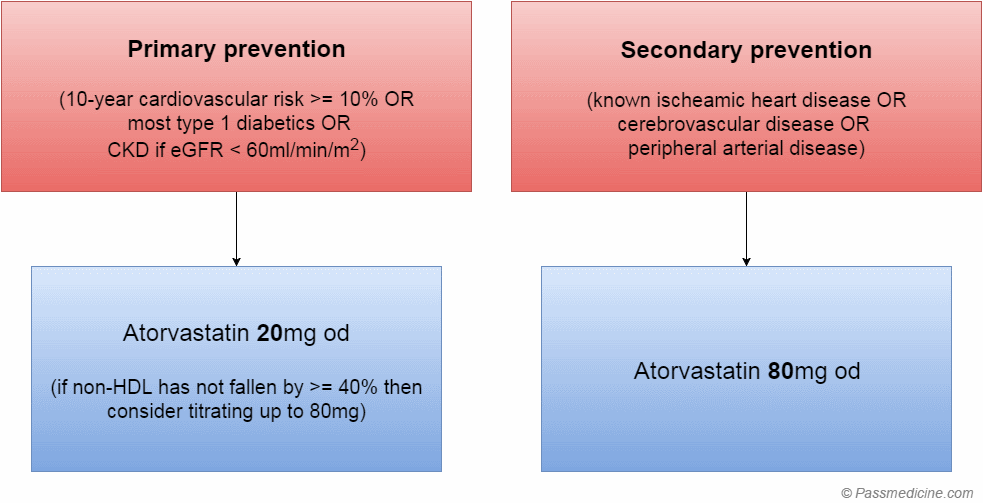 | |
Graphic showing choice of statin.