Amiodarone
Amiodarone is a class III antiarrhythmic agent used in the treatment of atrial, nodal and ventricular tachycardias.
Table 1: Classes of Anti-arrhythmics
Factors restricting use
The use of amiodarone is limited by a number of factors
Monitoring
Adverse effects
Contraindications
Mechanism of action
The main mechanism of action is by blocking potassium channels which inhibits repolarisation and hence prolongs the action potential. Amiodarone also has other actions such as blocking sodium channels (a class I effect).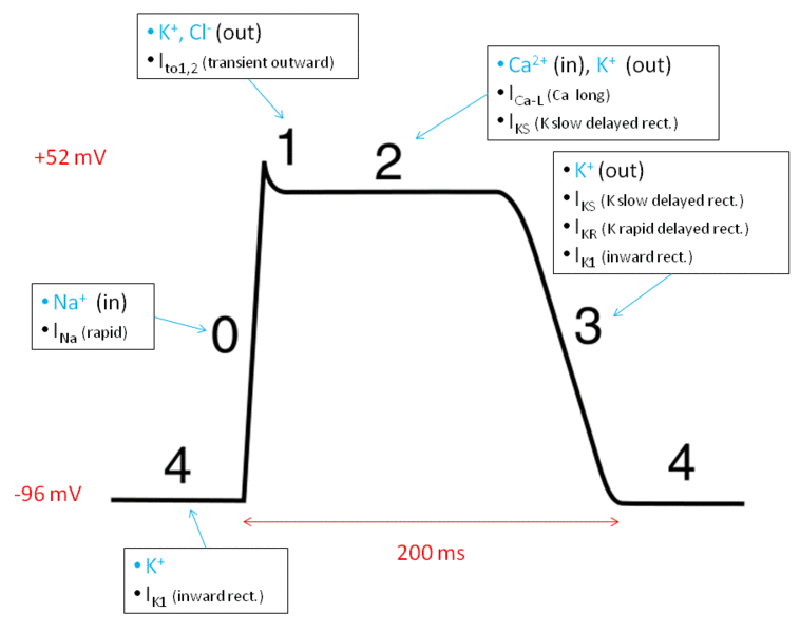 | |
Phases of action potential for cardiac myocyte. Click on image to enlarge
Table 1: Classes of Anti-arrhythmics
| Class | Mechanism of action | Example drugs |
|---|---|---|
| I | Fast sodium (Na) channel blockers Depress phase 0 prolonging repolarization | Ia -Quinidine, procainamide, disopyramide Ib -Lidocaine, phenytoin, mexiletine Ic -Flecainide, propafenone, moricizine |
| II | Beta blockers Decreases slope of phase 4 | Atenolol Bisoprololol Propranolol Metoprolol |
| III | Potassium (K) channel blockers Prolongs phase 3* | Amiodarone (*also acts on phases 1, 2, and 4) Sotalol (* also decreases slope of phase 4) Ibutilide Dofetilide |
| IV | Slow calcium (Ca) channel blockers Prolongs phase 2 | Verapamil Diltiazem |
| V | Variable mechanism | Adenosine Digoxin Magnesium sulfate |
Indications
- Paroxysmal supraventricular, nodal and ventricular tachycardias
- Atrial fibrillation and flutter
- Ventricular fibrillation
- Tachyarrhythmias associated with Wolff-Parkinson-White syndrome
- Ventricular fibrillation or pulseless ventricular tachycardia refractory to defibrillation
Factors restricting use
The use of amiodarone is limited by a number of factors
- long half-life (20-100 days)
- should ideally be given into central veins (causes thrombophlebitis)
- has proarrhythmic effects due to lengthening of the QT interval
- interacts with drugs commonly used concurrently e.g. Decreases metabolism of warfarin
- numerous long-term adverse effects (see below)
Monitoring
- TFT, LFT, U&E, CXR prior to treatment
- TFT, LFT every 6 months
Adverse effects
- thyroid dysfunction
- corneal deposits
- pulmonary fibrosis/pneumonitis
- liver fibrosis/hepatitis
- peripheral neuropathy, myopathy
- photosensitivity
- altered taste
- sleep disorders
- constipation
- movement disorders
- 'slate-grey' appearance
- thrombophlebitis and injection site reactions
- bradycardia
Contraindications
- Severe conduction disturbances (unless pacemaker fitted)
- Sinus node disease (unless pacemaker fitted)
- Iodine sensitivity
- Sino-atrial heart block (except in cardiac arrest)
- Sinus bradycardia (except in cardiac arrest)
- Thyroid dysfunction
- Avoid bolus injection in cardiomyopathy
- Avoid bolus injection in congestive heart failure
- Circulatory collapse
- Severe arterial hypotension
- Severe respiratory failure